Loading...
Done
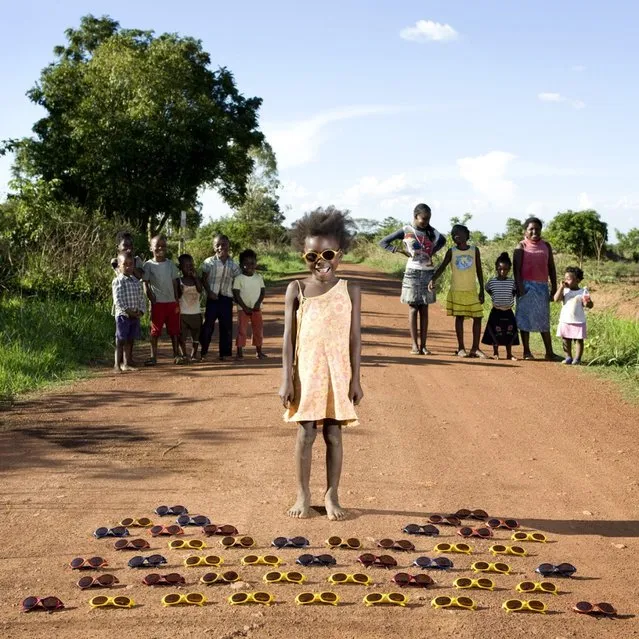
Maudy – Kalulushi, Zambia. Maudy was born in a hut in a small village close to Kalulushi, in Zambia. She grew up playing in the street with the other children in the village, who all attend the same school, where students ages 3 to 10 years old are in the same class. The village has no shops, restaurants or hotels, and just a few children are lucky enough to have toys. Maudy and her friends found a box full of sunglasses on the street, which quickly became their favorite toys. “Toy Stories” project. (Gabriele Galimberti)

Maudy – Kalulushi, Zambia. Maudy was born in a hut in a small village close to Kalulushi, in Zambia. She grew up playing in the street with the other children in the village, who all attend the same school, where students ages 3 to 10 years old are in the same class. The village has no shops, restaurants or hotels, and just a few children are lucky enough to have toys. Maudy and her friends found a box full of sunglasses on the street, which quickly became their favorite toys. “Toy Stories” project. (Photo and caption by Gabriele Galimberti)
Details
05 Dec 2013 07:54:00
Fireworks explode over a floating Christmas tree in Lagoa Lake in Rio de Janeiro. (Photo by Victor R. Caivano/Associated Press)

Fireworks explode over a floating Christmas tree in Lagoa Lake in Rio de Janeiro. (Photo by Victor R. Caivano/Associated Press)
Details
13 Dec 2013 09:00:00
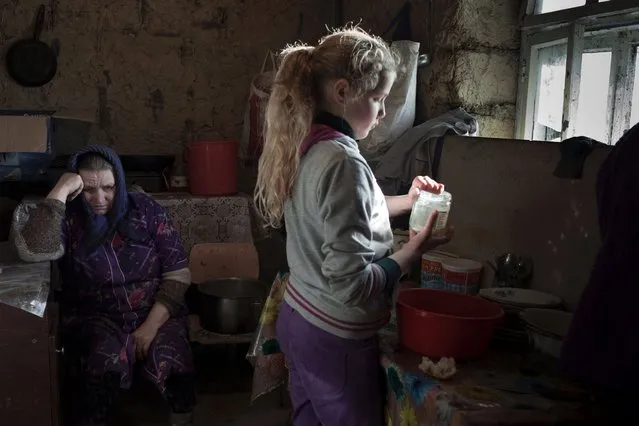
According to the U.S. government, Moldova, one of the poorest countries in Europe, depends on about $1.6 billion annually sent back from the roughly one million Moldovans who left for work in in Europe, Russia, and other former Soviet Bloc countries. Photographer Myriam Meloni went to Moldova to document what she refers to as “social orphans” – children whose parents have emigrated to another country in search of a job and a better future for their families. Here: Lulia is seen washing dishes in her grandmother's house, where she lives. (Photo by Myriam Meloni)

According to the U.S. government, Moldova, one of the poorest countries in Europe, depends on about $1.6 billion annually sent back from the roughly one million Moldovans who left for work in in Europe, Russia, and other former Soviet Bloc countries. Photographer Myriam Meloni went to Moldova to document what she refers to as “social orphans” – children whose parents have emigrated to another country in search of a job and a better future for their families. Here: Lulia is seen washing dishes in her grandmother's house, where she lives. (Photo by Myriam Meloni)
Details
12 Mar 2016 14:57:00
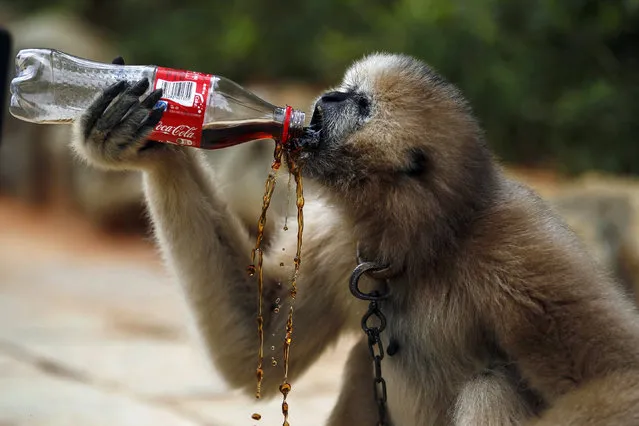
A gibbon drinks from a soft drink bottle, given by a tourist, at a zoo in Kunming, Yunnan province, June 18, 2015. (Photo by Wong Campion/Reuters)

A gibbon drinks from a soft drink bottle, given by a tourist, at a zoo in Kunming, Yunnan province, June 18, 2015. (Photo by Wong Campion/Reuters)
Details
30 Jun 2015 11:48:00
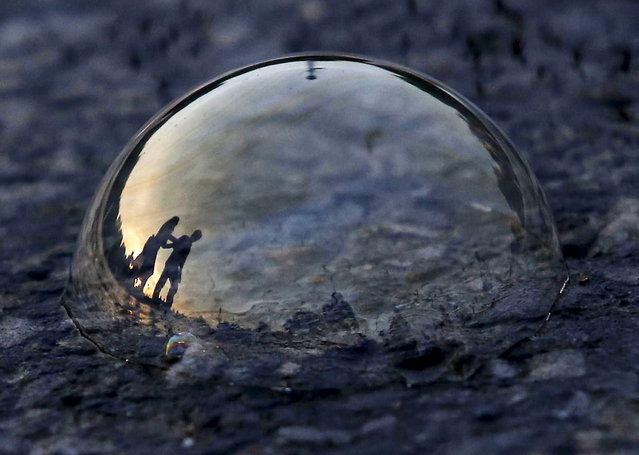
People are reflected on a soap bubble lying on a road during the evening in New Delhi, India, June 23, 2015. (Photo by Anindito Mukherjee/Reuters)

People are reflected on a soap bubble lying on a road during the evening in New Delhi, India, June 23, 2015. (Photo by Anindito Mukherjee/Reuters)
Details
17 Aug 2015 11:51:00
A stunt rider jumps over spectators after the final stage of the annual ABSA Cape Epic mountain bike stage race, Cape Town, South Africa, 30 March 2014. (Photo by Kim Ludbrook/EPA)

A stunt rider jumps over spectators after the final stage of the annual ABSA Cape Epic mountain bike stage race, Cape Town, South Africa, 30 March 2014. The multi day stage race is know as the “Tour de France” of mountain biking and sees 1,200 riders riding 720km in seven days. The race includes the worlds leading professional racers along with amateur cyclists. (Photo by Kim Ludbrook/EPA)
Details
31 Mar 2014 09:12:00
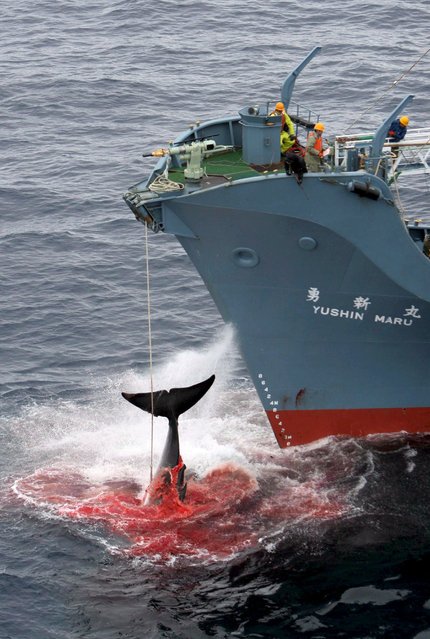
A file photograph dated 07 January 2006 and released by Greenpeace, showing the Yushin Maru, a factory ship in a Japanese whaling fleet, injuring a whale with it's first harpoon attempt. A UN court in The Hague on 31 March 2014 halted Japan's much-criticized whaling programme, ruling that it contravenes a 1986 moratorium on whale hunting. Japan must end its 'research whaling' programme, the International Court of Justice (ICJ) said. (Photo by Kate Davison/EPA)

A file photograph dated 07 January 2006 and released by Greenpeace, showing the Yushin Maru, a factory ship in a Japanese whaling fleet, injuring a whale with it's first harpoon attempt. A UN court in The Hague on 31 March 2014 halted Japan's much-criticized whaling programme, ruling that it contravenes a 1986 moratorium on whale hunting. Japan must end its 'research whaling' programme, the International Court of Justice (ICJ) said. Japan said the programme was for scientific research and permitted under international conventions. Australia had brought the case to the ICJ in 2010, charging that Japan was breaching international law by killing hundreds of whales every year for commercial purposes. Japan was “deeply disappointed” by the ruling, an unnamed government official was quoted by the Kyodo News agency as saying. But the official said Japan would stand by the ruling. (Photo by Kate Davison/EPA)
Details
01 Apr 2014 08:38:00
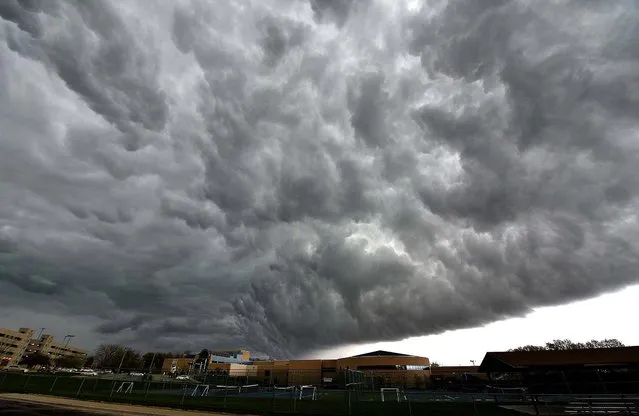
Storm clouds gather over the scene outside the Jewish Community Center in Leawood, Kansas following a shooting, on April 13, 2014. (Photo by John Sleezer/Kansas City Star/MCT)

Storm clouds gather over the scene outside the Jewish Community Center in Leawood, Kansas following a shooting, on April 13, 2014. (Photo by John Sleezer/Kansas City Star/MCT)
Details
01 May 2014 10:02:00