Loading...
Done


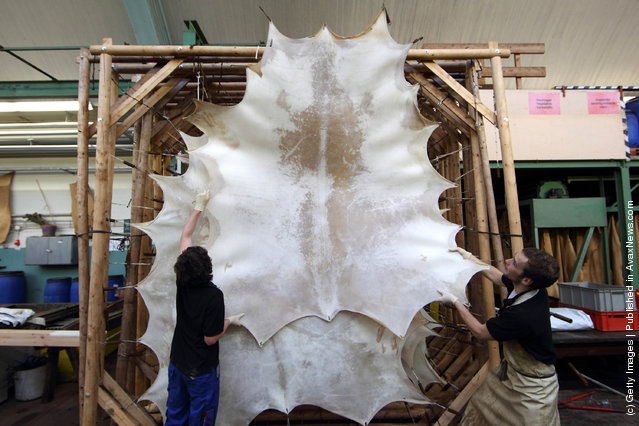
REUTLINGEN, GERMANY - NOVEMBER 17: Students hang out finished parchment leather at the LGR (Lederinstitut Gerberschule Reutlingen) tannery school on November 17, 2010 in Reutlingen, Germany. Even in early antiquity and up their hair or dried goat and sheep skins were used as material for documents. In the small Asian city Pergamon these skins were processed in large quantities for this purpose, so they formed the main trading arm of the city, of which the name is parchment is derived. In medieval times, reached the parchment is of great importance, it was such as France's production under the supervision of the University of Paris. Even now, important documents, placed on their unlimited shelf life as possible large value (eg diplomas, addresses, memory, writings, documents for primary and keystones) written on parchment...
Details
20 Nov 2011 18:17:00
“Two-Handed Saw, 2014”. “Most of the neighbors have switched to power tools to run their households, the buzz of chain saws and weed-whackers overpowering the quieter sounds of country life, but my aunts hold on to the two-handed saw that's decades old, the sickle and scythe that need to be sharpened and polished after each use, the old axe that's becoming heavier each year. Each of these objects is familiar, holding memories of their brother, who succumbed to cancer a few years ago, of days before my grandfather lost his vision in the 50's, of busier days and longer futures”, Sablin told. (Photo by Nadia Sablin)

In northwest Russia, in a small village called Alekhovshchina, Nadia Sablin's aunts spend the warmer months together in the family home and live as the family has always lived, chopping wood to heat the house and making their own clothes. Sablin's book of photographs, “Aunties: The Seven Summers of Alevtina and Ludmila”, is published by Duke University Press. Here: “Two-Handed Saw, 2014”. (Photo by Nadia Sablin)
Details
25 Feb 2016 12:12:00
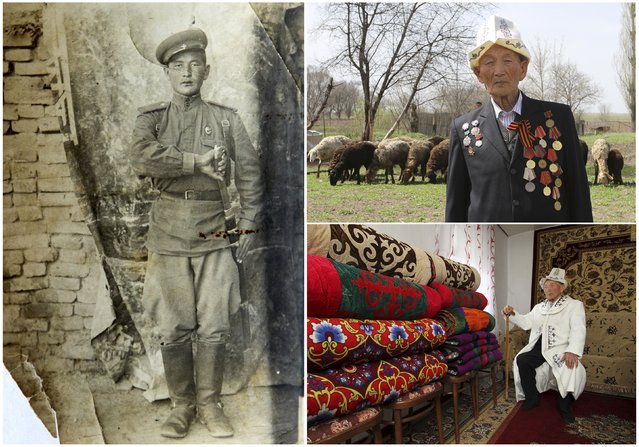
World War Two veteran Abla Begaliyev, 91, is seen in an undated handout picture (L), poses for a picture in Arashan (Top R) and at home in Kyrgyzstan April 14, 2015. Begaliyev served in the border guard cavalry from February 1942 until April 1947. Originally from Kyrgyzstan, he fought on the Ukrainian front and relocated to the border with Afghanistan at the end of World War Two. (Photo by Vladimir Pirogov/Reuters/Family handout (L))

World War Two veteran Abla Begaliyev, 91, is seen in an undated handout picture (L), poses for a picture in Arashan (Top R) and at home in Kyrgyzstan April 14, 2015. Begaliyev served in the border guard cavalry from February 1942 until April 1947. Originally from Kyrgyzstan, he fought on the Ukrainian front and relocated to the border with Afghanistan at the end of World War Two. As the world marks the 70th anniversary of the end of World War Two, Reuters photographers the length and breadth of the former Soviet republics (CCCP) captured portraits of Red Army veterans, mostly now in their 80s and 90s, today and through archive pictures at the time. More than 20 million Soviet citizens were killed in the war. (Photo by Vladimir Pirogov/Reuters/Family handout (L))
Details
08 May 2015 14:22:00
Children dressed in festival costume sit on the huge paper doll of historical Japanese figure named Hashi-Benkeii on the carts during the Mikuini annual festival on May 20, 2014 in Sakai, Japan. The annual festival takes place from May 19-21 and is attended by thousands of visitors. During the festival people dressed in traditional Japanese costumes pull carts carrying 6 meter high dolls of Japanese historical figures through the narrow streets. The origins of the festival are unclear but its history can be traced back more than 250 years. (Photo by Buddhika Weerasinghe/Getty Images)

Children dressed in festival costume sit on the huge paper doll of historical Japanese figure named Hashi-Benkeii on the carts during the Mikuini annual festival on May 20, 2014 in Sakai, Japan. The annual festival takes place from May 19-21 and is attended by thousands of visitors. During the festival people dressed in traditional Japanese costumes pull carts carrying 6 meter high dolls of Japanese historical figures through the narrow streets. The origins of the festival are unclear but its history can be traced back more than 250 years. (Photo by Buddhika Weerasinghe/Getty Images)
Details
21 May 2014 08:49:00
A mudlark uses a torch to look for items on the bank of the River Thames in London, Britain June 06, 2016. Mudlarking is believed to trace its origins to the 18th and 19th century, when scavengers searched the Thames' shores for items to sell. These days, history and archaeology fans are the ones hoping to find old relics such as coins, ceramics, artifacts or everyday items from across centuries. They wait for the low tide and then scour specific areas of exposed shores. "If you're in a field you could be out all day long, with the river you're restricted to about two or three hours," mudlark Nick Stevens said. While many just use the naked eye for their searches, others rely on metal detectors for which a permit from the Port of London Authority is needed. Digging also requires consent. (Photo by Neil Hall/Reuters)

A mudlark uses a torch to look for items on the bank of the River Thames in London, Britain June 06, 2016. Mudlarking is believed to trace its origins to the 18th and 19th century, when scavengers searched the Thames' shores for items to sell. These days, history and archaeology fans are the ones hoping to find old relics such as coins, ceramics, artifacts or everyday items from across centuries. their finds with the Portable Antiquities Scheme. Any item over 300 years old must be recorded. (Photo by Neil Hall/Reuters)
Details
27 Aug 2016 10:43:00
Construction Continues At Ground Zero On One World Trade Center

Construction continues on One World Trade Center (TALLEST BUILDING AT LOWER LEFT) as the memorial footprints of the twin towers are seen (BOTTOM C) on August 12, 2011 in New York City. Upon completion, One World Trade Center will be New York's tallest skyscraper, topping out at a symbolic 1,776 feet, with 3 million square feet of office space. More than 2,700 people were killed when al-Qaeda terrorists hijacked U.S. passenger jets and flew them into the twin towers of the World Trade Center on September 11, 2001. Nearly ten years after the crippling attacks on Lower Manhattan, business, tourism and new construction like One World Trade Center have rejuvenated the formerly devastated cityscape.(Photo by Mario Tama/Getty Images)
Details
14 Aug 2011 13:58:00
Crowds look on as Xolo the Giant Dog, one of the giant Royal De Luxe street puppets taking part in Liverpool's World War I centenary commemorations, walks through the streets of Liverpool on July 25, 2014 in Liverpool, England. (Photo by Christopher Furlong/Getty Images)

Crowds look on as Xolo the Giant Dog, one of the giant Royal De Luxe street puppets taking part in Liverpool's World War I centenary commemorations, walks through the streets of Liverpool on July 25, 2014 in Liverpool, England. French street theatre company Royal de Luxe are putting on a show throughout the city as part of Liverpool's World War I centenary commemorations from July 23-27. The giant puppet grandmother has slept in the hall for two days as part of “Memories of August 1914”. As the giants tour the city the Little Girl Giant and her dog Xolo will meet up with the giant Grandmother telling the story of life leading up to World War One. (Photo by Christopher Furlong/Getty Images)
Details
27 Jul 2014 10:52:00
People throw turnips at the Jarramplas as he comes out from the church beating his drum during the Jarramplas Festival on January 20, 2016 in Piornal, Caceres province, Spain. The centuries old Jarramplas festival takes place annually every January 19-20 on Saint Sebastian Day and this year they expect to use more than 20 thousand kilogrames of turnips. Even though the exact origins of the festival are not known, various theories exist including the mythological punishment of Caco by Hercules. (Photo by Pablo Blazquez Dominguez/Getty Images)

People throw turnips at the Jarramplas as he comes out from the church beating his drum during the Jarramplas Festival on January 20, 2016 in Piornal, Caceres province, Spain. The centuries old Jarramplas festival takes place annually every January 19-20 on Saint Sebastian Day and this year they expect to use more than 20 thousand kilogrames of turnips. Even though the exact origins of the festival are not known, various theories exist including the mythological punishment of Caco by Hercules, a relation to ceremonies celebrated by the American Indians that were seen by the first conquerors, to a cattle thief ridiculed and expelled by his village neighbours. It is generally believed to symbolize the expulsion of everything bad. (Photo by Pablo Blazquez Dominguez/Getty Images)
Details
21 Jan 2016 13:21:00