Loading...
Done
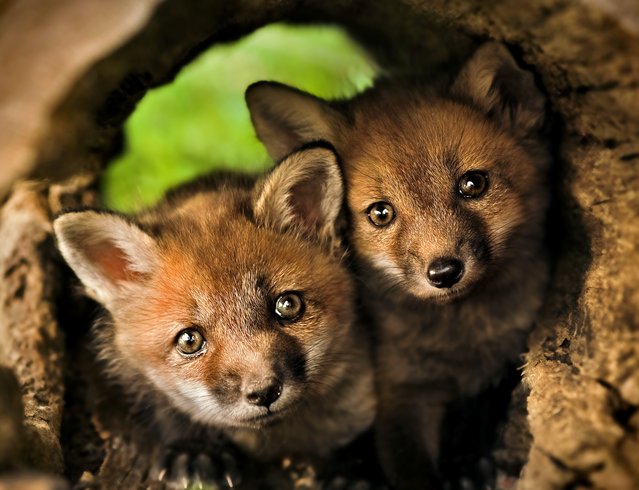
Red fox kits look out from a hollow log. (Photo by Kevin Fleming)

Wildlife photographer Kevin Fleming has covered the world as a photographer for National Geographic and has been recognized America’s Best Observer by Readers Digest. His assignments have taken him into war and famine in Somalia, to the Mediterranean for a re-creation of the voyage of Ulysses and put him on a dogsled crossing the Canadian arctic. Now Kevin is working on his 27th book. Here: Red fox kits look out from a hollow log. (Photo by Kevin Fleming)
Details
02 Oct 2014 10:28:00
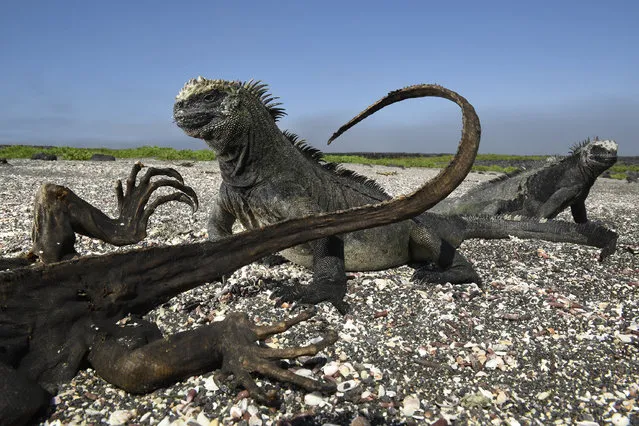
Galapagos – Rocking the Cradle: Four major ocean currents converge along the Galapagos archipelago, creating the conditions for an extraordinary diversity of animal life, April 25, 2016. The islands are home to at least 7,000 flora and fauna species, of which 97 percent of the reptiles, 80 percent of the land birds, 50 percent of the insects and 30 percent of the plants are endemic. The local ecosystem is highly sensitive to the changes in temperature, rainfall and ocean currents that characterize the climatic events known as El Niño and La Niña. These changes cause marked fluctuations in weather and food availability. Many scientists expect the frequency of El Niño and La Niña to increase as a result of climate change, making the Galapagos a possible early-warning location for its effects. (Photo by Thomas P. Peschak for National Geographic/World Press Photo)

Galapagos – Rocking the Cradle: Four major ocean currents converge along the Galapagos archipelago, creating the conditions for an extraordinary diversity of animal life, April 25, 2016. The islands are home to at least 7,000 flora and fauna species, of which 97 percent of the reptiles, 80 percent of the land birds, 50 percent of the insects and 30 percent of the plants are endemic. (Photo by Thomas P. Peschak for National Geographic/World Press Photo)
Details
16 Apr 2018 00:01:00
A security personnel keeps watch before the second plenary session of the National People's Congress (NPC) at the Great Hall of the People in Beijing, China on March 8, 2022. (Photo by Carlos Garcia Rawlins/Reuters)

A security personnel keeps watch before the second plenary session of the National People's Congress (NPC) at the Great Hall of the People in Beijing, China on March 8, 2022. (Photo by Carlos Garcia Rawlins/Reuters)
Details
12 Mar 2022 05:58:00
A soldier looks at a line during a ceremony to mark Martyrs' Day at the Tiananmen Square in Beijing, China, 30 September 2022. Martyr's Day is celebrated on the eve of National Day of the People's Republic of China to commemorate the people who sacrificed their lives in pursuit of national independence. (Photo by Mark R. Cristino/EPA/EFE)

A soldier looks at a line during a ceremony to mark Martyrs' Day at the Tiananmen Square in Beijing, China, 30 September 2022. Martyr's Day is celebrated on the eve of National Day of the People's Republic of China to commemorate the people who sacrificed their lives in pursuit of national independence. (Photo by Mark R. Cristino/EPA/EFE)
Details
04 Oct 2022 03:14:00
Hotel guides jump as they pose for pictures outside the Great Hall of the People during the opening session of the National People's Congress (NPC) in Beijing, China, March 5, 2016. (Photo by Aly Song/Reuters)

Hotel guides jump as they pose for pictures outside the Great Hall of the People during the opening session of the National People's Congress (NPC) in Beijing, China, March 5, 2016. (Photo by Aly Song/Reuters)
Details
06 Mar 2016 09:25:00
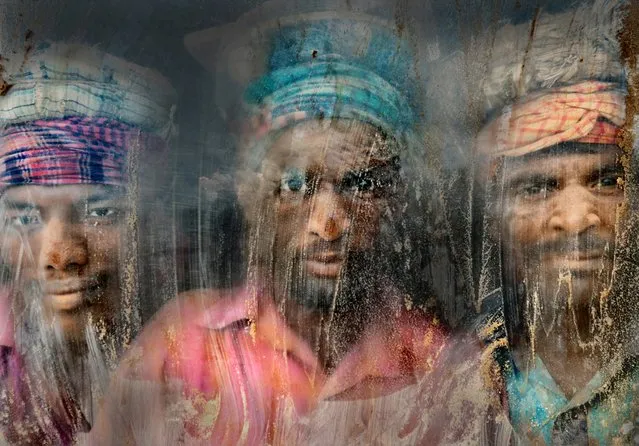
Gravel Workmen of Chittagong, Bangladesh, by Faisal Azim. Gravel workmen look through a glass window at a gravel-crushing yard in Chittagong. Full of dust and sand, it is an extremely unhealthy environment for working, but still hundreds of people work here for their livelihoods. (Photo by Faisal Azim/2016 Atkins CIWEM Environmental Photographer of the Year)

From Tibetan monks playing basket ball with ice thawing high up in the Himalayas, to the pollution that hides behind the Taj Mahal, here’s pick from 60 exceptional environmental photographs, by photographers and filmmakers from 70 countries, that will go on show at the Royal Geographical Society in London from 29 June to 21 August. The winners will be announced on 28 June. Here: Gravel Workmen of Chittagong, Bangladesh, by Faisal Azim. Gravel workmen look through a glass window at a gravel-crushing yard in Chittagong. Full of dust and sand, it is an extremely unhealthy environment for working, but still hundreds of people work here for their livelihoods. (Photo by Faisal Azim/2016 Atkins CIWEM Environmental Photographer of the Year)
Details
01 Jun 2016 12:25:00
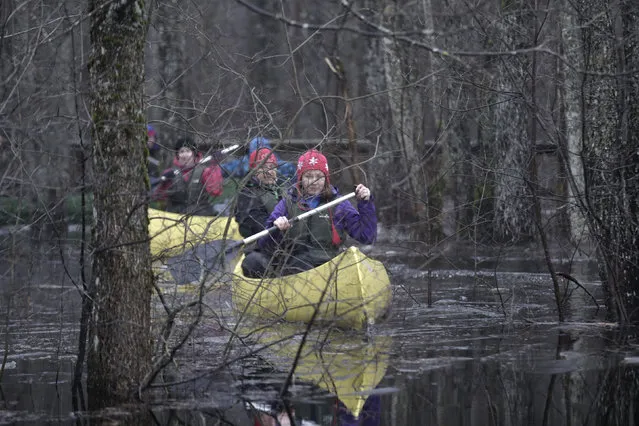
People canoe through a flooded forest in Soomaa national park, Estonia, February 7, 2016. (Photo by Ints Kalnins/Reuters)

People canoe through a flooded forest in Soomaa national park, Estonia, February 7, 2016. In this Estonian region hit by floods every spring the natural disaster is used to attract visitors and organise canoe tours through flooded territories. The floods are called Fifth Season by local people. (Photo by Ints Kalnins/Reuters)
Details
09 Feb 2016 13:50:00


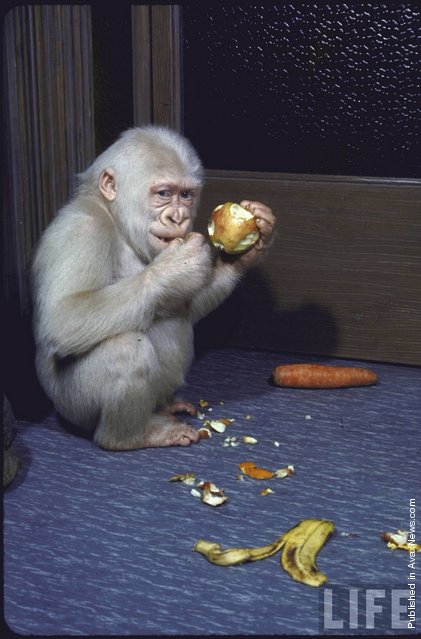
“Snowflake (c. 1964 – November 24, 2003) was an albino gorilla. He was the only known albino gorilla so far, and the most popular resident of the Barcelona Zoo in Catalonia, Spain. Originally named Nfumu Ngui in Fang language ("white gorilla") by his captor, he was then nicknamed Floquet de Neu (Catalan for little snowflake) by his keeper Jordi Sabater Pi. On his arrival to Barcelona where he was given an official reception by the then Mayor of Barcelona, Josep Maria de Porcioles, in November 1966, he was called Blancanieves (“Snow White”) in the newspaper Tele/Exprés. But he became famous with the name given to him by Sabater when National Geographic Magazine featured him on the main page in March 1967, with the English name Snowflake. This name spread among the press (Stern, Life, Paris-Match) and was later translated to Spanish as Copito de Nieve. Sabater himself called the gorilla Floquet or Copi, and in the later years Nfumu. The asteroid 95962 Copito, discovered by Catalan astronomer J. Manteca, is named in his honour”.

Details
07 Mar 2011 15:50:00