Loading...
Done
Filipino children frolic next to ships taking shelter inside a seaport in Navotas city, north of Manila, Philippines, 27 August 2019. According to the latest advisory from Philippine Atmospheric Geophysical and Astronomical Services Administration (PAGASA), Tropical Storm Podul intensified from a tropical depression into a tropical storm on August 27, while moving toward Central Luzon with a maximum winds of 65 kilometers per hour and gustiness of up to 80 km/h. (Photo by Francis R. Malasig/EPA/EFE)

Filipino children frolic next to ships taking shelter inside a seaport in Navotas city, north of Manila, Philippines, 27 August 2019. According to the latest advisory from Philippine Atmospheric Geophysical and Astronomical Services Administration (PAGASA), Tropical Storm Podul intensified from a tropical depression into a tropical storm on August 27, while moving toward Central Luzon with a maximum winds of 65 kilometers per hour and gustiness of up to 80 km/h. (Photo by Francis R. Malasig/EPA/EFE)
Details
14 Jan 2020 00:01:00
Dancer Megan changes costume as she performs in the review “Feerie” at the Moulin Rouge in Paris, France, July 3, 2018. Each show requires 1,000 outfits, all crafted in the workshops that have been supplying the Moulin Rouge for decades. Each dancer has to make between 10 and 15 costume changes per show, with about 90 seconds to complete each one before they have to be back out on stage. (Photo by Philippe Wojazer/Reuters)

Dancer Megan changes costume as she performs in the review “Feerie” at the Moulin Rouge in Paris, France, July 3, 2018. Each show requires 1,000 outfits, all crafted in the workshops that have been supplying the Moulin Rouge for decades. Each dancer has to make between 10 and 15 costume changes per show, with about 90 seconds to complete each one before they have to be back out on stage. (Photo by Philippe Wojazer/Reuters)
Details
05 Oct 2019 00:03:00
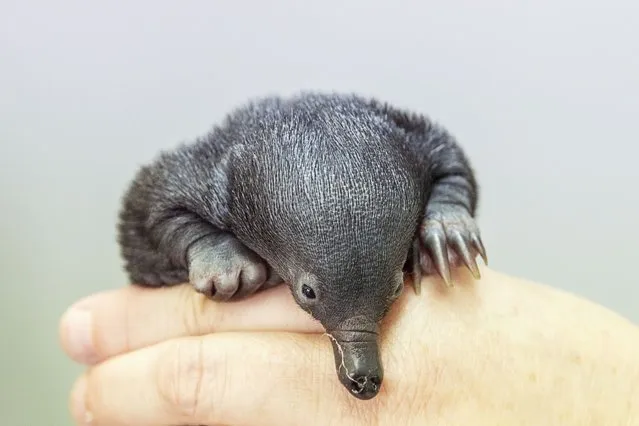
“Smudge” an orphaned echidna puggle is held by Veterinary nurse Sarah Male ahead of its feeding on November 07, 2022 in Sydney, Australia. Echidnas, sometimes known as spiny anteaters, are native to Australia. A baby echidna was found orphaned by the side of the road and is being cared for at Sydney's Taronga Zoo hospital. The care is intensive with several feedings per day, and the echidna is housed in temperature-controlled environment to aid its recovery and growth. (Photo by Jenny Evans/Getty Images)

“Smudge” an orphaned echidna puggle is held by Veterinary nurse Sarah Male ahead of its feeding on November 07, 2022 in Sydney, Australia. Echidnas, sometimes known as spiny anteaters, are native to Australia. A baby echidna was found orphaned by the side of the road and is being cared for at Sydney's Taronga Zoo hospital. The care is intensive with several feedings per day, and the echidna is housed in temperature-controlled environment to aid its recovery and growth. (Photo by Jenny Evans/Getty Images)
Details
04 Jan 2024 19:37:00
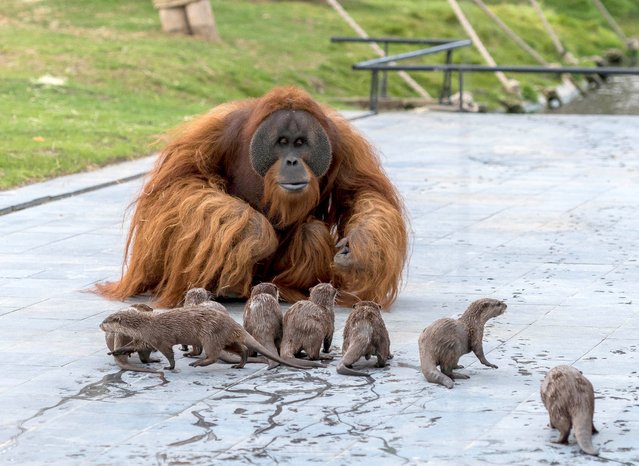
The three orangutans at Pairi Daiza zoo, Belgium, developed a “special bond” with the otters after their river was run through the ape enclosure on March 2020. The zoo said it enriched both species’ environments. An animal – and this is even more the case of orangutans, with whom humans share 97 per cent of their DNA – must be entertained, occupied, challenged and kept busy mentally, emotionally and physically at all times. (Photo by Pascale Jones/The Sun)

The three orangutans at Pairi Daiza zoo, Belgium, developed a “special bond” with the otters after their river was run through the ape enclosure on March 2020. The zoo said it enriched both species’ environments. An animal – and this is even more the case of orangutans, with whom humans share 97 per cent of their DNA – must be entertained, occupied, challenged and kept busy mentally, emotionally and physically at all times. (Photo by Pascale Jones/The Sun)
Details
05 Apr 2020 00:01:00
Carolaine Reis and her son Miguel Alves, residents of the Aglomerado da Serra favela, wear a protective mask against the spread of the new Coronavirus (COVID-19) made by the seamstresses of the Remexe Favelinha studio, in the Aglomerado da Serra favela, on April 13, 2020 in Belo Horizonte, Brazil. Facial masks follow the protocol and guidelines defined by the Ministry of Health. Around 6,000 masks have already been produced. The masks are being distributed to a part of the population and sold throughout the country, in the amount of 5 reais per unit. (Photo by Pedro Vilela/Getty Images)

Carolaine Reis and her son Miguel Alves, residents of the Aglomerado da Serra favela, wear a protective mask against the spread of the new Coronavirus (COVID-19) made by the seamstresses of the Remexe Favelinha studio, in the Aglomerado da Serra favela, on April 13, 2020 in Belo Horizonte, Brazil. Facial masks follow the protocol and guidelines defined by the Ministry of Health. Around 6,000 masks have already been produced. The masks are being distributed to a part of the population and sold throughout the country, in the amount of 5 reais per unit. (Photo by Pedro Vilela/Getty Images)
Details
16 Apr 2020 00:03:00
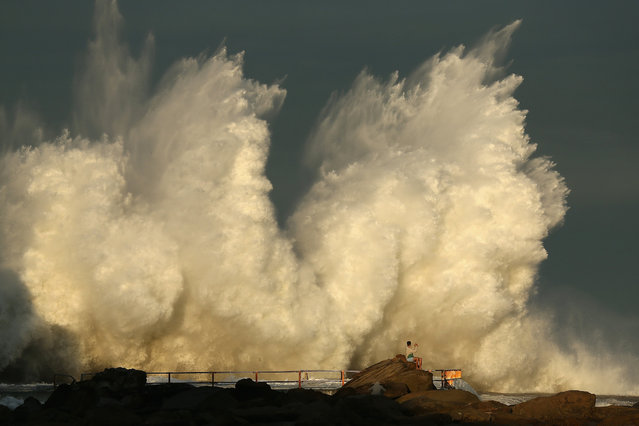
A man watches a wave hit a rock pool at Curl Curl beach as large swell hits the East Coast of Australia on June 6, 2016 in Sydney, Australia. Torrential rain over the weekend saw streets and homes flooded while wind gusts up to 120km per hour brought down trees and powerlines. A king tide has also seen beachside homes evacuated on Sydney's northern beaches as large waves erode the coast. (Photo by Cameron Spencer/Getty Images)

A man watches a wave hit a rock pool at Curl Curl beach as large swell hits the East Coast of Australia on June 6, 2016 in Sydney, Australia. Torrential rain over the weekend saw streets and homes flooded while wind gusts up to 120km per hour brought down trees and powerlines. A king tide has also seen beachside homes evacuated on Sydney's northern beaches as large waves erode the coast. (Photo by Cameron Spencer/Getty Images)
Details
25 Jul 2016 11:30:00
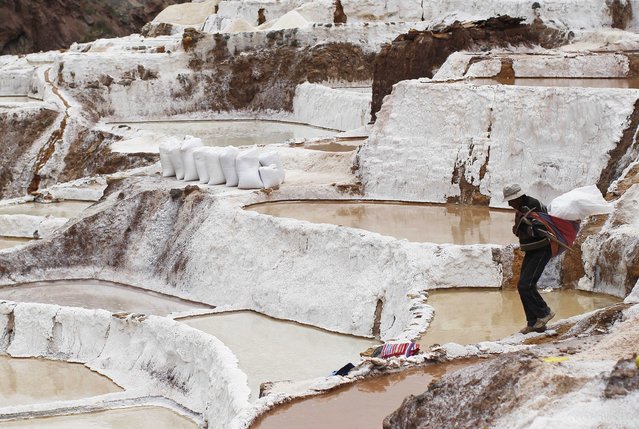
A worker carries a bag of salt after collecting it from a pond at the Maras mines in Cuzco December 3, 2014. Salt has been obtained in Maras since pre-Incan times by evaporating highly salty local subterranean stream water. The water is intricately channelled through constructions, flowing gradually down onto several hundred ancient terraced ponds. (Photo by Enrique Castro-Mendivil/Reuters)

A worker carries a bag of salt after collecting it from a pond at the Maras mines in Cuzco December 3, 2014. Salt has been obtained in Maras since pre-Incan times by evaporating highly salty local subterranean stream water. The water is intricately channelled through constructions, flowing gradually down onto several hundred ancient terraced ponds. From each pond, a local member of the mine cooperative can produce 150 to 200 kilos per month which can be sold in the markets at $0.34 per kilogram, according to miners. (Photo by Enrique Castro-Mendivil/Reuters)
Details
05 Dec 2014 13:36:00
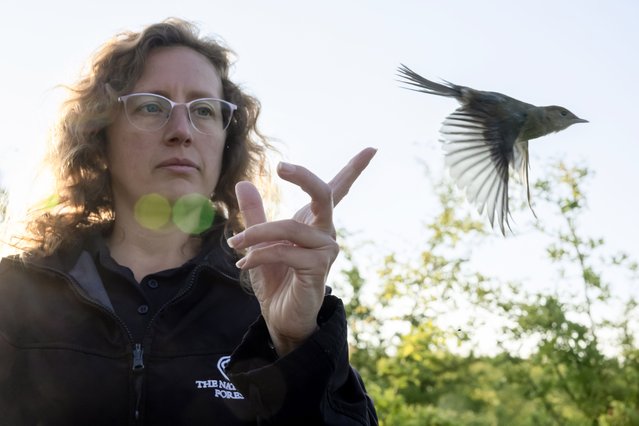
A juvenile blackcap is recorded in the soft light of morning at Minorca, UK, a former open-cast mine near Moira in the National Forest on June 18, 2025. Dr Heather Gilbert, research and evidence manager, checks mist nets among wildflowers and young trees as part of long-term monitoring that shows bird numbers have increased by 48 per cent over 30 years. (Photo by Rod Kirkpatrick/RKP Photography)

A juvenile blackcap is recorded in the soft light of morning at Minorca, UK, a former open-cast mine near Moira in the National Forest on June 18, 2025. Dr Heather Gilbert, research and evidence manager, checks mist nets among wildflowers and young trees as part of long-term monitoring that shows bird numbers have increased by 48 per cent over 30 years. (Photo by Rod Kirkpatrick/RKP Photography)
Details
29 Jun 2025 03:58:00