Loading...
Done


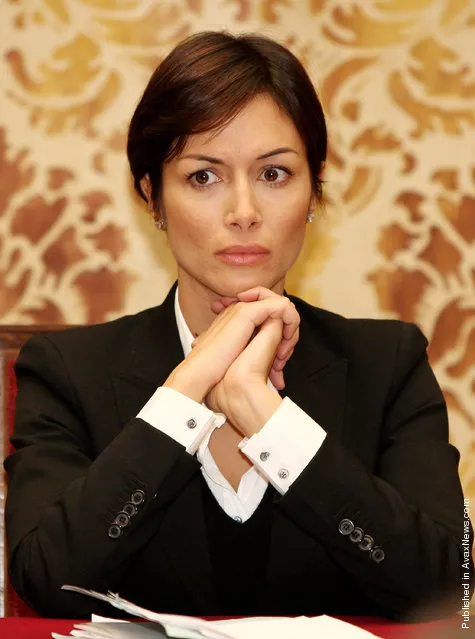
“Maria Rosaria (Mara) Carfagna (born December 18, 1975 in Salerno) is an Italian politician and former showgirl and topless model. After obtaining a degree in law, Carfagna worked for several years on Italian television shows and as a model. She later entered politics and was elected to the Chamber of Deputies for Forza Italia party in 2006. On May 8, 2008, Prime Minister Silvio Berlusconi appointed her Minister for Equal Opportunity, a move that received international attention due to her background and her appearance. Carfagna has been called «The most beautiful minister in the world», and was ranked number one on Maxim's «World´s Hottest Politicians»”.

Photo: Minister Mara Carfagna attends a press conference for the Pink Box Project held at Palazzo Marino on November 24, 2008 in Milan, Italy. The Pink Box is a tracking device, designed to help women drivers in danger. (Photo by Vittorio Zunino Celotto/Getty Images). MILAN, ITALY – NOVEMBER 24 2008
Details
11 Mar 2011 12:09:00


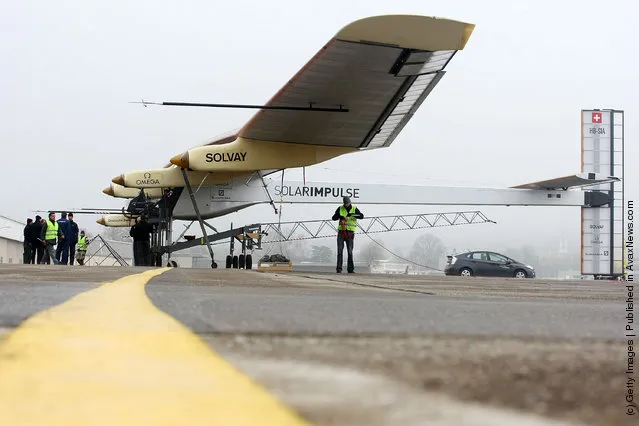
“Solar Impulse is a European long-range solar powered plane project being undertaken by Bertrand Piccard and André Borschberg. The project eventually hopes to succeed in the first circling of the earth with a piloted fixed-wing aircraft using only solar power. The first aircraft, bearing the Swiss aircraft registration code of HB-SIA, is a single-seater, capable of taking off under its own power, and intended to remain airborne up to 36 hours. This aircraft first flew an entire diurnal solar cycle, including nearly 9 hours of night flying, in a 26-hour flight on 7–8 July 2010”. – Wikipedia


Photo: Workers prepare the Solar Impulse airplane HB-SIA for a first runway test on November 19, 2009 in Dubendorf, Switzerland. Solar Impulse chairman Bertrand Piccard, psychatrist and aeronaut, who made the first non-stop round-the-world balloon flight, and CEO and former fighter pilot Andrй Borschberg plan a round-the-world flight, driven only by solar energy, for 2012. (Photo by Johannes Simon/Getty Images)
Details
16 May 2011 08:13:00
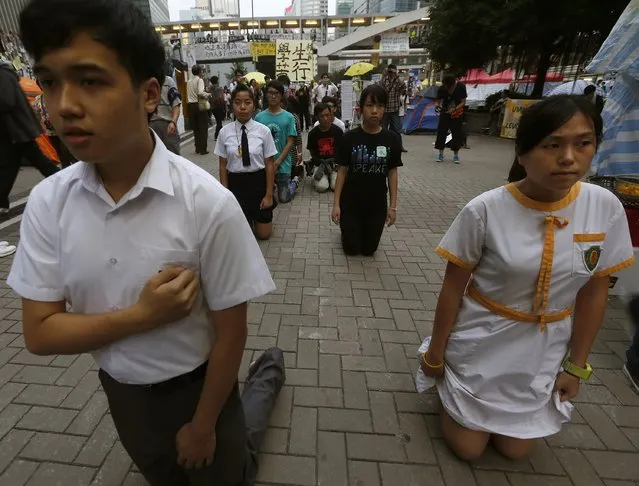
Secondary school students perform a barefoot “pilgrimage of suffering” to support the Occupy Central civil disobedience movement at the Admiralty protest site in Hong Kong November 30, 2014. It has been two months since police first fired tear gas to disperse demonstrators from the main protest site in the Admiralty district next to government offices in the heart of the Asian financial centre. (Photo by Bobby Yip/Reuters)

Secondary school students perform a barefoot “pilgrimage of suffering” to support the Occupy Central civil disobedience movement at the Admiralty protest site in Hong Kong November 30, 2014. It has been two months since police first fired tear gas to disperse demonstrators from the main protest site in the Admiralty district next to government offices in the heart of the Asian financial centre. (Photo by Bobby Yip/Reuters)
Details
01 Dec 2014 13:41:00
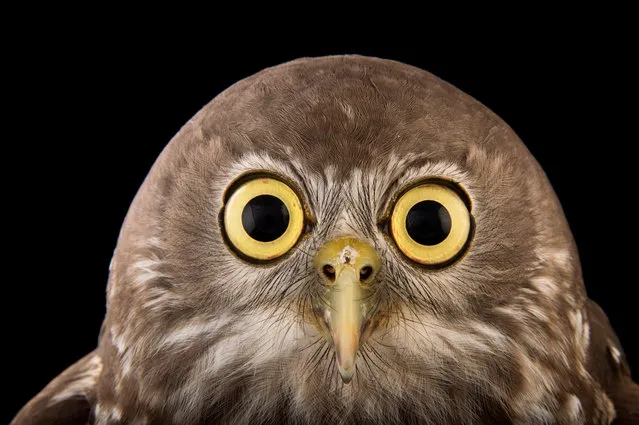
The National Geographic Photo Ark is a travelling exhibition of photographer Joel Sartore’s quest to create a photo archive of biodiversity around the world. So far, Sartore has captured studio portraits of more than 6,000 species – a number that he hopes to double. On 1 July, the ark will open at Melbourne zoo – the first time it has been exhibited in the southern hemisphere. More than 50 portraits will be on display, including many of Australian endangered animals being protected by programs at the zoo itself. These captions have been edited from text supplied by Melbourne zoo. Here: Barking owl. So-named because its call sounds like a barking dog, these birds are native to Australia, Indonesia and Papua New Guinea. In Victoria they are listed as an endangered species, and in 2003 there were estimated to be fewer than 50 breeding pairs. The main threat to the species in Victoria is loss of habitat, especially large trees with hollows in which they can nest and on which many of their prey depend. Apart from a bark, they may utter a chilling scream when they feel threatened. (Photo by Joel Sartore/National Geographic Photo Ark/The Guardian)

The National Geographic Photo Ark is a travelling exhibition of photographer Joel Sartore’s quest to create a photo archive of biodiversity around the world. So far, Sartore has captured studio portraits of more than 6,000 species – a number that he hopes to double. On 1 July, the ark will open at Melbourne zoo – the first time it has been exhibited in the southern hemisphere. More than 50 portraits will be on display, including many of Australian endangered animals being protected by programs at the zoo itself. These captions have been edited from text supplied by Melbourne zoo. Here: Barking owl. (Photo by Joel Sartore/National Geographic Photo Ark/The Guardian)
Details
01 Jul 2017 07:45:00
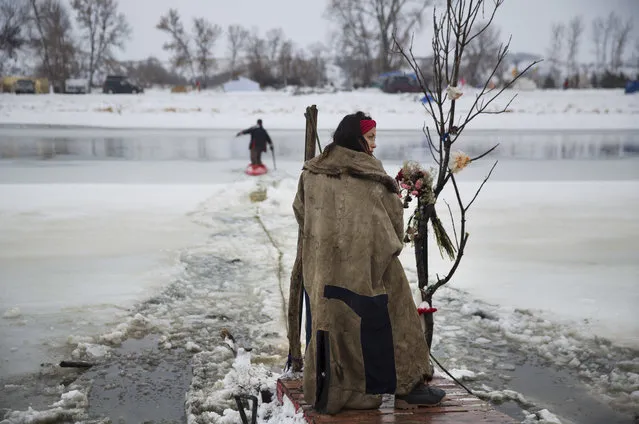
In this Thursday, December 1, 2016 photo, Cat Bigney, part of the Oglala Native American tribe, waits on the shore of the Cannonball river for travelers to arrive by canoe at the Oceti Sakowin camp where people have gathered to protest the Dakota Access oil pipeline in Cannon Ball, N.D. So far, those at the camp have shrugged off the heavy snow, icy winds and frigid temperatures. But if they defy next week's government deadline to abandon the camp, demonstrators know the real deep freeze lies ahead. Life-threatening wind chills and towering snow drifts could mean the greatest challenge is simple survival. (Photo by David Goldman/AP Photo)

In this Thursday, December 1, 2016 photo, Cat Bigney, part of the Oglala Native American tribe, waits on the shore of the Cannonball river for travelers to arrive by canoe at the Oceti Sakowin camp where people have gathered to protest the Dakota Access oil pipeline in Cannon Ball, N.D. So far, those at the camp have shrugged off the heavy snow, icy winds and frigid temperatures. But if they defy next week's government deadline to abandon the camp, demonstrators know the real deep freeze lies ahead. Life-threatening wind chills and towering snow drifts could mean the greatest challenge is simple survival. (Photo by David Goldman/AP Photo)
Details
06 Dec 2016 10:22:00
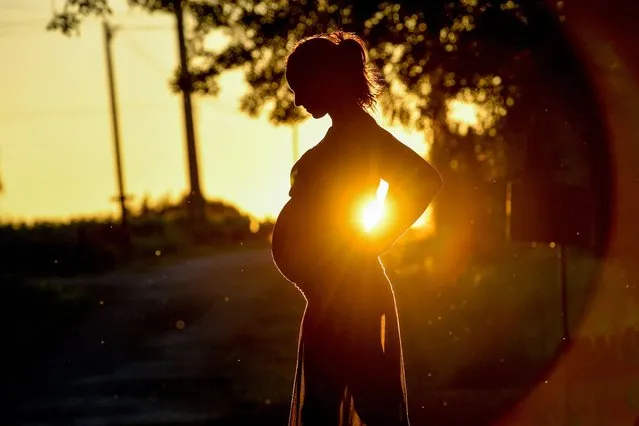
A pregnant woman poses on June 19, 2018 in Vertou, western France. France had an estimated population of 68.4 million by January 1, 2024, representing a further year-on-year increase of 0.3 percent, limited by a marked drop in the birth rate, the INSEE national statistics bureau of France reported on January 16, 2024. In 2023, 678,000 babies were born in France, 6.6 percent fewer than the previous year, the lowest number of births in any year since 1946. Over the same period, there were 631,000 deaths, down 6.5 percent on 2022, a year marked by the consequences of the Covid-19 pandemic and episodes of extreme heat. (Photo by Loic Venance/AFP Photo)

A pregnant woman poses on June 19, 2018 in Vertou, western France. France had an estimated population of 68.4 million by January 1, 2024, representing a further year-on-year increase of 0.3 percent, limited by a marked drop in the birth rate, the INSEE national statistics bureau of France reported on January 16, 2024. In 2023, 678,000 babies were born in France, 6.6 percent fewer than the previous year, the lowest number of births in any year since 1946. Over the same period, there were 631,000 deaths, down 6.5 percent on 2022, a year marked by the consequences of the Covid-19 pandemic and episodes of extreme heat. (Photo by Loic Venance/AFP Photo)
Details
27 Feb 2024 07:29:00
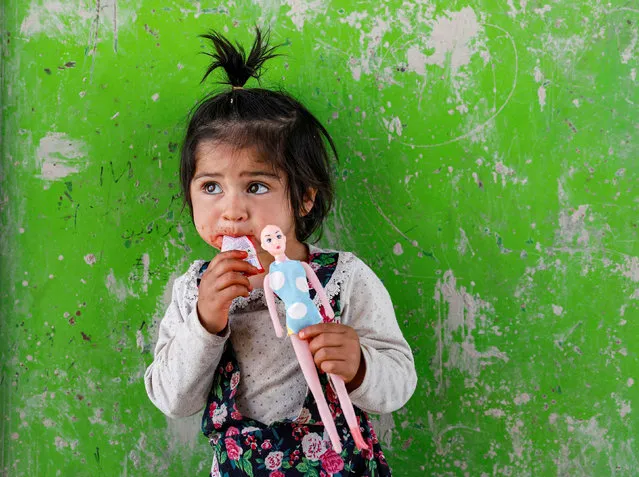
An internally displaced Afghan girl plays outside her shelter, amid the spread of the coronavirus disease (COVID-19), in Kabul, Afghanistan on May 7, 2020. (Photo by Mohammad Ismail/Reuters)

An internally displaced Afghan girl plays outside her shelter, amid the spread of the coronavirus disease (COVID-19), in Kabul, Afghanistan on May 7, 2020. (Photo by Mohammad Ismail/Reuters)
Details
11 May 2020 00:05:00
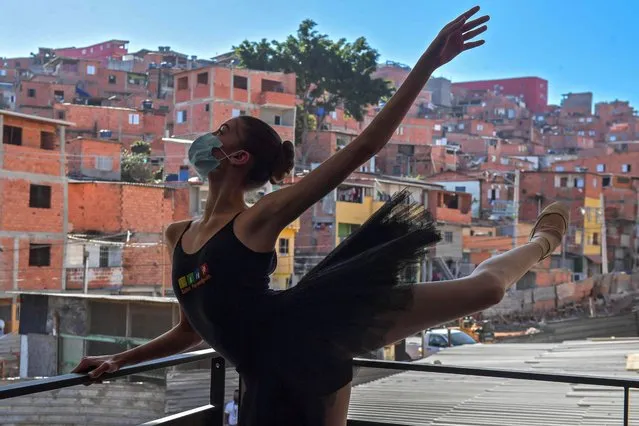
Mariana Sousa, student of the Ballet Paraisopolis, warms up during a rehearse in Paraisopolis favela, outskirts of Sao Paulo, Brazil on August 27, 2020, amid the new coronavirus COVID-19 pandemic. The 200 ballet students of Paraisopolis, the second largest favela in Sao Paulo, restarted rehearsals after five months with a coreography about a police operation that put their community in mourning last year. (Photo by Nelson Almeida/AFP Photo)

Mariana Sousa, student of the Ballet Paraisopolis, warms up during a rehearse in Paraisopolis favela, outskirts of Sao Paulo, Brazil on August 27, 2020, amid the new coronavirus COVID-19 pandemic. The 200 ballet students of Paraisopolis, the second largest favela in Sao Paulo, restarted rehearsals after five months with a coreography about a police operation that put their community in mourning last year. (Photo by Nelson Almeida/AFP Photo)
Details
11 Sep 2020 00:03:00