Loading...
Done
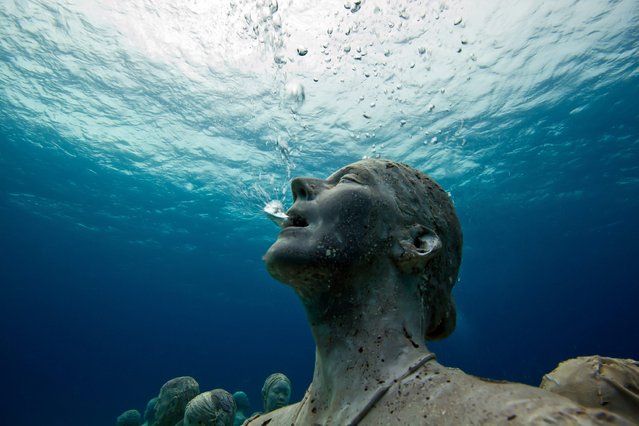
Monumental Underwater Museum MUSA; Jason deCaires Taylor; Silent Evolution

“In 2009 a monumental underwater museum called “MUSA” (Museo Subacuático de Arte) was formed in the waters surrounding Cancun, Isla Mujeres and Punta Nizuc. The project founded by Jaime Gonzalez Cano of The National Marine Park, Roberto Diaz of The Cancun Nautical Association and Jason deCaires Taylor consists of over 450 permanent life-size sculptures and is one of the largest and most ambitious underwater artificial art attractions in the world”. – UnderwaterSculpture (Photos by Jason deCaires Taylor/Intrepidacious/Kozy and Dan Kitchens)

Details
05 Oct 2012 07:26:00
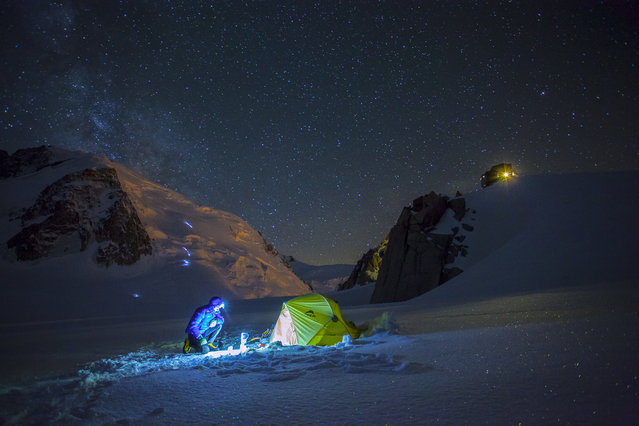
“A snapshot from mountaineer's life”. Have you ever wondered how does a mountaineer's day start? (Photo and caption by Kamil Tamiola/National Geographic Traveler Photo Contest)

“A snapshot from mountaineer's life”. Have you ever wondered how does a mountaineer's day start? I will give you a hint: you wake up at 3 am, set the stove, wake up your partner, pretend it is warm, quickly consume a high-calorie breakfast, watch your friends slowly ascending the icy slopes of your dream summit with their tiny head torches glimmering against perfectly blue ice, and hope for the good weather. One would ask: why all this trouble? The answer is easy: for the love of the adventure and the unknown. Location: Chamonix, Haute Savoye, France. (Photo and caption by Kamil Tamiola/National Geographic Traveler Photo Contest)

ATTENTION! All pictures are presented in high resolution. To see Hi-Res images – just TWICE click on any picture. In other words, click small picture – opens the BIG picture. Click BIG picture – opens VERY BIG picture.
Details
27 Jun 2013 12:47:00
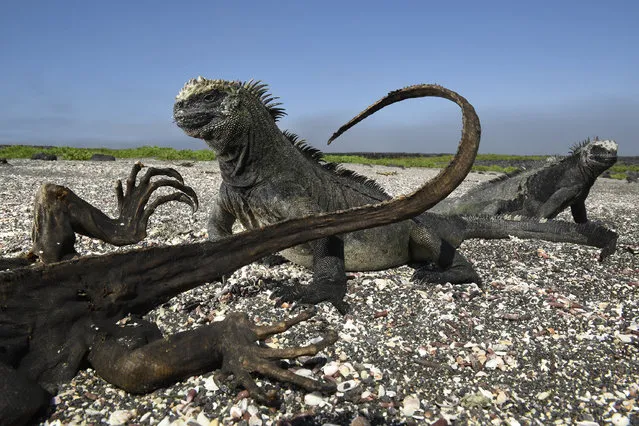
Galapagos – Rocking the Cradle: Four major ocean currents converge along the Galapagos archipelago, creating the conditions for an extraordinary diversity of animal life, April 25, 2016. The islands are home to at least 7,000 flora and fauna species, of which 97 percent of the reptiles, 80 percent of the land birds, 50 percent of the insects and 30 percent of the plants are endemic. The local ecosystem is highly sensitive to the changes in temperature, rainfall and ocean currents that characterize the climatic events known as El Niño and La Niña. These changes cause marked fluctuations in weather and food availability. Many scientists expect the frequency of El Niño and La Niña to increase as a result of climate change, making the Galapagos a possible early-warning location for its effects. (Photo by Thomas P. Peschak for National Geographic/World Press Photo)

Galapagos – Rocking the Cradle: Four major ocean currents converge along the Galapagos archipelago, creating the conditions for an extraordinary diversity of animal life, April 25, 2016. The islands are home to at least 7,000 flora and fauna species, of which 97 percent of the reptiles, 80 percent of the land birds, 50 percent of the insects and 30 percent of the plants are endemic. (Photo by Thomas P. Peschak for National Geographic/World Press Photo)
Details
16 Apr 2018 00:01:00
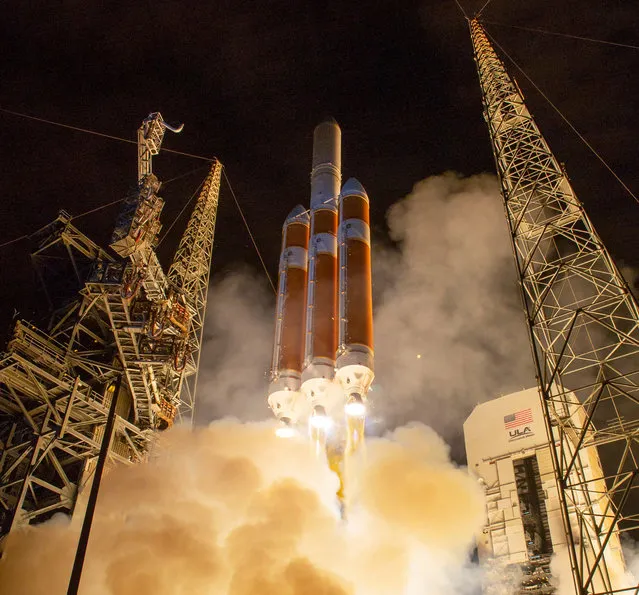
A handout photo made available by the NASA shows the United Launch Alliance Delta IV Heavy rocket launches NASA's Parker Solar Probe to touch the Sun, from Launch Complex 37 at Cape Canaveral Air Force Station, Florida, USA, 12 August 2018. Parker Solar Probe is humanity’s first-ever mission into a part of the Sun’s atmosphere called the corona. Here it will directly explore solar processes that are key to understanding and forecasting space weather events that can impact life on Earth. (Photo by Bill Ingalls/EPA-EFE/NASA)

A handout photo made available by the NASA shows the United Launch Alliance Delta IV Heavy rocket launches NASA's Parker Solar Probe to touch the Sun, from Launch Complex 37 at Cape Canaveral Air Force Station, Florida, USA, 12 August 2018. Parker Solar Probe is humanity’s first-ever mission into a part of the Sun’s atmosphere called the corona. Here it will directly explore solar processes that are key to understanding and forecasting space weather events that can impact life on Earth. (Photo by Bill Ingalls/EPA-EFE/NASA)
Details
13 Aug 2018 07:26:00
In this Thursday, August 22, 2013 photo, a female member of the Basij paramilitary militia aims a rifle as a trainer looks over her shoulder in Tehran, Iran. (Photo by Ebrahim Noroozi/AP Photo)

With a presence in nearly every city and town across Iran, the paramilitary Basij volunteer corps has an ever-increasing influence on life in the Islamic Republic. Authorities created the Basij, which means mobilization in Persian, just after the country's 1979 Islamic Republic. It is part of Iran's powerful Revolutionary Guard. Photo: In this Thursday, August 22, 2013 photo, a female member of the Basij paramilitary militia aims a rifle as a trainer looks over her shoulder in Tehran, Iran. (Photo by Ebrahim Noroozi/AP Photo)
Details
17 Jan 2014 09:19:00
Roma Community In Romania

“Inspired by the French authorities' solution to move Romas from point A to point B, Romanian authorities planned and started forced evictions of Roma informal settlements in cities like Cluj-Napoca and Baia Mare. Some of these settlements date back to the early 1990’s. These communities were tolerated by the authorities who verbally encouraged Romas to build in the area, meanwhile, reassuring them nothing bad would ever happen to them. However, the the reality today is that during political campaigns, authorities are planning forced evictions without reasons other than ethnic cleansing of the cities. My home documents the every day life of Roma communities in Romania, 2011”. – Mugur Varzariu. (Photo by Mugur Varzariu, 2011 FotoVisura Grant Finalist)
Details
20 Apr 2012 13:22:00
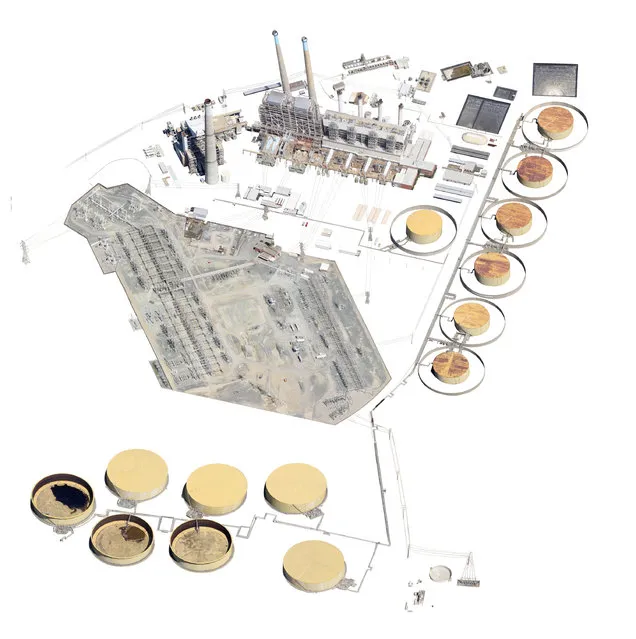
Natural gas plant in Pittsburg, CA (detail of Power Landscape), 2013. (Photo by Jenny Odell)

Jenny Odell repurposes online imagery mostly from Google Maps, but also from YouTube, Craigslist, and other sites. In her “Satellite Collections”, for example, she incorporated aerial views of swimming pools, basketball courts, parking lots, and other recognizable structures, seen from space. Her more recent series, “Satellite Landscapes”, includes painstakingly isolated Google Maps imagery of oil refineries, wastewater treatment plants, solar farms, etc. This work is meant as a reminder of our physically determined and vulnerable existence, since we depend on many of these things for survival and maintenance of our way of life. Photo: Natural gas plant in Pittsburg, CA (detail of Power Landscape), 2013. (Photo by Jenny Odell)
Details
19 Mar 2014 07:28:00
Norwegian Trolls By Ivar Rodningen Part 2

Some people think of trolls as nothing but savage beast, yet others realize that beneath their rock-hard skin hides a gentle kind heart. Ivar Rodningem is one of the people who knows the true nature of trolls. Though these creatures look unruly, it is just the way they were born. Trolls come in all shapes and sizes. Some are small, some are large, and some are simply enormous. They help each other out, though elders tend to be loners, preferring the company of their own thoughts to anybody else. You shouldn’t run for your life if you ever meet a troll, though we wouldn’t recommend pestering them, as they are mighty strong, even the little ones.


See also:Part 1
Details
07 Mar 2015 12:05:00