Loading...
Done
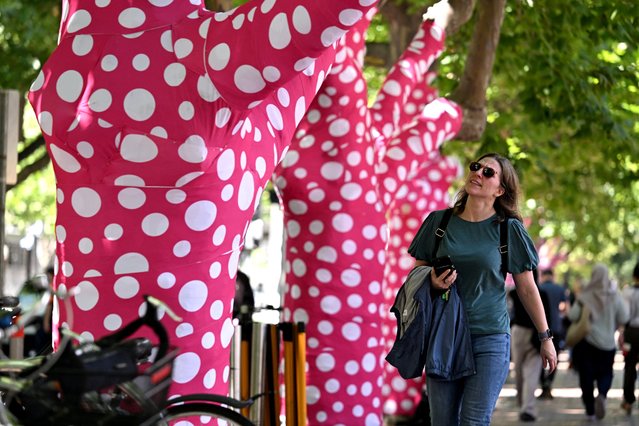
A woman looks at some of the 60 plane trees wrapped in a pink-and-white polka-dot design developed especially for Melbourne by Japanese contemporary artist Yayoi Kusama titled “Ascension of Polka Dots on the Trees”, in Melbourne on November 27, 2024. The National Gallery of Victoria’s (NGV) world-premiere blockbuster exhibition Yayoi Kusama will be on display from 15 December 2024 to 21 April 2025. (Photo by William West/AFP Photo)

A woman looks at some of the 60 plane trees wrapped in a pink-and-white polka-dot design developed especially for Melbourne by Japanese contemporary artist Yayoi Kusama titled “Ascension of Polka Dots on the Trees”, in Melbourne on November 27, 2024. The National Gallery of Victoria’s (NGV) world-premiere blockbuster exhibition Yayoi Kusama will be on display from 15 December 2024 to 21 April 2025. (Photo by William West/AFP Photo)
Details
23 Jan 2025 05:10:00
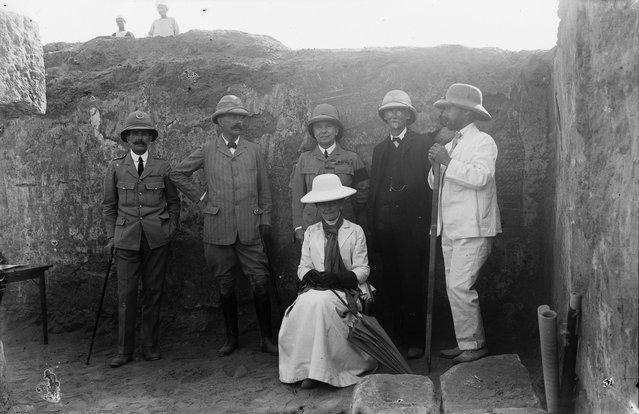
Remarkable discoveries were made, like the decapitated head of a bronze statue of Roman emperor Augustus, sacked from a raid on Roman garrisons further north in Egypt. Here: A group visiting the excavations at Meroë, including (from left) Midwinter Bey, director of Sudan Railways; Lord Kitchener; General Sir Francis Reginald Wingate, Sirdar of the Egyptian Army; Professor Archibald Sayce; John Garstang; and Lady Catherine Wingate, 1911. (Photo by Garstang Museum of Archaeology)

The city of Meroë laid undiscovered for two millennia before British archaeologist John Garstang excavated it in the early 20th century. Garstang took the radical decision to document his discoveries with photography – and immortalised an ancient world. “Meroë: Africa’s Forgotten Empire” is being shown until 14 September at Garstang Museum of Archaeology, Liverpool. Here: A group visiting the excavations at Meroë, including (from left) Midwinter Bey, director of Sudan Railways; Lord Kitchener; General Sir Francis Reginald Wingate, Sirdar of the Egyptian Army; Professor Archibald Sayce; John Garstang; and Lady Catherine Wingate, 1911. (Photo by Garstang Museum of Archaeology)
Details
15 Jun 2016 14:49:00
A couple hugs while standing near a Christmas tree made out of plastic bins and plastic hampers outside the Museum of History in Monterrey, Mexico, December 4, 2015. (Photo by Daniel Becerril/Reuters)

A couple hugs while standing near a Christmas tree made out of plastic bins and plastic hampers outside the Museum of History in Monterrey, Mexico, December 4, 2015. The humble Christmas tree has a rich history, from evergreen trees used to symbolise eternal life in Ancient Egypt to tree worship among pagan Europeans. The modern version has its origins in Germany, where the song “O Tannenbaum” is still a festive favourite. Today the traditional tree with lights and decorations appears in cities including Washington, Moscow and Beirut. Alternative constructions range from recycled rubbish in Mexico City to old window frames in Rakvere, Estonia. Whatever the shape or size, the message is the same: Merry Christmas. (Photo by Neil Hall/Reuters)
Details
23 Dec 2015 08:01:00
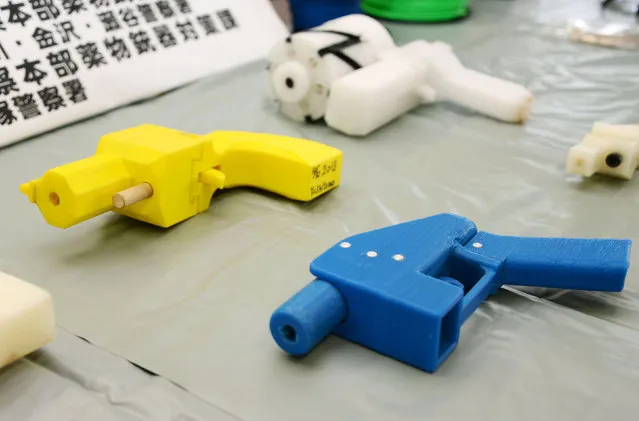
Seized plastic handguns which were created using 3D printing technology are displayed at Kanagawa police station in Yokohama, south of Tokyo, in this photo taken by Kyodo May 8, 2014. (Photo by Reuters/Kyodo)

Seized plastic handguns which were created using 3D printing technology are displayed at Kanagawa police station in Yokohama, south of Tokyo, in this photo taken by Kyodo May 8, 2014. Yoshimoto Imura became the first man to be arrested in Japan for illegal possession of two guns he created himself using 3D printing technology, Japanese media said on Thursday. The 27-year-old, a college employee in the city of Kawasaki, was arrested after police found video online posted by Imura claiming to have produced his own guns. Gun possession is strictly regulated in Japan. Police raided Imura's home and found five guns, two of which could fire real bullets, Japanese media said. (Photo by Reuters/Kyodo)
Details
12 May 2014 10:46:00


“Itasha (痛車), literally “painmobile”, is a Japanese term for an otaku fad of individuals decorating the bodies of their cars with fictional characters of anime, manga, or video games (especially bishōjo game or eroge). These characters are predominately “cute” female. The decorations usually involve paint schemes and stickers. Automobiles are called Itasha, while similar motorcycles and bicycles are called itansha (痛単車) and itachari (痛チャリ), respectively”. – Wikipedia


Photo: A visitor takes pictures of an anime-decorated «Itasha» car displayed during the “Moe Fes in Washimiya” at Washimiya Town Hall on July 18, 2009 in Washimiya, Saitama, Japan. Itasha, a word derived from “itai” (painful) and “sha” (car), are vehicles decorated with mostly female characters from Japanese manga, anime and video games. (Photo by Kiyoshi Ota/Getty Images)
Details
02 May 2011 08:38:00
Japanese sumo wrestler Kisenosato (C) holds a red sea bream next to his stablemaster Tagonoura's wife Kotomi as he celebtares after receiving messengers from the Japan Sumo Association bringing official notice of his promotion to Yokozuna, or grand champion, during a ceremony in Tokyo, Japan, January 25, 2017. (Photo by Toru Hanai/Reuters)

Japanese sumo wrestler Kisenosato (C) holds a red sea bream next to his stablemaster Tagonoura's wife Kotomi as he celebtares after receiving messengers from the Japan Sumo Association bringing official notice of his promotion to Yokozuna, or grand champion, during a ceremony in Tokyo, Japan, January 25, 2017. (Photo by Toru Hanai/Reuters)
Details
26 Jan 2017 13:11:00
Orient Industry 40th Anniversary-Love Doll in Tokyo, Japan on May 19,  2017. Orient industry prides itself on its detail with two looking extremely real as they sit flirtatiously on a couch. (Photo by Masatoshi Okauchi/Rex Features/Shutterstock)

Japanese sеx doll exhibition attracts hundreds of mannequin-fetishists to celebrate 40 years of the X-rated love bots in Tokyo, Japan on May 19, 2017. These silicon seductresses were the star of an extraordinary exhibition in Japan showcasing sеx dolls that cost as little as a second hand car. Japanese sеx doll maker Orient Industry (originally Orient made dolls for disabled people) were laying bare their dazzling bevvy of beauties in an extravaganza to mark its 40th anniversary this week. Here: Orient industry prides itself on its detail with two looking extremely real as they sit flirtatiously on a couch. (Photo by Masatoshi Okauchi/Rex Features/Shutterstock)
Details
20 May 2017 10:03:00
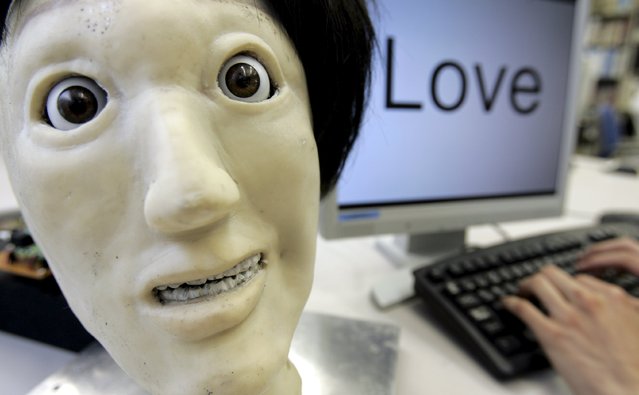
A humanoid robot named Kansei, meaning “sensibility” in Japanese, makes a facial expression depicting “happiness”, next to the word “Love” during a demonstration at a laboratory of Meiji University's Robot and Science Institute in Kawasaki, south of Tokyo in this June 4, 2007 file photo. (Photo by Yuriko Nakao/Reuters)

A humanoid robot named Kansei, meaning “sensibility” in Japanese, makes a facial expression depicting “happiness”, next to the word “Love” during a demonstration at a laboratory of Meiji University's Robot and Science Institute in Kawasaki, south of Tokyo in this June 4, 2007 file photo. Three-fourths of robot installations over the next decade are expected to be concentrated in four areas: transportation equipment, including the automotive sector; computer and electronic products; electrical equipment and machinery. Labor costs have climbed in countries such as China that have been popular for outsourcing production, while technological advances for robots allow them to be more flexible and perform more tasks. (Photo by Yuriko Nakao/Reuters)
Details
17 Apr 2015 09:39:00