Loading...
Done
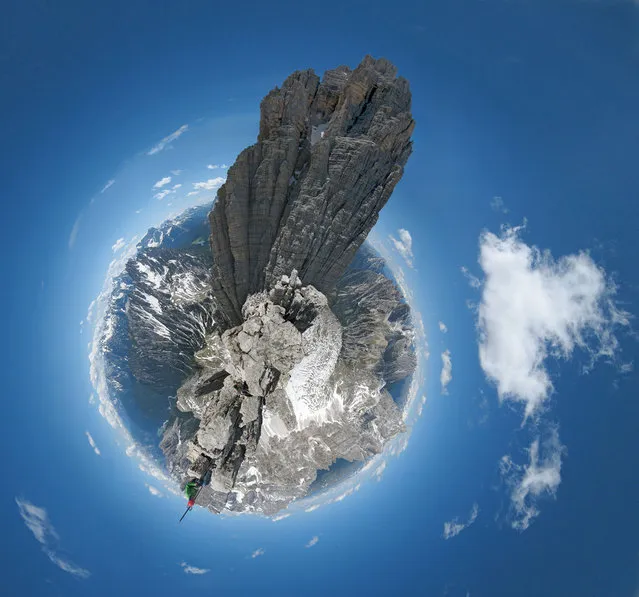
“Taken at the tiny summit of Cima Piccola in the the Tre Cima group in the Dolomites, Italy. The large peak is Cima Grande Some remote peaks have a summit register, and my climbing partner Steve can be seen signing this in the bottom of the picture”. (“Little Planets” Project. Photo and comment by Dan Arkle)

These are the amazing panoramic photographs that look like little planets. They were taken by photographer Dan Arkle, 34, from Sheffield, UK. He said: “On a sharp summit, you feel literally on top of the world, with dramatic views in all directions, including straight down. I tried using conventional photography to capture this feeling, but even with a wide angle lens I couldnt get all the view in the image”. Here: “Taken at the tiny summit of Cima Piccola in the the Tre Cima group in the Dolomites, Italy. The large peak is Cima Grande Some remote peaks have a summit register, and my climbing partner Steve can be seen signing this in the bottom of the picture”. (“Little Planets” Project. Photo and comment by Dan Arkle)
Details
06 Jun 2015 09:52:00
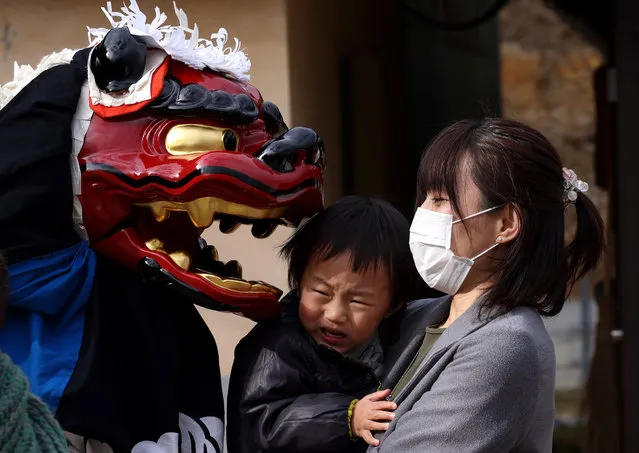
A performer wearing a lion mask performs the Ise Daikagura lion dance at the remote village of Yamanawa on February 08, 2021 in Ryuo, Japan. Ise Daikagura is a group of traditional Lion Dance performers who pray in front of farmers houses and businesses for good grain harvests and disease-free lives. Performers play sacred music using drums and flutes with two lion mask dancers. A lion mask is considered a symbol of God, who enters the house and performs in front of the Shinto God, a statue placed inside the house, mostly in the kitchen. These prayers are called “Kamodo Barai”. After the prayers, they are gifted with money, rice, sake and Japanese sweets from the householders. A group can travel for more than one hundred days to thousands of households and businesses throughout rural-villages in western Japan, and pray to those who are unable to visit the country’s most sacred shrine, the Grand Ise Shrine in Mie Prefecture. The group started its performance in the Edo era between 1603 to 1868 according to Japanese history. The Japanese government designated it as an important folk cultural national property in 1981. (Photo by Buddhika Weerasinghe/Getty Images)

A performer wearing a lion mask performs the Ise Daikagura lion dance at the remote village of Yamanawa on February 08, 2021 in Ryuo, Japan. Ise Daikagura is a group of traditional Lion Dance performers who pray in front of farmers houses and businesses for good grain harvests and disease-free lives. (Photo by Buddhika Weerasinghe/Getty Images)
Details
18 Feb 2021 09:27:00
Records Motion In Light By Stephen Orlando

The mystifying flow of motion. We can rarely appreciate its beauty. Though there are ways to capture it on film, allowing us to marvel at its complexity. Stephen Orlando is a photographer who takes pleasure highlighting the magnificence of aquatic sports by using the brilliance of light. The beauty of the images that he creates comes not only from the composition of the photo, but also from the way Stephen managed to show the color transitions between each stroke of the kayaker. Even the rapids do not stand in the way of the marvelous dance of light. (Photo by Stephen Orlando)
Details
21 Dec 2014 10:57:00
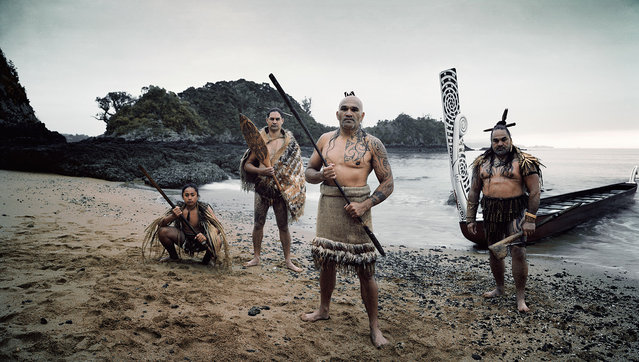
Maori  People New Zealand

The long and intriguing story of the origine of the indigenous Maori people can be traced back to the 13th century, the mythical homeland Hawaiki, Eastern Polynesia. Due to centuries of isolation, the Maori established a distinct society with characteristic art, a separate language and unique mythology. Defining aspects of Maori traditional culture include art, dance, legends, tattoos and community. While the arrival of European colonists in the 18th centure had a profound impact on the Maori way of life, many aspects of traditional society have survived into the 21th century.
Details
11 Mar 2014 14:40:00
Online hostess Xianggong (L) and other hostesses check their pictures as they gather around the photographer while taking part in a football-themed photoshoot at a photography studio in Beijing March 4, 2015. (Photo by Jason Lee/Reuters)

Online hostess Xianggong (L) and other hostesses check their pictures as they gather around the photographer while taking part in a football-themed photoshoot at a photography studio in Beijing March 4, 2015. In China's online hostessing world, men find virtual company and the women can find riches. Xianggong is one of more than 10,000 hostesses on the internet site bobo.com, a live broadcasting web platform where anyone can record themselves singing, playing piano, dancing or just chatting. (Photo by Jason Lee/Reuters)
Details
17 Apr 2015 10:06:00
“Jessica”, a silicon s*x doll for sexual encounters lies on a bed at the “Bordoll” brothel on April 17, 2019 in Dortmund, Germany. (Photo by Lukas Schulze/Bongarts/Getty Images)

“Jessica”, a silicon sеx doll for sexual encounters lies on a bed at the “Bordoll” brothel on April 17, 2019 in Dortmund, Germany. Bordoll is Germany's first brothel to specialize in sеx dolls. It currently offers 13 female dolls and one male doll and will soon be expanding its female line-up. Schwarz says “sеx dolls are so popular because the client can do what he wants to and nobody complains”. (Photo by Lukas Schulze/Bongarts/Getty Images)
Details
19 Apr 2018 00:03:00
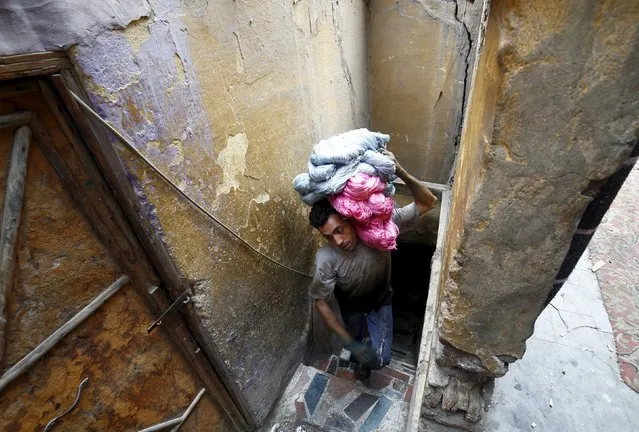
Mohamed Mostafa, 35, carries dyed yarns at a dye workshop in old Cairo, Egypt, March 17, 2016. (Photo by Amr Abdallah Dalsh/Reuters)

Mohamed Mostafa, 35, carries dyed yarns at a dye workshop in old Cairo, Egypt, March 17, 2016. Egypt's hard currency crisis and competition from modern factories in Asia and at home threaten one of the last dye workshops in Egypt. But one of its owners takes comfort in the trade's ancient resilience. Mohamed Mostafa boasts that the profession dates back 3,000 years, so it can survive anything. (Photo by Amr Abdallah Dalsh/Reuters)
Details
09 Apr 2016 13:26:00
A staff member removes a coffin from a room of the “Corpse Hotel” in Kawasaki, Japan, April 20, 2016. (Photo by Thomas Peter/Reuters)

A staff member removes a coffin from a room of the “Corpse Hotel” in Kawasaki, Japan, April 20, 2016. Many so-called corpse hotels have emerged as a flourishing business in the city following a crunch in crematoriums. Families can rent a room in Sousou on a daily charge of 9,000 Japanese yen (£58, €74, $84) to keep the body of the deceased relative for up to four days until they find a crematorium. (Photo by Thomas Peter/Reuters)
Details
30 Apr 2016 09:46:00