Loading...
Done
A beautiful snowy owl looks like she is flying above a cloud, but in fact she is gliding inches above a snowplain in a hunt for food. The owls fit in perfectly with their surroundings as both the male and female, which has darker markings on her feathers referred to as barres, hunt for voles. (Photo by Rick Dobson/Solent News/SIPA Press)

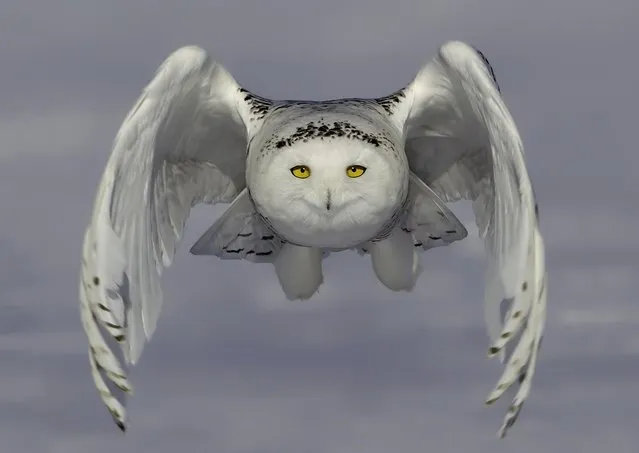
A beautiful snowy owl looks like she is flying above a cloud, but in fact she is gliding inches above a snowplain in a hunt for food. The owls fit in perfectly with their surroundings as both the male and female, which has darker markings on her feathers referred to as barres, hunt for voles. The female is so low to the ground she is almost touching it as she spots her prey in the snow. Nature photographer Rick Dobson captured the two birds hunting in corn fields near his home, just outside of Ottawa, Ontario, Canada. (Photo by Rick Dobson/Solent News/SIPA Press)
Details
24 Mar 2015 10:00:00
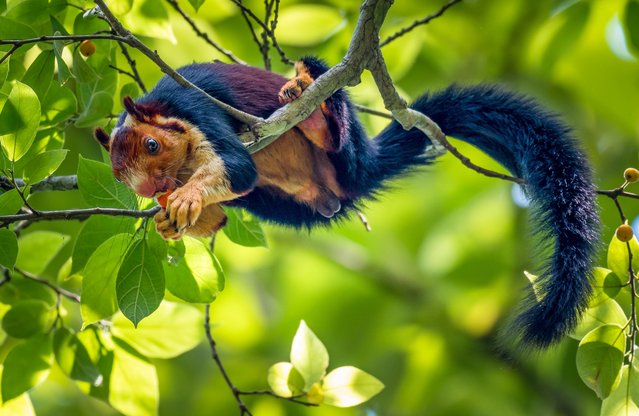
Its main predators are the birds of prey and the leopard. The Giant Squirrel is mostly active in the early hours of the morning and in the evening, resting in the midday. They are typically solitary animals that only come together for breeding. (Photo by Kaushik Vijayan/South West News Service)

The Malabar Giant squirrel – double the size of their grey relatives and measuring up to 36 inches (91.5 cm) from head to tail – lives deep in the forests of India. The athletic animals can leap an incredible 20 feet (6 m) between trees. Photographer Kaushik Vijayan, 39, snapped the animals in their native habit to produce these stunning images. Kaushik, from Kerala State, India, said: “Up until that point I had never heard about a squirrel like that or seen one. The sight was an absolute feast for my eyes. The squirrels fascinated me and I got excited to capture this beauty on my camera”. (Photo by Kaushik Vijayan/South West News Service)
Details
04 Apr 2019 00:03:00
The National Geographic Photo Ark is a travelling exhibition of photographer Joel Sartore’s quest to create a photo archive of biodiversity around the world. So far, Sartore has captured studio portraits of more than 6,000 species – a number that he hopes to double. On 1 July, the ark will open at Melbourne zoo – the first time it has been exhibited in the southern hemisphere. More than 50 portraits will be on display, including many of Australian endangered animals being protected by programs at the zoo itself. These captions have been edited from text supplied by Melbourne zoo. Here: Barking owl. So-named because its call sounds like a barking dog, these birds are native to Australia, Indonesia and Papua New Guinea. In Victoria they are listed as an endangered species, and in 2003 there were estimated to be fewer than 50 breeding pairs. The main threat to the species in Victoria is loss of habitat, especially large trees with hollows in which they can nest and on which many of their prey depend. Apart from a bark, they may utter a chilling scream when they feel threatened. (Photo by Joel Sartore/National Geographic Photo Ark/The Guardian)

The National Geographic Photo Ark is a travelling exhibition of photographer Joel Sartore’s quest to create a photo archive of biodiversity around the world. So far, Sartore has captured studio portraits of more than 6,000 species – a number that he hopes to double. On 1 July, the ark will open at Melbourne zoo – the first time it has been exhibited in the southern hemisphere. More than 50 portraits will be on display, including many of Australian endangered animals being protected by programs at the zoo itself. These captions have been edited from text supplied by Melbourne zoo. Here: Barking owl. (Photo by Joel Sartore/National Geographic Photo Ark/The Guardian)
Details
01 Jul 2017 07:45:00
An undated handout photo obtained on May 14, 2022, from Khartoum's Marshall Nature Reserve for exotic birds, shows a visitor posing for pictures with some of the protected birds in the capital Khartoum. Tucked away east of Sudan's capital Khartoum, a sanctuary of lush green vegetation has been a haven for dozens of exotic birds from far and wide. (Photo by Khartoum Marshall Nature Reserve/AFP Photo)

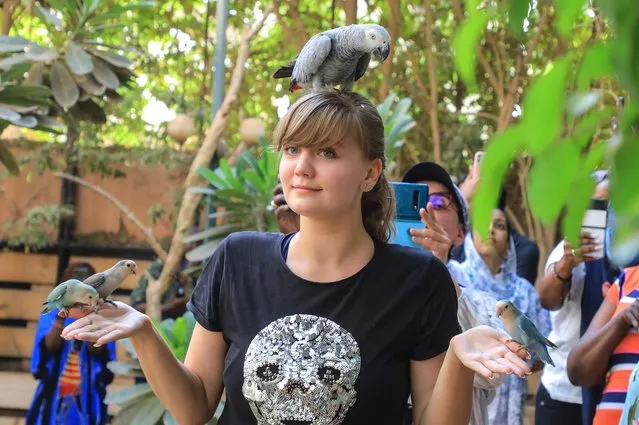
An undated handout photo obtained on May 14, 2022, from Khartoum's Marshall Nature Reserve for exotic birds, shows a visitor posing for pictures with some of the protected birds in the capital Khartoum. Tucked away east of Sudan's capital Khartoum, a sanctuary of lush green vegetation has been a haven for dozens of exotic birds from far and wide. (Photo by Khartoum Marshall Nature Reserve/AFP Photo)
Details
29 May 2022 04:20:00
An American robin feeds on holly berries in a thicket near Elkton in southwestern Oregon on November 16, 2024. Many birds can safely consume holly berries, including blackbirds, redwings, and thrushes. There is an old wives tale that if you see a bird eating a berry, it is safe for humans to eat, but this is not true. Birds consume many plants that are poisonous to humans, holly berries included. (Photo by Robin Loznak/ZUMA Press Wire/Rex Features/Shutterstock)

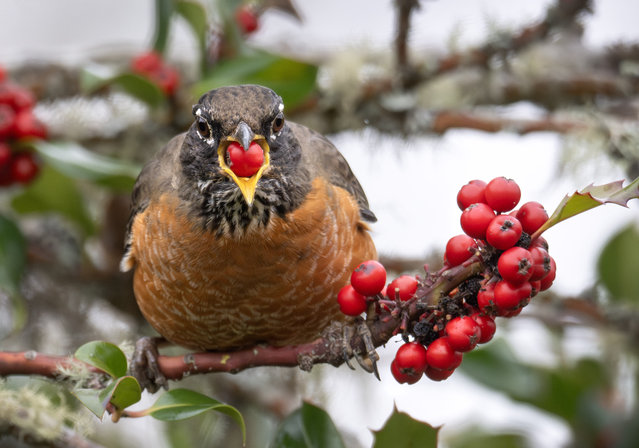
An American robin feeds on holly berries in a thicket near Elkton in southwestern Oregon on November 16, 2024. Many birds can safely consume holly berries, including blackbirds, redwings, and thrushes. There is an old wives tale that if you see a bird eating a berry, it is safe for humans to eat, but this is not true. Birds consume many plants that are poisonous to humans, holly berries included. (Photo by Robin Loznak/ZUMA Press Wire/Rex Features/Shutterstock)
Details
01 Dec 2024 01:43:00
Birds made of recycled tires are displayed in a shop located on the Panamerican highway near Catarina town, May 7, 2015. (Photo by Oswaldo Rivas/Reuters)

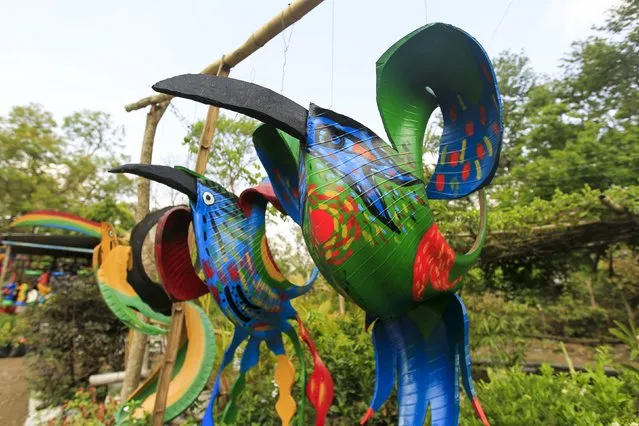
Birds made of recycled tires are displayed in a shop located on the Panamerican highway near Catarina town, May 7, 2015. Salazar recycles used tyres to make bird figurines and sofas to sell in his shop located on the Panamerican highway. (Photo by Oswaldo Rivas/Reuters)
Details
10 May 2015 12:49:00
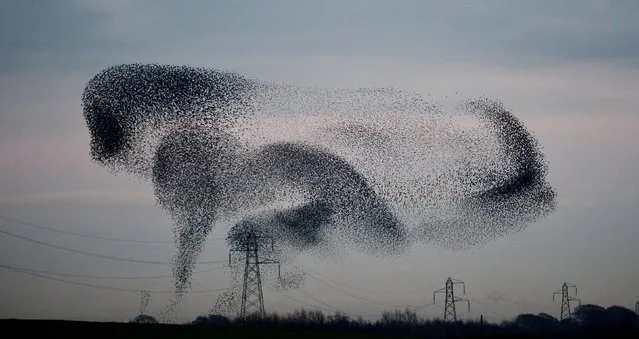
A murmuration of starlings above the  the small village of Rigg, near Gretna, in the Scottish Borders, on November 25, 2013. The weight of the resting birds on power lines caused some power localised power outages in the village. Still one of the commonest of garden birds, its decline elsewhere puts it on the Red List of endangered species. (Photo by Owen Humphreys/PA Wire)

A murmuration of starlings above the the small village of Rigg, near Gretna, in the Scottish Borders, on November 25, 2013. The weight of the resting birds on power lines caused some power localised power outages in the village. Still one of the commonest of garden birds, its decline elsewhere puts it on the Red List of endangered species. (Photo by Owen Humphreys/PA Wire)
Details
27 Nov 2013 11:00:00
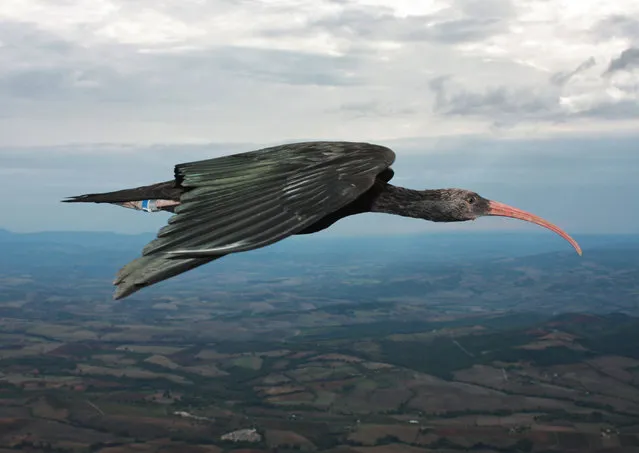
In this undated photo made available by journal Nature on January 15, 2014, a northern bald ibis (Geronticus eremita) flies in Tuscany, Italy. A new study released Wednesday, January 15, 2014 says the birds choreograph the flapping of their wings, getting a boost from an updraft of air in the wake of the flapping wings by flying behind the first bird and off to the side. When a flock of birds take advantage of these aerodynamics, they form a V. (Photo by Markus Unsöld/AP Photo)

In this undated photo made available by journal Nature on January 15, 2014, a northern bald ibis (Geronticus eremita) flies in Tuscany, Italy. A new study released Wednesday, January 15, 2014 says the birds choreograph the flapping of their wings, getting a boost from an updraft of air in the wake of the flapping wings by flying behind the first bird and off to the side. When a flock of birds take advantage of these aerodynamics, they form a V. (Photo by Markus Unsöld/AP Photo)
Details
18 Jan 2014 13:54:00