Loading...
Done
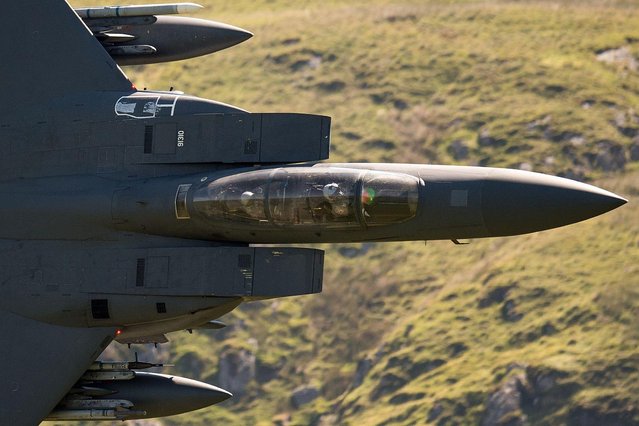
A United States Air Force (USAF) F-15 fighter jet travels at low altitude through the “Mach Loop” series of valleys near Dolgellau, north Wales on June 26, 2018. (Photo by Oli Scarff/AFP Photo)

A United States Air Force (USAF) F-15 fighter jet travels at low altitude through the “Mach Loop” series of valleys near Dolgellau, north Wales on June 26, 2018. The Mach Loop valleys, situated between Dolgellau and Machynlleth, are regularly used by the military for operational low flying training which can take place as low as 76 metres from the nearest terrain. The USAF regularly use the loop to practice low-altitude flight, which confuses radar systems. (Photo by Oli Scarff/AFP Photo)
Details
29 Jun 2018 00:05:00
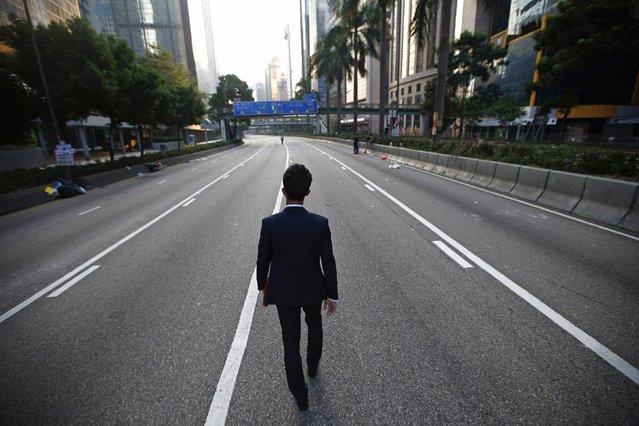
A man walks along an empty street near the central financial district in Hong Kong September 30, 2014. Tens of thousands of pro-democracy protesters extended a blockade of Hong Kong streets on Tuesday, stockpiling supplies and erecting makeshift barricades ahead of what some fear may be a push by police to clear the roads before Chinese National Day. (Photo by Carlos Barria/Reuters)

Reuters photographer Bobby Yip took a series of portraits of people taking part in the “Occupy Central” protests in Hong Kong, and asked them why they had joined the demonstrations. China rules Hong Kong under a “one country, two systems” formula that accords the territory limited democracy. Tens of thousands of mostly student protesters are demanding Beijing give them full democracy, with the freedom to nominate election candidates. The unrest is the worst in Hong Kong since China resumed its rule over the former British colony in 1997. (Photo by Carlos Barria/Reuters)
Details
30 Sep 2014 09:10:00
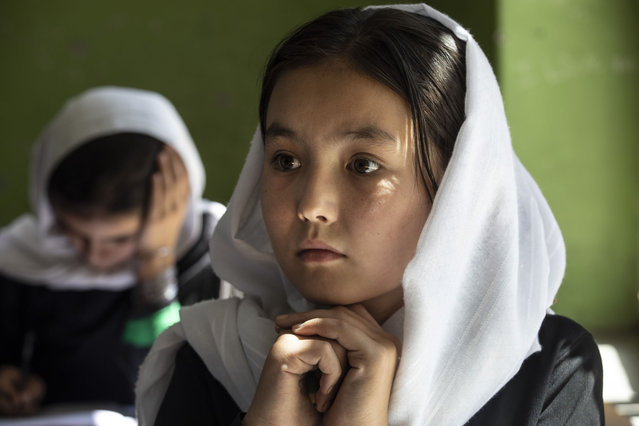
Behishta,11, listens during 4th grade class at the Zarghoona high school on July 25 2021 in Kabul, Afghanistan. The Zarghoona girls high school is the largest in Kabul with 8,500 female students attending classes. The school opened after a nearly two-month break due to the coronavirus (COVID-19) pandemic. Currently there is widespread fear that the Taliban who already control around half the country will reintroduce its notorious system barring girls and women from almost all work, and access to education. The Ministry of Education has announced the opening of schools, but there are  mixed reports in many areas where the Taliban have taken control or where fighting is ongoing. (Photo by Paula Bronstein/Getty Images)

Behishta,11, listens during 4th grade class at the Zarghoona high school on July 25 2021 in Kabul, Afghanistan. The Zarghoona girls high school is the largest in Kabul with 8,500 female students attending classes. The school opened after a nearly two-month break due to the coronavirus (COVID-19) pandemic. (Photo by Paula Bronstein/Getty Images)
Details
12 Aug 2021 08:41:00
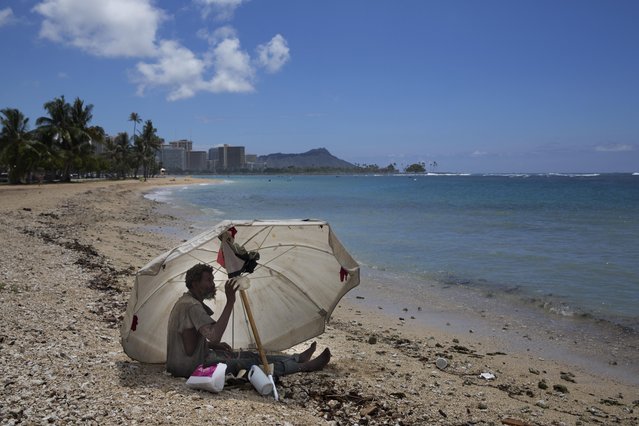
In this Thursday, August 27, 2015 photo, a homeless man drinks water while sitting on the beach at Ala Moana Beach Park located near Waikiki in Honolulu. Homelessness in Hawaii has grown steadily in recent years, leaving the state with the nation's highest rate of homeless people per capita. (Photo by Jae C. Hong/AP Photo)

Hawaii has long been known as a tropical paradise, but in recent years another image has intruded into the state's carefully crafted one of idyllic beaches and relaxing resorts: homelessness. The number of homeless people has grown in recent years, leaving the state with 487 homeless per 100,000 people, the nation's highest rate per capita, above New York and Nevada, according to federal statistics. Many of the homeless, however, defy the stereotype of the mentally ill or drug addicted. They are families, with men and women who work full-time jobs. They are struggling to get a foothold in a place with a high cost of living and low wages. Here: in this Thursday, August 27, 2015 photo, a homeless man drinks water while sitting on the beach at Ala Moana Beach Park located near Waikiki in Honolulu. (Photo by Jae C. Hong/AP Photo)
Details
11 Nov 2015 08:03:00
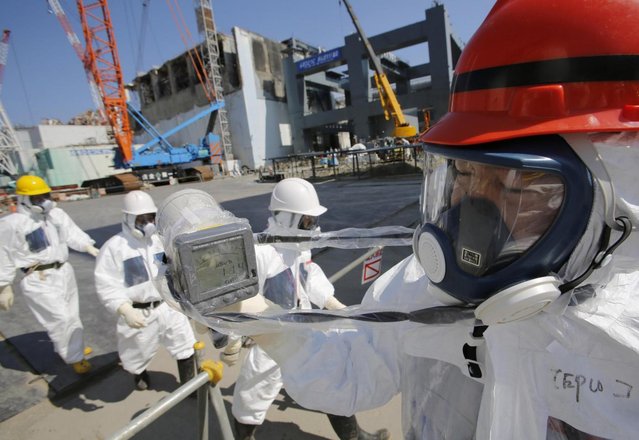
A radiation monitor indicates 114.00 microsieverts per hour near the building housing the plant's No. 4 reactor, center, and an under construction foundation, right, which will store the reactor's melted fuel rods at Tokyo Electric Power Co.'s tsunami-crippled Fukushima Dai-ichi nuclear power plant in Okuma, Fukushima prefecture, Wednesday, March 6, 2013, ahead of the second anniversary of the March 11, 2011 tsunami and earthquake. (Photo by Issei Kato/AP Photo/Pool)

A radiation monitor indicates 114.00 microsieverts per hour near the building housing the plant's No. 4 reactor, center, and an under construction foundation, right, which will store the reactor's melted fuel rods at Tokyo Electric Power Co.'s tsunami-crippled Fukushima Dai-ichi nuclear power plant in Okuma, Fukushima prefecture, Wednesday, March 6, 2013, ahead of the second anniversary of the March 11, 2011 tsunami and earthquake. Some 110,000 people living around the nuclear plant were evacuated after the massive March 11, 2011, earthquake and tsunami knocked out the plant's power and cooling systems, causing meltdowns in three reactors and spewing radiation into the surrounding air, soil and water. (Photo by Issei Kato/AP Photo/Pool)
Details
06 Mar 2013 13:19:00
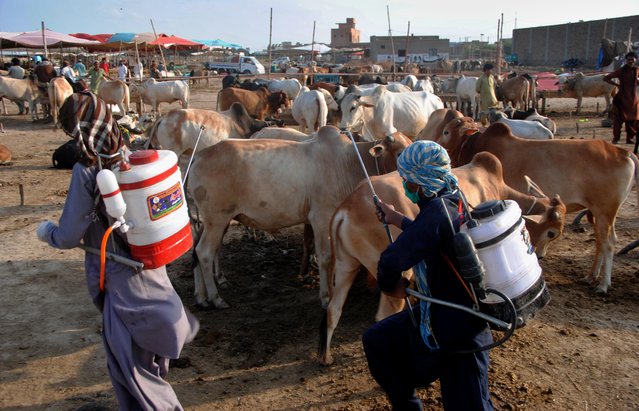
Health workers wearing face masks spray disinfectant liquid on sacrificial animals amid concerns over the spread of the SARS-CoV-2 coronavirus that causes the pandemic COVID-19 disease ahead of the Muslim festival of Eid al-Adha at an animal market in Hyderabad, southern Pakistan, 21 July 2020. Eid al-Adha, also known as the Festival of the Sacrifice, is the second and holiest of the two main Islamic holidays celebrated each year (the other one being Eid al-Fitr). Every year, on the 10th day of the Islamic lunar month of Dhu al-Hijjah, Muslims around the world ritually slaughter a sacrificial animal and split the meat into three parts: one is reserved for the family, another for friends and relatives, and the third is given to the poor and needy. The Saudi Supreme Court has declared that the first day of Eid al-Adha this year falls on 31 July. (Photo by Nadeem Khawar/EPA/EFE)

Health workers wearing face masks spray disinfectant liquid on sacrificial animals amid concerns over the spread of the SARS-CoV-2 coronavirus that causes the pandemic COVID-19 disease ahead of the Muslim festival of Eid al-Adha at an animal market in Hyderabad, southern Pakistan, 21 July 2020. (Photo by Nadeem Khawar/EPA/EFE)
Details
23 Jul 2020 00:07:00
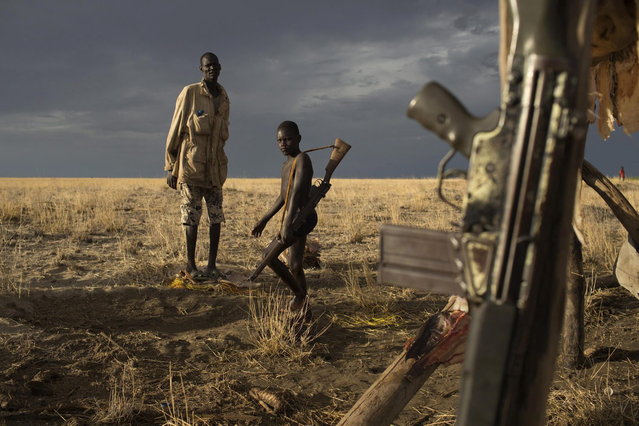
A Turkana man and a boy carrying a gun look on as a G3 battle rifle hangs from a structure used to dry fish at a fishing camp on the shores of Lake Turkana, some kilometres from Todonyang near the Kenya-Ethiopia border in northwestern Kenya October 12, 2013. (Photo by Siegfried Modola/Reuters)

A Turkana man and a boy carrying a gun look on as a G3 battle rifle hangs from a structure used to dry fish at a fishing camp on the shores of Lake Turkana, some kilometres from Todonyang near the Kenya-Ethiopia border in northwestern Kenya October 12, 2013The Turkana are traditionally nomadic pastoralists, but they have seen the pasture that they need to feed their herds suffer from recurring droughts and many have turned to fishing. However, Lake Turkana is overfished, and scarcity of food and pastureland is fuelling long-standing conflict with Ethiopian indigenous Dhaasanac, who have seen grazing grounds squeezed by large-scale government agricultural schemes in southern Ethiopia. The Dhaasanac now venture ever deeper into Kenyan territory in search of fish and grass, clashing with neighbours. Fighting between the communities has a long history, but the conflict has become ever more fatal as automatic weapons from other regional conflicts seep into the area. While the Turkana region is short of basics like grass and ground-water, it contains other resources including oil reserves and massive, newly discovered underground aquifers. (Photo by Siegfried Modola/Reuters)
Details
05 Dec 2013 12:08:00
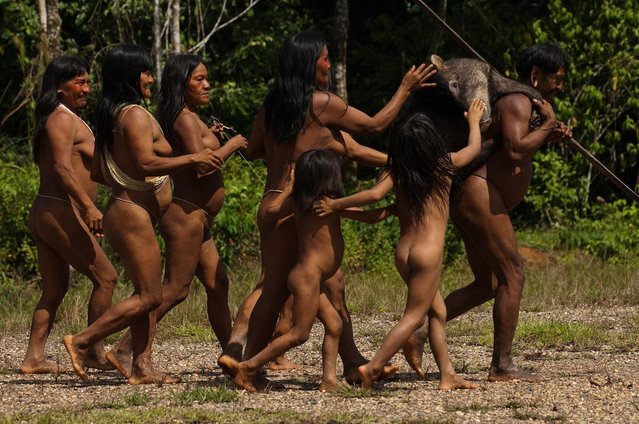
Spectacular images offering insight into the lives of the Huaorani people in the Ecuadorian Amazon have been revealed showing how they use traditional methods to hunt monkeys for food. The stunning pictures were taken by conservation photographer Pete Oxford from Torquay, Devon in the Ecuadorian Amazon. “The Huaorani Indians are a forest people highly in tune with their environment. Many are now totally acculturated since the 1950s by missionaries”, said Pete. “Today they face radical change to their culture to the proximity of oil exploration within their territory and the Yasuni National Park and Biosphere Reserve, they are vastly changed. Some still live very traditionally and for this shoot, through my Huaorani friend, a direct relative of those photographed he wanted to depict them as close to their original culture as possible. They still largely hunt with blow pipes and spears eating a lot of monkeys and peccaries”. The Huaorani are also known as the Waorani, Waodani or the Waos and are native Amerindians. Their lands are located between the Curaray and Napo rivers and speak the Huaorani language. Pete says that during his visit he was welcomed into the group and hopes that ancient cultures can be saved. Here: The tribe were seen celebrating after a hunter returned to camp with a wild pig. (Photo by Pete Oxford/Mediadrumworld.com)

Spectacular images offering insight into the lives of the Huaorani people in the Ecuadorian Amazon have been revealed showing how they use traditional methods to hunt monkeys for food. The stunning pictures were taken by conservation photographer Pete Oxford from Torquay, Devon in the Ecuadorian Amazon. Here: The tribe were seen celebrating after a hunter returned to camp with a wild pig. (Photo by Pete Oxford/Mediadrumworld.com)
Details
20 Jan 2017 07:58:00