Loading...
Done
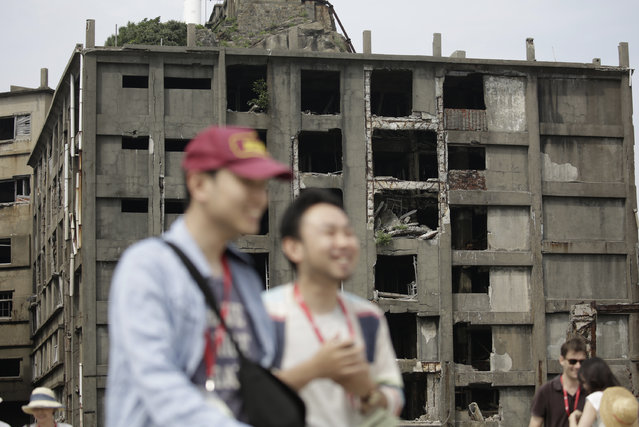
In this June 29, 2015 photo, forlorn buildings are seen at Hashima Island, commonly known as Gunkanjima, which means “Battleship Island”, off Nagasaki, Nagasaki Prefecture, southern Japan. (Photo by Eugene Hoshiko/AP Photo)

In this June 29, 2015 photo, forlorn buildings are seen at Hashima Island, commonly known as Gunkanjima, which means “Battleship Island”, off Nagasaki, Nagasaki Prefecture, southern Japan. The island is one of 23 old industrial facilities seeking UNESCO's recognition as world heritage “Sites of Japan's Meiji Industrial Revolution” meant to illustrate Japan's rapid transformation from a feudal farming society into an industrial power at the end of the 19th century. UNESCO's World Heritage Committee is expected to approve the proposal during a meeting being held in Bonn, Germany, through July 9. (Photo by Eugene Hoshiko/AP Photo)
Details
01 Jul 2015 13:41:00
Models display a creation by K-Lynn Lingerie during a fashion show in the Lebanese capital Beirut on April 24, 2016. (Photo by Anwar Amro/AFP Photo)

Models display a creation by K-Lynn Lingerie during a fashion show in the Lebanese capital Beirut on April 24, 2016. (Photo by Anwar Amro/AFP Photo)
Details
27 Apr 2016 10:06:00
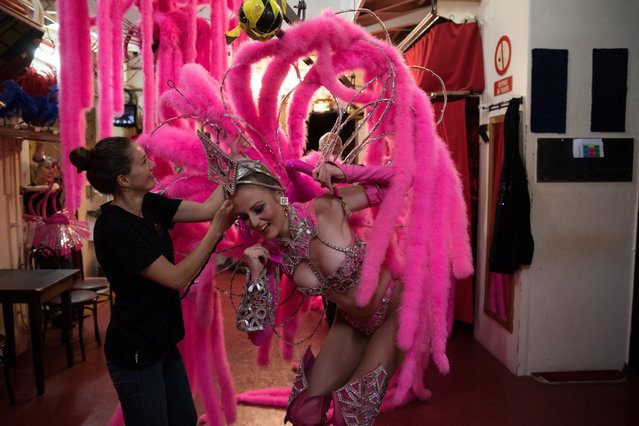
Dancer Megan changes costume as she performs in the review “Feerie” at the Moulin Rouge in Paris, France, July 3, 2018. Each show requires 1,000 outfits, all crafted in the workshops that have been supplying the Moulin Rouge for decades. Each dancer has to make between 10 and 15 costume changes per show, with about 90 seconds to complete each one before they have to be back out on stage. (Photo by Philippe Wojazer/Reuters)

Dancer Megan changes costume as she performs in the review “Feerie” at the Moulin Rouge in Paris, France, July 3, 2018. Each show requires 1,000 outfits, all crafted in the workshops that have been supplying the Moulin Rouge for decades. Each dancer has to make between 10 and 15 costume changes per show, with about 90 seconds to complete each one before they have to be back out on stage. (Photo by Philippe Wojazer/Reuters)
Details
05 Oct 2019 00:03:00
(L–R) Unknown, Alan Jones, Chrissie Hynde, Vivienne Westwood and punk fashion icon Jordan at Kings Road fashion shop «Sеx» run by Westwood and Malcolm McLaren in London, United Kingdom, 1976. (Photo by David Dagley/Rex Features/Shutterstock)

(L–R) Unknown, Alan Jones, Chrissie Hynde, Vivienne Westwood and punk fashion icon Jordan at Kings Road fashion shop «Sеx» run by Westwood and Malcolm McLaren in London, United Kingdom, 1976. (Photo by David Dagley/Rex Features/Shutterstock)
Details
04 Apr 2021 08:37:00
Saintsetseg Jambaldorj, a member of the Tsaatan ethnic minority, one of the last remaining groups of nomadic reindeer herders in East Taiga, Mongolia, wearing a traditional deel, on July 5, 2016. (Photo by Madoka Ikegami/Barcroft Images)

Saintsetseg Jambaldorj, a member of the Tsaatan ethnic minority, one of the last remaining groups of nomadic reindeer herders in East Taiga, Mongolia, wearing a traditional deel, on July 5, 2016. (Photo by Madoka Ikegami/Barcroft Images)
Details
17 Aug 2016 11:21:00
Hotel staff practice self-defence skills after a training session given by team member of Special Weapons and Tactics (SWAT) team, in Hangzhou, Zhejiang province, April 7, 2016. (Photo by Reuters/Stringer)

Hotel staff practice self-defence skills after a training session given by team member of Special Weapons and Tactics (SWAT) team, in Hangzhou, Zhejiang province, April 7, 2016. (Photo by Reuters/Stringer)
Details
12 Apr 2016 11:37:00
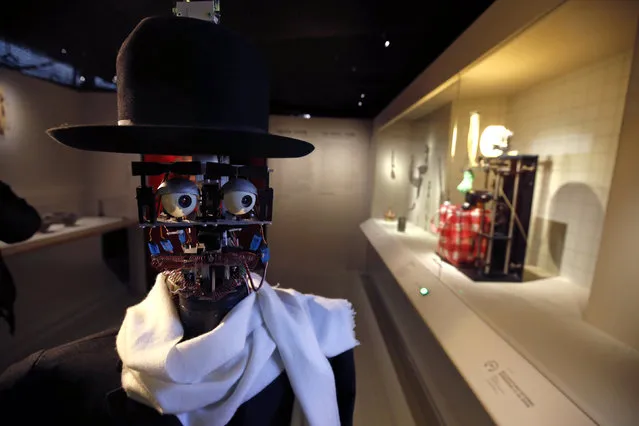
The Berenson robot strolls among visitors during the exhibition “Persona : Oddly Human” at the Quai Branly museum in Paris, France, February 23, 2016. The Berenson robot, developed in France in 2011, is the brainchild of anthropologist Denis Vidal and robotics engineer Philippe Gaussier. Its programming allows it to record reactions of museum visitors to certain pieces of art and then use the data to develop its own unique taste, which allows “Berenson” to judge whether or not it likes a certain work of art within an exhibition. (Photo by Philippe Wojazer/Reuters)

The Berenson robot strolls among visitors during the exhibition “Persona : Oddly Human” at the Quai Branly museum in Paris, France, February 23, 2016. The Berenson robot, developed in France in 2011, is the brainchild of anthropologist Denis Vidal and robotics engineer Philippe Gaussier. Its programming allows it to record reactions of museum visitors to certain pieces of art and then use the data to develop its own unique taste, which allows “Berenson” to judge whether or not it likes a certain work of art within an exhibition. (Photo by Philippe Wojazer/Reuters)
Details
25 Feb 2016 12:26:00
A local boy plays football on Iracema Beach on June 11, 2014 in Fortaleza, Brazil. (Photo by Robert Cianflone/Getty Images)

A local boy plays football on Iracema Beach on June 11, 2014 in Fortaleza, Brazil. (Photo by Robert Cianflone/Getty Images)
Details
17 Jun 2014 10:20:00