Loading...
Done
A Beijing Opera performer dances for a show by designer Hao Weimin at China Fashion Week, China, October 28, 2019. (Photo by Jason Lee/Reuters)

A Beijing Opera performer dances for a show by designer Hao Weimin at China Fashion Week, China, October 28, 2019. (Photo by Jason Lee/Reuters)
Details
30 Oct 2019 00:07:00
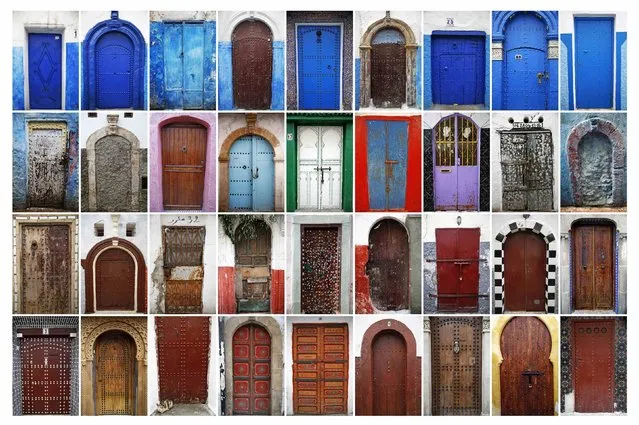
A combination photo shows some of the colourful doors seen in Rabat's Medina and Kasbah of the Udayas, September 2014. UNESCO made Rabat a World Heritage Site two years ago and media and tour operators call it a “must-see destination”. (Photo by Damir Sagolj/Reuters)

A combination photo shows some of the colourful doors seen in Rabat's Medina and Kasbah of the Udayas, September 2014. UNESCO made Rabat a World Heritage Site two years ago and media and tour operators call it a “must-see destination”. But it seems the tourist hordes have yet to find out. While visitors are getting squeezed through the better-known sites of Marrakesh and Fez, the old part of Rabat - with its beautiful Medina and Kasbah of the Udayas - remains an almost unspoiled oasis of calm. Smaller and more compact, its labyrinths of streets, passages and dead ends are a treasure trove of shapes and colours, of moments begging to be caught by the photographer's lens. (Photo by Damir Sagolj/Reuters)
Details
08 Oct 2014 12:08:00
A guard stands at Dityatki checkpoint, marking a 30 km (18-mile) zone around the Chernobyl nuclear power plant April 23, 2013. Ukraine will mark the 27th anniversary of the Chernobyl disaster, the world's worst civil nuclear accident, on April 26. (Photo by Gleb Garanich/Reuters)

A guard stands at Dityatki checkpoint, marking a 30 km (18-mile) zone around the Chernobyl nuclear power plant April 23, 2013. Ukraine will mark the 27th anniversary of the Chernobyl disaster, the world's worst civil nuclear accident, on April 26. (Photo by Gleb Garanich/Reuters)
Details
27 Apr 2013 09:27:00
U.S. President Barack Obama speaks at the foot of the Edmund Pettus Bridge in Selma, Alabama March 7, 2015. With a nod to ongoing U.S. racial tension and attempts to limit voting rights, Obama declared the work of the Civil Rights Movement advanced but unfinished on Saturday on a visit to the Alabama bridge that spawned a landmark voting law.  REUTERS/Tami Chappell  (UNITED STATES - Tags: POLITICS ANNIVERSARY SOCIETY)

U.S. President Barack Obama speaks at the foot of the Edmund Pettus Bridge in Selma, Alabama March 7, 2015. With a nod to ongoing U.S. racial tension and attempts to limit voting rights, Obama declared the work of the Civil Rights Movement advanced but unfinished on Saturday on a visit to the Alabama bridge that spawned a landmark voting law. REUTERS/Tami Chappell (UNITED STATES - Tags: POLITICS ANNIVERSARY SOCIETY)
Details
09 Mar 2015 13:51:00
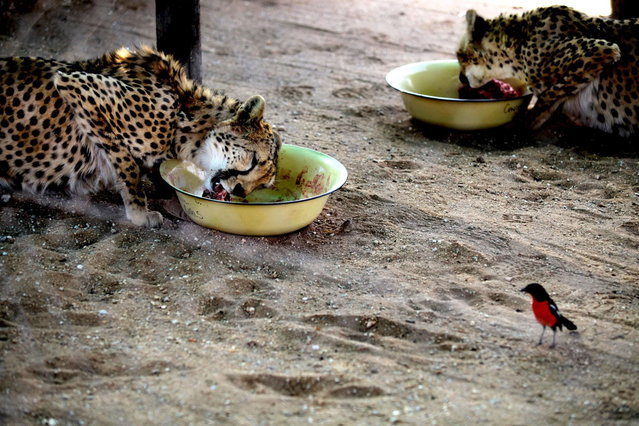
Young cheetahs eat meat at The Cheetah Conservation Fund (CCF) center in Otjiwarongo, Namibia, on August 13, 2013. The CCF started breeding Anatolian livestock dogs to promote cheetah-friendly farming after some 10,000 big cats – the current total worldwide population – were killed or moved off farms in the 1980s.  Up to 1,000 cheetahs were being killed a year, mostly by farmers who saw them as livestock killers. But the use of dogs has slashed losses for sheep and goat farmers and led to less retaliation against the vulnerable cheetah. (Photo by Jennifer Bruce/AFP Photo)

Young cheetahs eat meat at The Cheetah Conservation Fund (CCF) center in Otjiwarongo, Namibia, on August 13, 2013. The CCF started breeding Anatolian livestock dogs to promote cheetah-friendly farming after some 10,000 big cats – the current total worldwide population – were killed or moved off farms in the 1980s. Up to 1,000 cheetahs were being killed a year, mostly by farmers who saw them as livestock killers. But the use of dogs has slashed losses for sheep and goat farmers and led to less retaliation against the vulnerable cheetah. (Photo by Jennifer Bruce/AFP Photo)
Details
29 Aug 2013 10:56:00
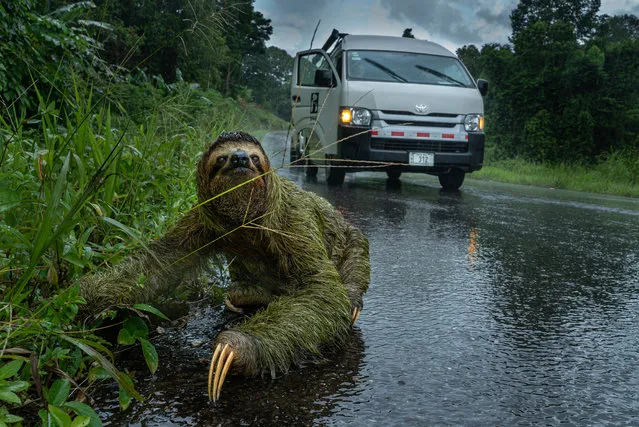
People and Nature category winner: Why did the sloth cross the road? by Andrew Whitworth (Osa Conservation and University of Glasgow), taken in Osa Peninsula, Costa Rica. “I was driving out from the Osa Peninsula, located on the southern Pacific coast of Costa Rica on a dark, stormy day. This female three-toed sloth (Bradypus variegatus) had luckily just about made it across the road, and the drivers of the Toyota on this occasion had spotted her in good time”. (Photo by Andrew Whitworth/2019 British Ecological Society Photography Competition)

People and Nature category winner: Why did the sloth cross the road? by Andrew Whitworth (Osa Conservation and University of Glasgow), taken in Osa Peninsula, Costa Rica. “I was driving out from the Osa Peninsula, located on the southern Pacific coast of Costa Rica on a dark, stormy day. This female three-toed sloth (Bradypus variegatus) had luckily just about made it across the road, and the drivers of the Toyota on this occasion had spotted her in good time”. (Photo by Andrew Whitworth/2019 British Ecological Society Photography Competition)
Details
30 Nov 2019 00:05:00
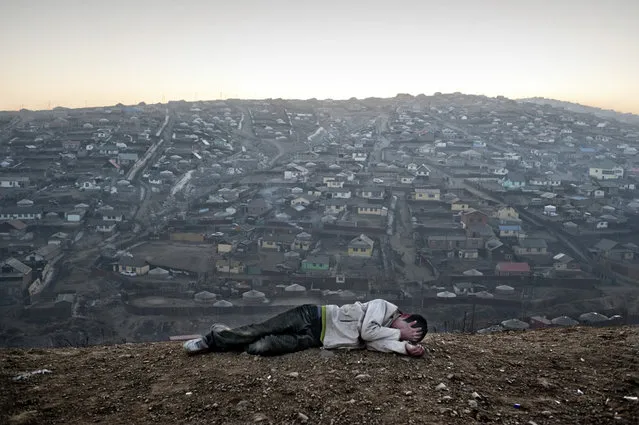
Asia, Mongolia, March 27, 2011. A view of Ulaan Baator over the shoulder of a slumbering drunk. Alcoholism is a huge problem in the city, home to almost half of Mongolia's people. The capital's population has doubled in the past two years, expanding outward in a haphazard sprawl, and many inhabitants live in slums known as the “Gher District”. (Photo by Alessandro Grassani)

“Environmental Migrants: The Last Illusion” by photographer Alessandro Grassani, documents the life of people in Kenya, Mongolia and Bangladesh who migrate to escape environmental stresses to the city of their own countries in hopes for a better life. Here: Asia, Mongolia, March 27, 2011. A view of Ulaan Baator over the shoulder of a slumbering drunk. Alcoholism is a huge problem in the city, home to almost half of Mongolia's people. The capital's population has doubled in the past two years. High levels of unemployment and poverty await herders who abandon rural areas and arrive in the city, illiterate and untrained in any skills necessary for urban jobs. (Photo by Alessandro Grassani)
Details
21 Jul 2015 10:10:00
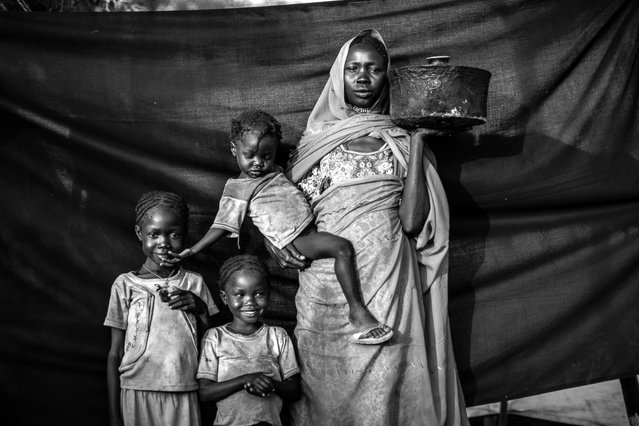
Magbola Alhadi, 20, and her three children pose for a portrait in Jamam refugee camp in Maban County, South Sudan on August 11th, 2012. Magboola and her family weathered aerial bombing raids for several months, but decided it was time to leave their village of Bofe the night that soldiers arrived and opened fire. (Photo by Brian Sokol/Panos Pictures)

Magbola Alhadi, 20, and her three children pose for a portrait in Jamam refugee camp in Maban County, South Sudan on August 11th, 2012. Magboola and her family weathered aerial bombing raids for several months, but decided it was time to leave their village of Bofe the night that soldiers arrived and opened fire. With her three children, she travelled for 12 days from Bofe to the town of El Fudj, on the South Sudanese border. The most important thing that Magboola was able to bring with her is the saucepan she holds in this photograph. It wasn't the largest pot that she had in Bofe, but it was small enough she could travel with it, yet big enough to cook sorghum for herself and her three daughters (from left: Aduna Omar, 6, Halima Omar, 4, and Arfa Omar, 2) during their journey. (Photo by Brian Sokol/Panos Pictures)

Details
18 Sep 2015 15:04:00