Loading...
Done
Venezuelan migrant and rap singer, Alfonso Mendoza aka "Alca", 25, practice with his skateboard in a park in Barranquilla, Colombia on September 28, 2018. Alca -who arrived in Colombia nine months ago due to the crisis in his country- was born without legs and changed the wheelchair for a skateboard. At present, he is an example of overcoming adversity, practicing extreme sports, singing rap and giving conferences to young people in vulnerable situations. (Photo by Raul Arboleda/AFP Photo)

Venezuelan migrant and rap singer, Alfonso Mendoza aka “Alca”, 25, practice with his skateboard in a park in Barranquilla, Colombia on September 28, 2018. Alca -who arrived in Colombia nine months ago due to the crisis in his country- was born without legs and changed the wheelchair for a skateboard. At present, he is an example of overcoming adversity, practicing extreme sports, singing rap and giving conferences to young people in vulnerable situations. (Photo by Raul Arboleda/AFP Photo)
Details
07 Oct 2018 00:07:00
Roof-topping enthusiast Daniel Lau takes a selfie with high-rise buildings down below as he stands on the top of a skyscraper in Hong Kong, China on August 15, 2017. Welcome to “roof-topping”, where daredevils take pictures of themselves standing on the tops of tall buildings, or in some cases even dangling from them, without any safety equipment. A craze that began in Russia has now taken hold in Hong Kong, one of the world's most vertical cities, with dramatic results. “I'm an explorer”, said Daniel Lau, one of the three who climbed to the top of The Center. A student, he said roof-topping was “a getaway from my structured life”. “Before doing this, I lived like an ordinary person, having a boring life”, he said. “I wanted to do something special, something memorable. I want to let people see Hong Kong, the place they are living, from a new perspective”. Mr Lau said he had been inspired by Russian climbers and that he was unafraid of the vertiginous heights he scales. (Photo by ImagineChina/Rex Features/Shutterstock)

Roof-topping enthusiast Daniel Lau takes a selfie with high-rise buildings down below as he stands on the top of a skyscraper in Hong Kong, China on August 15, 2017. A craze that began in Russia has now taken hold in Hong Kong, one of the world's most vertical cities. Mr Lau said he had been inspired by Russian climbers and that he was unafraid of the vertiginous heights he scales. (Photo by ImagineChina/Rex Features/Shutterstock)
Details
16 Aug 2017 07:23:00
Two women in traditional kimonos wear face masks to help curb the spread of the coronavirus as they visit the Sensoji temple in Tokyo on Friday, August 7, 2020. (Photo by Hiro Komae/AP Photo)

Two women in traditional kimonos wear face masks to help curb the spread of the coronavirus as they visit the Sensoji temple in Tokyo on Friday, August 7, 2020. (Photo by Hiro Komae/AP Photo)
Details
03 Sep 2020 00:01:00
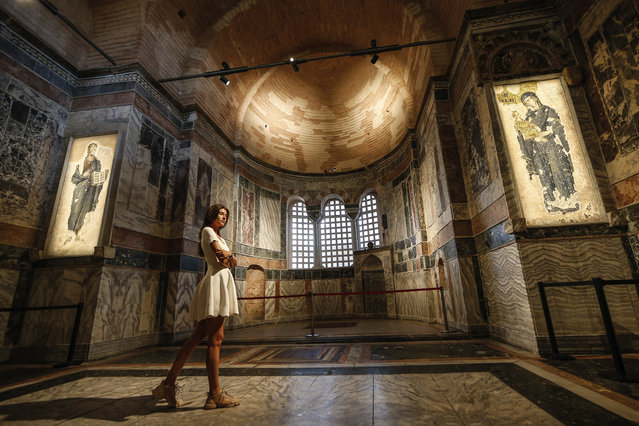
A woman visits St Savior in Chora church, known as Kariye in Turkish, in Istanbul, Friday, August 21, 2020. Turkey on Friday formally converted former Byzantine church, St Savior in Chora, into a mosque, a month after it similarly turned Istanbul's landmark Hagia Sophia into a Muslim house of prayer, drawing international rebuke. (Photo by Emrah Gurel/AP Photo)

A woman visits St Savior in Chora church, known as Kariye in Turkish, in Istanbul, Friday, August 21, 2020. Turkey on Friday formally converted former Byzantine church, St Savior in Chora, into a mosque, a month after it similarly turned Istanbul's landmark Hagia Sophia into a Muslim house of prayer, drawing international rebuke. (Photo by Emrah Gurel/AP Photo)
Details
09 Sep 2020 00:05:00
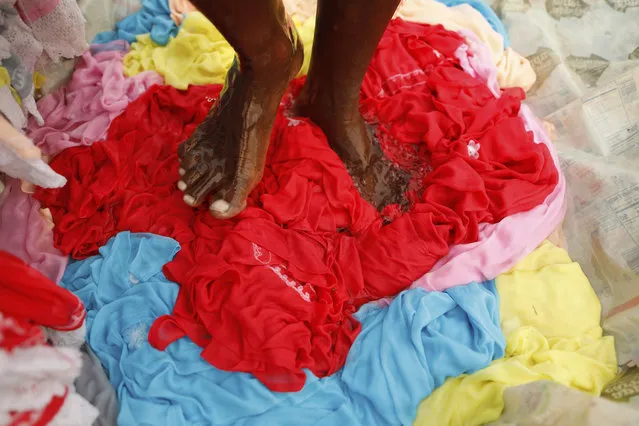
A dhobi, or a washerman washes cloths on the banks of the River Gomti in Lucknow, India, Saturday, September 12, 2020. Dhobis are traditional laundry workers who wash clothes by hand and dry them in the sun, an occupation which has been in existence for generations. Most cities in India have a Dhobi Ghat, or washermen's area, where the city's pile of clothes is laundered. This practice is still popular in India, despite of modern technology. Around 1,000 families work in Lucknow's Dhobi Ghat. However, in light of the novel coronavirus, their wages have decreased drastically. With each family earning around US$100-200 per month. (Photo by Rajesh Kumar Singh/AP Photo)

A dhobi, or a washerman washes cloths on the banks of the River Gomti in Lucknow, India, Saturday, September 12, 2020. Dhobis are traditional laundry workers who wash clothes by hand and dry them in the sun, an occupation which has been in existence for generations. Most cities in India have a Dhobi Ghat, or washermen's area, where the city's pile of clothes is laundered. This practice is still popular in India, despite of modern technology. Around 1,000 families work in Lucknow's Dhobi Ghat. However, in light of the novel coronavirus, their wages have decreased drastically. With each family earning around US$100-200 per month. (Photo by Rajesh Kumar Singh/AP Photo)
Details
25 Sep 2020 00:03:00
This picture taken on October 10, 2020 and released from North Korea's official Korean Central News Agency (KCNA) on October 11, 2020 shows the military parade during a ceremony to mark the 75th anniversary of the Workers' Party of Korea at Kim Il-sung Square of Pyongyang. (Photo by KCNA via KNS/AFP Photo)

This picture taken on October 10, 2020 and released from North Korea's official Korean Central News Agency (KCNA) on October 11, 2020 shows the military parade during a ceremony to mark the 75th anniversary of the Workers' Party of Korea at Kim Il-sung Square of Pyongyang. (Photo by KCNA via KNS/AFP Photo)
Details
12 Oct 2020 00:05:00
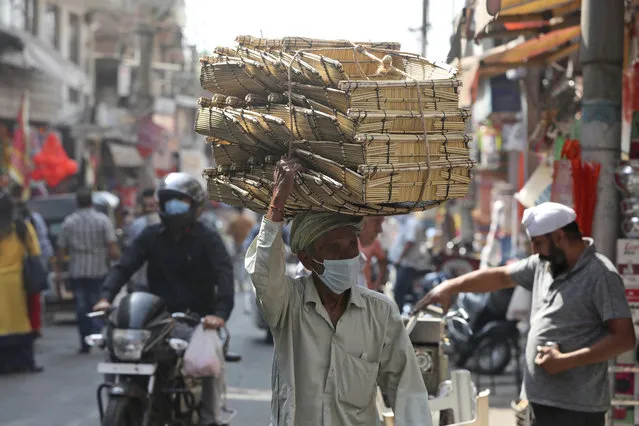
An Indian villager wearing a face mask as a precaution against the coronavirus sells his ware at market in Jammu, India, Friday, October 9, 2020. (Photo by Channi Anand/AP Photo)

An Indian villager wearing a face mask as a precaution against the coronavirus sells his ware at market in Jammu, India, Friday, October 9, 2020. (Photo by Channi Anand/AP Photo)
Details
14 Oct 2020 00:05:00
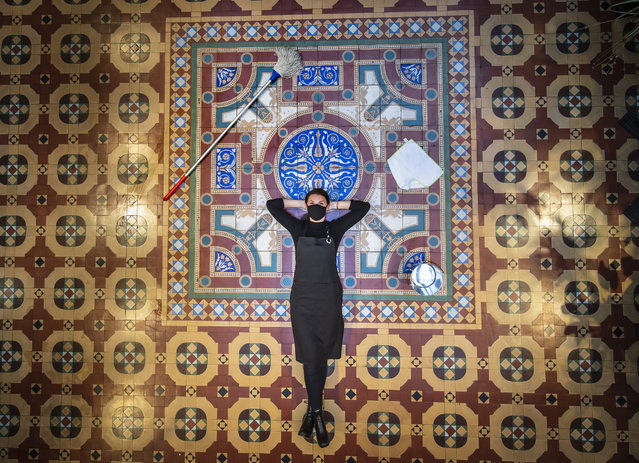
Bar Convent employee Lauren Masterman relaxes after cleaning a historic George and Arthur Maw tiled floor created in 1867, one of only two surviving examples of this assemblage of tiles, at England's oldest living convent Bar Convent on October 13, 2020. Visitors to the convent are being invited to follow in the footsteps of residents from the last 150 years and enjoy the historic space decorated with rare 19th century floor tiles. (Photo by Danny Lawson/PA Images via Getty Images)

Bar Convent employee Lauren Masterman relaxes after cleaning a historic George and Arthur Maw tiled floor created in 1867, one of only two surviving examples of this assemblage of tiles, at England's oldest living convent Bar Convent on October 13, 2020. Visitors to the convent are being invited to follow in the footsteps of residents from the last 150 years and enjoy the historic space decorated with rare 19th century floor tiles. (Photo by Danny Lawson/PA Images via Getty Images)
Details
15 Oct 2020 00:07:00