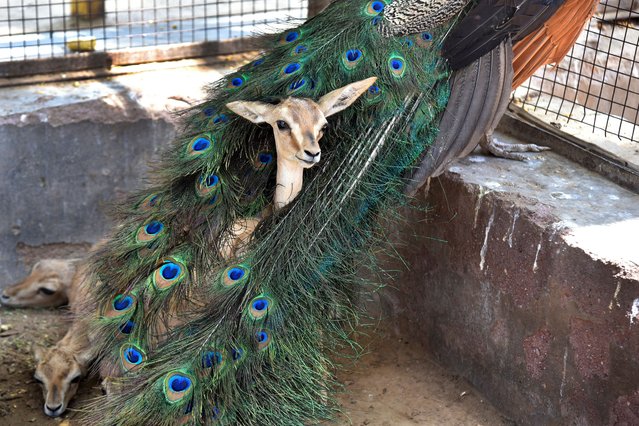
A Chinkara gazelle fawn rests in the plumage of a peacock at an animal rescue center on a hot summer day in Bikaner, Rajasthan, India, Thursday, May 23, 2024. (Photo by Dinesh Gupta/AP Photo)
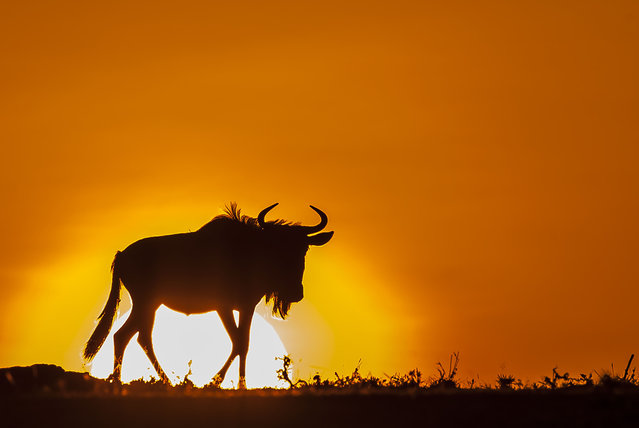
These images show off some of the world's most majestic creatures silhouetted against the beautiful rising and setting sun. The vibrant pictures feature a variety of animals in the wild and were taken by a host of photographers at locations around the world. The striking images all have one thing in common: the photographers' awe-inspiring ability to perfectly capture the silhouettes of earth's beautiful creatures. Here: a blue wildebeest moves through grassland at dawn with the sun in the background in Mara Naboisho Conservancy, Kenya, Africa. (Photo by Renato Granieri/Caters News/Ardea)
A security guard walks past a giant Doctor Who poster at the “Doctor Who 50th Celebration” event in the ExCeL centre on November 22, 2013 in London, England. The sold-out three day event in the ExCeL London convention centre celebrates 50 years of the show which has seen 11 actors play the role of Doctor Who and receives a worldwide cult following. (Photo by Oli Scarff/Getty Images)
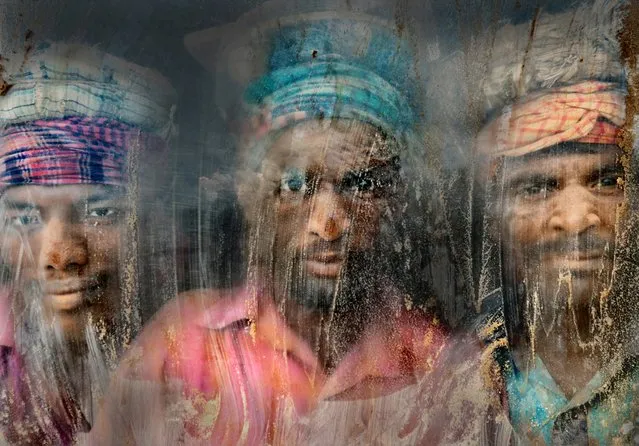
From Tibetan monks playing basket ball with ice thawing high up in the Himalayas, to the pollution that hides behind the Taj Mahal, here’s pick from 60 exceptional environmental photographs, by photographers and filmmakers from 70 countries, that will go on show at the Royal Geographical Society in London from 29 June to 21 August. The winners will be announced on 28 June. Here: Gravel Workmen of Chittagong, Bangladesh, by Faisal Azim. Gravel workmen look through a glass window at a gravel-crushing yard in Chittagong. Full of dust and sand, it is an extremely unhealthy environment for working, but still hundreds of people work here for their livelihoods. (Photo by Faisal Azim/2016 Atkins CIWEM Environmental Photographer of the Year)
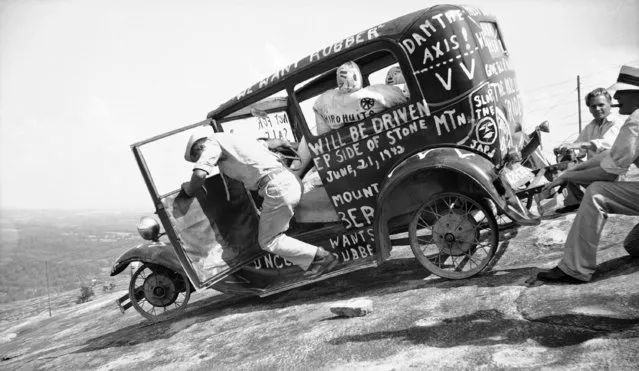
Hitler, Hirohito and Mussolini, in effigy, are about to take a mile-high plunge over Stone Mountain, near Atlanta, Georgia, June 21, 1942, as part of the scrap rubber drive. Private Elias Nour, who arranged the stunt as a farewell party on the eve of his entrance into the army, is on the running board. He guided as the “Axis” plunged to destruction. Spectators had to give a scrap of rubber as the price of admission to the spectacle. (Photo by AP Photo)
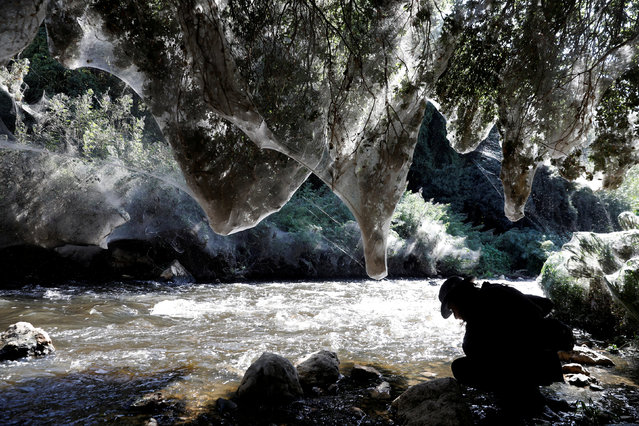
Igor Armicach, a doctoral student at Hebrew University's Arachnid Collection, looks onto giant spider webs, spun by long-jawed spiders (Tetragnatha), covering sections of the vegetation along the Soreq creek bank, near Jerusalem, Israel on November 7, 2017. (Photo by Ronen Zvulun/Reuters)
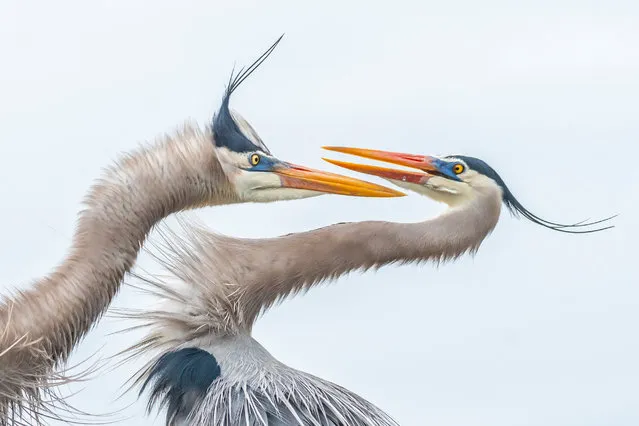
Wakodahatchee wetlands, Delray Beach, Florida, US. Equipped with sinewy necks and spear-like bills, great blue herons can lunge with fearsome speed to strike their aquatic prey. Adults will also employ rapid stabbing motions as one aspect of their complex courtship displays; they’re seemingly dangerous moves, but fitting to the intensity of mating season. (Photo by Melissa Rowell/Audubon Photography Awards)
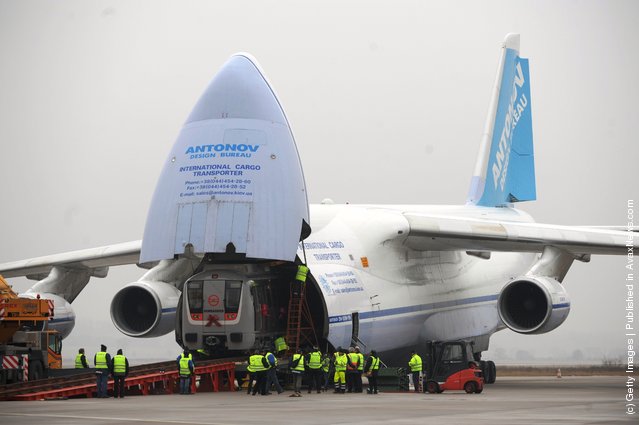
“The Antonov An-124 Ruslan (NATO reporting name: Condor) is a strategic airlift jet aircraft. It was designed by the Soviet Union's Antonov design bureau. It is the world's largest ever serially-manufactured cargo airplane and world's second largest operating cargo aircraft. During development it was known as Izdeliye 400 in house, and An-40 in the West. First flown in 1982, civil certification was issued on 30 December 1992”. – Wikipedia
Photo: The new metro called “Bombardier MOVIA” with 22,50 meters long and 3,2 meters wide is load on a Antonow An-124 plane for transport to India on February 25, 2009 in Parchim, Germany. (Photo Handout Bombardier Transportation via Getty Images)