Loading...
Done
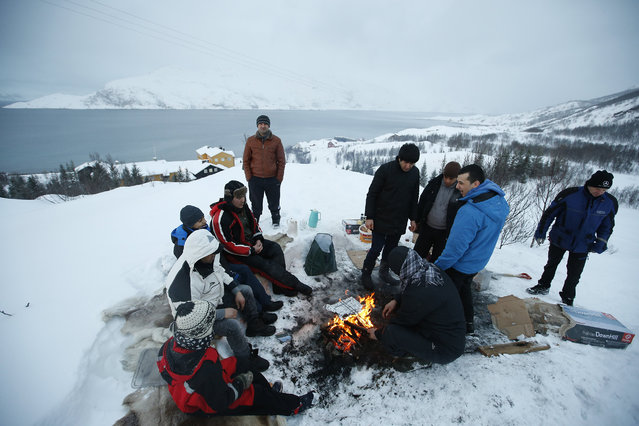
In this photo taken Tuesday, February 2, 2016, asylum seekers gather round a fire as they cook a meal overlooking the temporary Altnes camp refugee camp on the island of Seiland, northern Norway. (Photo by Alastair Grant/AP Photo)

In this photo taken Tuesday, February 2, 2016, asylum seekers gather round a fire as they cook a meal overlooking the temporary Altnes camp refugee camp on the island of Seiland, northern Norway. Waiting for their asylum claims to be processed, hundreds of people in emergency shelters in Hammerfest and neighboring towns are slowly getting used to the extreme climate and unfamiliar customs of the High North. They say they have adapted to the cold – the temperature rarely drops below minus 10 degrees C (14 F) along the coast, though it gets much colder further inland. It’s the darkness that throws them off. (Photo by Alastair Grant/AP Photo)
Details
18 Feb 2016 13:22:00
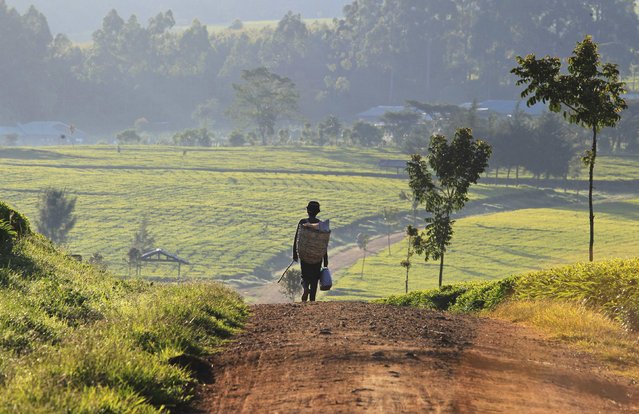
A man walks in the early morning to start his day picking tea leaves at a plantation in Nandi Hills, in Kenya's highlands region west of capital Nairobi, November 5, 2014. Emerald-coloured tea bushes blanketing the rolling hills of Nandi County have long provided a livelihood for small-scale farmers, helping make Kenya one of the world's biggest tea exporters. But ideal weather and bigger harvests, instead of producing bumper earnings, have led to a glut of Kenya's speciality black tea. (Photo by Noor Khamis/Reuters)

A man walks in the early morning to start his day picking tea leaves at a plantation in Nandi Hills, in Kenya's highlands region west of capital Nairobi, November 5, 2014. Emerald-coloured tea bushes blanketing the rolling hills of Nandi County have long provided a livelihood for small-scale farmers, helping make Kenya one of the world's biggest tea exporters. But ideal weather and bigger harvests, instead of producing bumper earnings, have led to a glut of Kenya's speciality black tea. (Photo by Noor Khamis/Reuters)

Details
17 Nov 2014 12:44:00
People struggle with the wind as they cross the street under the rain as typhoon Mitag is expected to hit northern Taiwan, in Keelung, Taiwan, 30 September 2019. According to report, Typhoon Mitag will disrupt air, land and water traffic. Mitag is located at sea about 290 kilometers off the south-southeast of Yilan County, moving at 27 kilometers per hour at a northwesterly direction, with maximum sustained winds of 126 kilometers per hour, with gusts of up to 162 kilometers per hour, and with a radius of 180 kilometers, according to Taiwan Central Weather Bureau. (Photo by Ritchie B. Tongo/EPA/EFE/Rex Features/Shutterstock)

People struggle with the wind as they cross the street under the rain as typhoon Mitag is expected to hit northern Taiwan, in Keelung, Taiwan, 30 September 2019. According to report, Typhoon Mitag will disrupt air, land and water traffic. Mitag is located at sea about 290 kilometers off the south-southeast of Yilan County, moving at 27 kilometers per hour at a northwesterly direction, with maximum sustained winds of 126 kilometers per hour, with gusts of up to 162 kilometers per hour, and with a radius of 180 kilometers, according to Taiwan Central Weather Bureau. (Photo by Ritchie B. Tongo/EPA/EFE/Rex Features/Shutterstock)
Details
02 Oct 2019 00:05:00
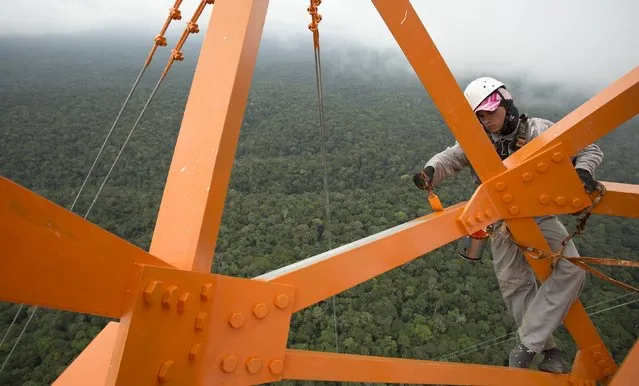
A worker paints the Amazon Tall Tower Observatory (ATTO) in Sao Sebastiao do Uatuma in the middle of the Amazon forest in Amazonas state January 10, 2015. (Photo by Bruno Kelly/Reuters)

A worker paints the Amazon Tall Tower Observatory (ATTO) in Sao Sebastiao do Uatuma in the middle of the Amazon forest in Amazonas state January 10, 2015. The Amazon Tall Tower Observatory is a project of Brazil's National Institute of Amazonian Research and Germany's Max Planck Institute and will be equipped with high-tech instruments and an observatory to monitor relationships between the jungle and the atmosphere from next July. According to the institutes, ATTO will gather data on heat, water, carbon gas, winds, cloud formation and weather patterns. (Photo by Bruno Kelly/Reuters)
Details
14 Jan 2015 12:39:00
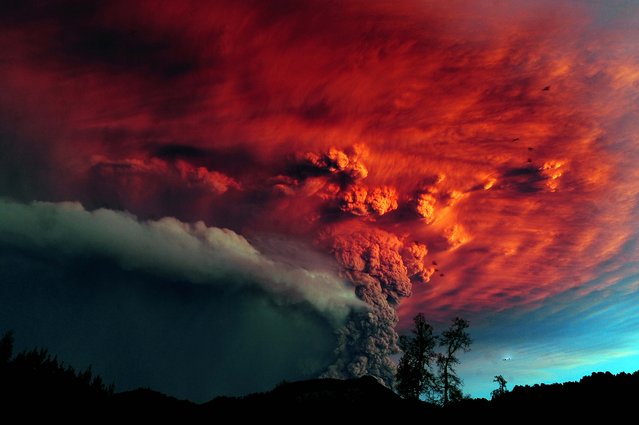
A cloud of ash pours from Puyehue volcano in southern Chile, at sunset on June 5, 2011

“A dirty thunderstorm (also, Volcanic lightning) is a weather phenomenon that occurs when lightning is produced in a volcanic plume. Dirty thunderstorms have been reported in Chile above the Chaiten Volcano, above Alaska's Mount Augustine volcano, and Iceland's Eyjafjallajökull volcano”.

Photo: A cloud of ash pours from Puyehue volcano in southern Chile, at sunset on June 5, 2011. (Claudio Santana/AFP)
Details
15 May 2012 11:31:00
This area of the hospital was last used as a day care center in the early 2000s. (Photo by Will Ellis/Caters News)

A spooky sight to behold! This is what a psychiatric hospital that has been abandoned for years looks like. Complete with bowling alley and a theater, the hospital shows just how much nature has weathered it over time as paint peels from the walls and the mattress gather dust. Here: This area of the hospital was last used as a day care center in the early 2000s. (Photo by Will Ellis/Caters News)
Details
03 Dec 2015 08:01:00
The spinning vortex of Saturn's north polar storm resembles a deep red rose of giant proportions surrounded by green foliage in this false-color image from NASA's Cassini spacecraft. (Photo by NASA/JPL-Caltech/SSI)

NASA's Cassini spacecraft has provided scientists the first close-up, visible-light views of a behemoth hurricane swirling around Saturn's north pole. In high-resolution pictures and video, scientists see the hurricane's eye is about 1,250 miles (2,000 kilometers) wide, 20 times larger than the average hurricane eye on Earth. Thin, bright clouds at the outer edge of the hurricane are traveling 330 mph(150 meters per second). The hurricane swirls inside a large, mysterious, six-sided weather pattern known as the hexagon. Photo: The spinning vortex of Saturn's north polar storm resembles a deep red rose of giant proportions surrounded by green foliage in this false-color image from NASA's Cassini spacecraft. (Photo by NASA/JPL-Caltech/SSI)
Details
31 May 2015 09:11:00
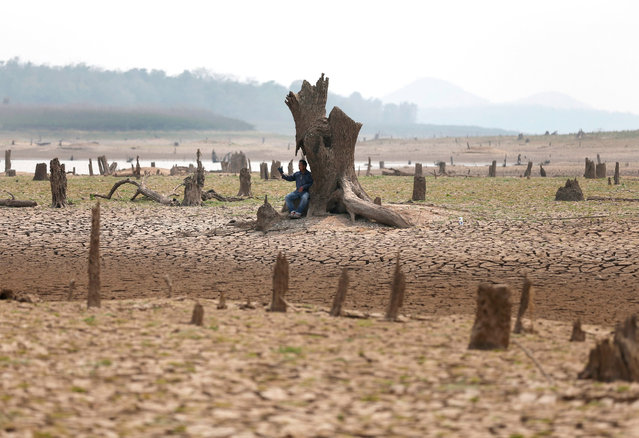
A photo made available on 14 March 2016 shows a Thai villager takes selfie photograph on drought parched land at the dried up Mae Chang reservoir in Lampang province, northern Thailand, 12 March 2016. The ruined village including ancient temple had been underwater for 34 years since the Mae Chang reservoir was built in 1982, the area has now re-emerged after water in the reservoir dried up caused by the severe drought. Thailand is facing the worst drought in decades hardest hit by El Nino phenomenon combined with seasonal hot weather. (Photo by Rungroj Yongrit/EPA)

A photo made available on 14 March 2016 shows a Thai villager takes selfie photograph on drought parched land at the dried up Mae Chang reservoir in Lampang province, northern Thailand, 12 March 2016. The ruined village including ancient temple had been underwater for 34 years since the Mae Chang reservoir was built in 1982, the area has now re-emerged after water in the reservoir dried up caused by the severe drought. Thailand is facing the worst drought in decades hardest hit by El Nino phenomenon combined with seasonal hot weather. (Photo by Rungroj Yongrit/EPA)
Details
28 Apr 2016 11:51:00