Loading...
Done
The Royal Castle is seen a veil of heavy winter smog in Budapest, Hungary January 30, 2017. (Photo by Laszlo Balogh/Reuters)

The Royal Castle is seen a veil of heavy winter smog in Budapest, Hungary on January 30, 2017. (Photo by Laszlo Balogh/Reuters)
Details
20 Dec 2019 00:03:00
This photo taken on October 23, 2022 shows a soap bubble reflecting the Namsan Seoul Tower at Namsan Park in Seoul, South Korea. (Photo by Xinhua News Agency/Rex Features/Shutterstock)

This photo taken on October 23, 2022 shows a soap bubble reflecting the Namsan Seoul Tower at Namsan Park in Seoul, South Korea. (Photo by Xinhua News Agency/Rex Features/Shutterstock)
Details
13 Jun 2024 02:53:00
Jellyfish with a juvenile imperial blackfish (Schedophilus ovalis) in Castellammare di Stabia, Naples, Italy, winter 2023. (Photo by Marco Gargiulo/Media Drum Images)

Jellyfish with a juvenile imperial blackfish (Schedophilus ovalis) in Castellammare di Stabia, Naples, Italy, winter 2023. (Photo by Marco Gargiulo/Media Drum Images)
Details
02 Aug 2024 04:20:00
An opposition fighter from the Failaq al-Rahman brigade fires a heavy machine gun in Jobar, a rebel-held district on the eastern outskirts of the Syrian capital Damascus, on March 19, 2017. (Photo by Amer Almohibany/AFP Photo)

An opposition fighter from the Failaq al-Rahman brigade fires a heavy machine gun in Jobar, a rebel-held district on the eastern outskirts of the Syrian capital Damascus, on March 19, 2017. (Photo by Amer Almohibany/AFP Photo)
Details
02 Apr 2017 10:11:00
Ryon Healy #25 of the Oakland Athletics is covered in water by Adam Rosales #16 after he hit a walk-off home run in the ninth inning against the Detroit Tigers at Oakland Alameda Coliseum on May 7, 2017 in Oakland, California. (Photo by Ezra Shaw/Getty Images)

Ryon Healy #25 of the Oakland Athletics is covered in water by Adam Rosales #16 after he hit a walk-off home run in the ninth inning against the Detroit Tigers at Oakland Alameda Coliseum on May 7, 2017 in Oakland, California. (Photo by Ezra Shaw/Getty Images)
Details
27 Dec 2017 07:04:00
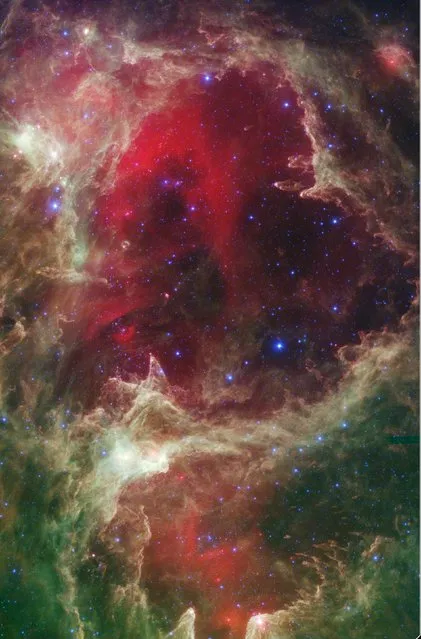
An infrared portrait from NASA's Spitzer Space Telescope which shows generations of stars is seen in this undated NASA handout image released February 14, 2013. In this wispy star-forming region, called W5, the oldest stars can be seen as blue dots in the centers of the two hollow cavities (other blue dots are background and foreground stars not associated with the region). Red shows heated dust that pervades the region's cavities, while green highlights dense clouds. (Photo by NASA/Reuters/JPL-Caltech/Harvard-Smithsonian/Handout)

An infrared portrait from NASA's Spitzer Space Telescope which shows generations of stars is seen in this undated NASA handout image released February 14, 2013. In this wispy star-forming region, called W5, the oldest stars can be seen as blue dots in the centers of the two hollow cavities (other blue dots are background and foreground stars not associated with the region). Red shows heated dust that pervades the region's cavities, while green highlights dense clouds. (Photo by NASA/Reuters/JPL-Caltech/Harvard-Smithsonian/Handout)
Details
03 Mar 2013 08:44:00


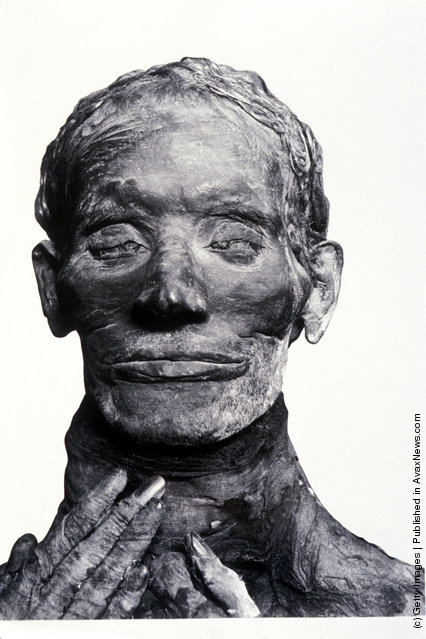
The mummy of Yuya thought by some to be Josua who, after Moses, led the Hebrews into the Promised land and logically would be the father-in-law of Amenophis III, at Cairo Museum, Egypt. (Photo by Patrick Landmann/Cairo Museum/Getty Images)
Details
22 Apr 2011 08:47:00
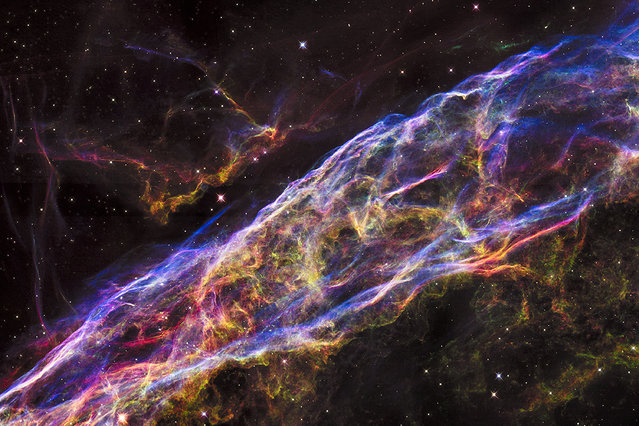
A small section of the expanding remains of the Veil Nebula, a massive star that exploded about 8,000 years ago. The entire nebula is 110 light-years across, covering six full moons on the sky as seen from Earth, and resides about 2,100 light-years away in the constellation Cygnus, the Swan. Image taken by NASA's Hubble Space Telescope. Released September 24, 2015. (Photo by Reuters/NASA/ESA/Hubble Heritage Team)


A small section of the expanding remains of the Veil Nebula, a massive star that exploded about 8,000 years ago. The entire nebula is 110 light-years across, covering six full moons on the sky as seen from Earth, and resides about 2,100 light-years away in the constellation Cygnus, the Swan. Image taken by NASA's Hubble Space Telescope. Released September 24, 2015. (Photo by Reuters/NASA/ESA/Hubble Heritage Team)

Details
10 Dec 2015 08:01:00