Loading...
Done
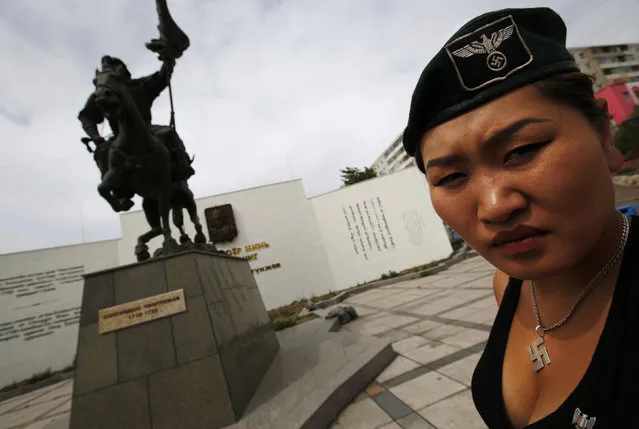
Uranjargal, a leader of the Mongolian neo-Nazi group Tsagaan Khass, stands next to a statue of Chingunjav, a Mongolian national hero, in Ulan Bator June 22, 2013. (Photo by Carlos Barria/Reuters)

Uranjargal, a leader of the Mongolian neo-Nazi group Tsagaan Khass, stands next to a statue of Chingunjav, a Mongolian national hero, in Ulan Bator June 22, 2013. The group has rebranded itself as an environmentalist organisation fighting pollution by foreign-owned mines, seeking legitimacy as it sends Swastika-wearing members to check mining permits. Over the past years, ultra-nationalist groups have expanded in the country and among those garnering attention is Tsagaan Khass, which has recently shifted its focus from activities such as attacks on women it accuses of consorting with foreign men to environmental issues, with the stated goal of protecting Mongolia from foreign mining interests. This ultra-nationalist group was founded in the 1990s and currently has 100-plus members. (Photo by Carlos Barria/Reuters)
Details
09 Jul 2013 07:23:00
Black women in Brazil sit at the intersection of racism and misogyny, and have in recent years been at the forefront of a movement that challenges issues ranging from sexual and domestic violence to police brutality and stereotyping. Kolor Collective considers itself to be a part of this movement and questions expectations imposed on black women with satirical and subversive images, as seen here. (Photo by Kolor Art Collective/The Guardian)

Photographer Pol Kurucz’s vivid collection of photos explores issues faced by black Brazilian women, from political misrepresentation to unrealistic beauty standards. Kolor Collective is a Rio de Janeiro-based creative group that challenges the struggle faced by black women in Brazil through theatrical and provocative art. It was founded in 2015 by Franco-Hungarian photographer Pol Kurucz, who often touches on his own experiences of discrimination to call out sensitive social problems. (Photo by Kolor Art Collective/The Guardian)
Details
28 Dec 2016 07:24:00
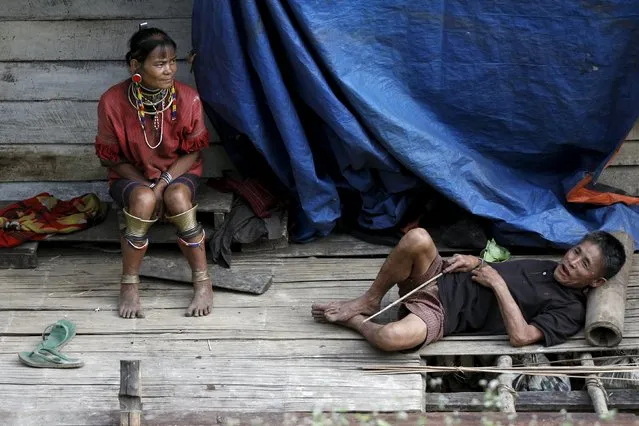
An ethnic Kayaw couple Mu Htoo and her husband Htaw Eili rest at their home at Htaykho village in the Kayah state, Myanmar September 12, 2015. (Photo by Soe Zeya Tun/Reuters)

An ethnic Kayaw couple Mu Htoo and her husband Htaw Eili rest at their home at Htaykho village in the Kayah state, Myanmar September 12, 2015. With about 30,000 members, the Kayaw are one of the smallest ethnic minorities among Myanmar's 135 groups. Their village has for decades been off-limits, as armed rebels fought the military before a recent ceasefire stopped the bloody conflict here. The rebels in the area have put down their guns and taken to the hills to grow rice and corn, but slash-and-burn cultivation methods mean they struggle to find new places to farm. (Photo by Soe Zeya Tun/Reuters)
Details
21 Oct 2015 08:03:00
Florin Bors, aged 8 from Bacau, northern Romania, wearing a bear fur takes a break from performing a holiday season ritual in Bucharest, Romania, Tuesday, December 16, 2014. In pre-Christian rural traditions, dancers wearing colored costumes or animal furs, touring house to house in villages singing and dancing to ward off evil. (Photo by Octav Ganea/AP Photo/Mediafax)

Florin Bors, aged 8 from Bacau, northern Romania, wearing a bear fur takes a break from performing a holiday season ritual in Bucharest, Romania, Tuesday, December 16, 2014. In pre-Christian rural traditions, dancers wearing colored costumes or animal furs, touring house to house in villages singing and dancing to ward off evil. In recent years following the economic downturn in Romania, a European Union member since 2007, the tradition has moved to Romania's cities where dancers travel to perform the ritual for money. (Photo by Octav Ganea/AP Photo/Mediafax)
Details
20 Dec 2014 12:07:00
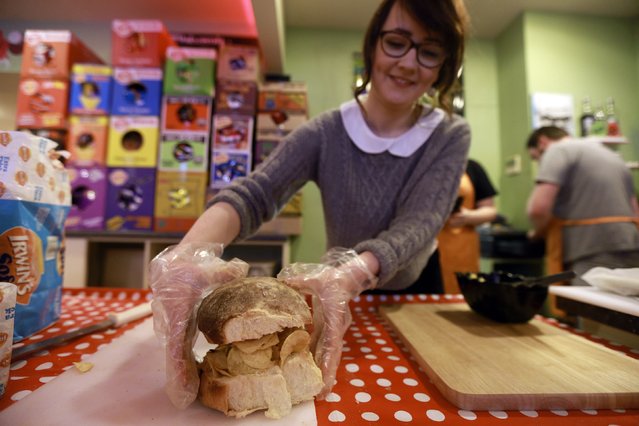
A member of staff prepares herself a crisp sandwich in the Simply Crispy sandwich cafe in Belfast, northern Ireland January 12, 2015. The sandwich shop which opened on Monday is the world's first crisp sandwich cafe, local media reported. The idea of a crisp sandwich cafe started as a joke article on a website called Ulster Fry.(Photo by Cathal McNaughton/Reuters)

A member of staff prepares herself a crisp sandwich in the Simply Crispy sandwich cafe in Belfast, northern Ireland January 12, 2015. The sandwich shop which opened on Monday is the world's first crisp sandwich cafe, local media reported. The idea of a crisp sandwich cafe started as a joke article on a website called Ulster Fry. The hilarious piece poked fun at recent ridiculous foody trends like the cereal café that opened in London last year. What was once a satirical joke has now become reality, after Belfast cafe owner Andrew McMenamin decided to make it happen. Customers will be able to choose their bread and crisps and add cheese or ham to their sandwich, which will be served with soup and chips. (Photo by Cathal McNaughton/Reuters)
Details
13 Jan 2015 13:41:00
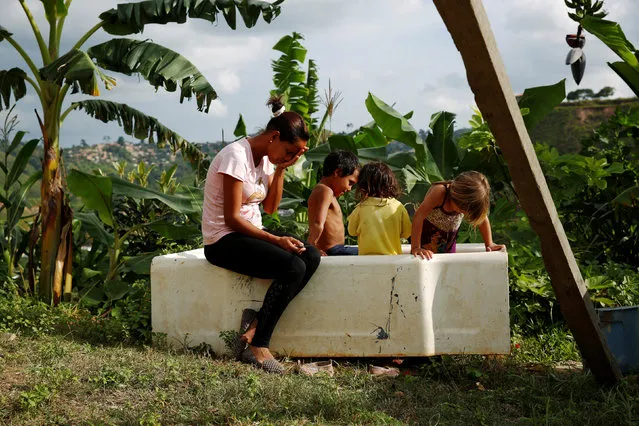
Lisibeht Martinez (L), 30, who was sterilized one year ago, sits next to her children while they play in a bathtub in the backyard of their house in Los Teques, Venezuela July 19, 2016. (Photo by Carlos Garcia Rawlins/Reuters)

Venezuela's food shortages, inflation and crumbling medical sector have become such a source of anguish that a growing number of young women are reluctantly opting for sterilizations rather than face the hardship of pregnancy and child-rearing. Traditional contraceptives like condoms or birth control pills have virtually vanished from store shelves, pushing women towards the hard-to-reverse surgery. While no recent national statistics on sterilizations are available, doctors and health workers say demand for the procedure is growing. (Photo by Carlos Garcia Rawlins/Reuters)
Details
04 Aug 2016 12:22:00
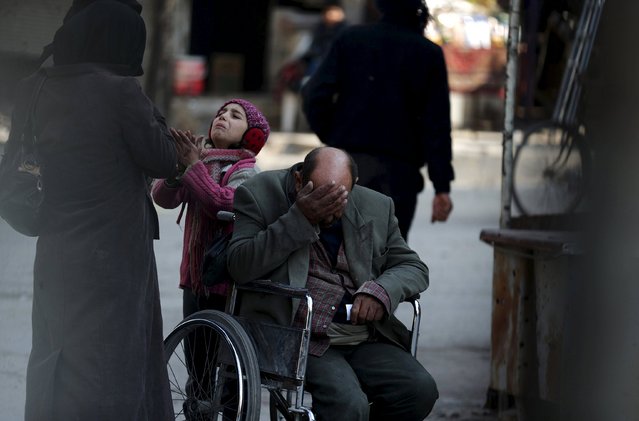
A girl asks a passerby for help to pay a medical bill as her father sits in his wheelchair in the Douma neighbourhood of Damascus Syria February 3, 2016. (Photo by Bassam Khabieh/Reuters)

Hadeel, 10, asks a passerby for help to pay a medical bill as her father Shahrour, 54, sits in his wheelchair in the Douma neighbourhood of Damascus Syria February 3, 2016. Shahrour said he developed diabetes at the beginning of the war in Syria. A lack of insulin led to his medical condition worsening and his right foot had to be amputated. Recently he also suffered a stroke that paralysed half his face. He and part of his extended family, a total of 18 people, live together and struggle to get by. (Photo by Bassam Khabieh/Reuters)
Details
12 Feb 2016 12:46:00
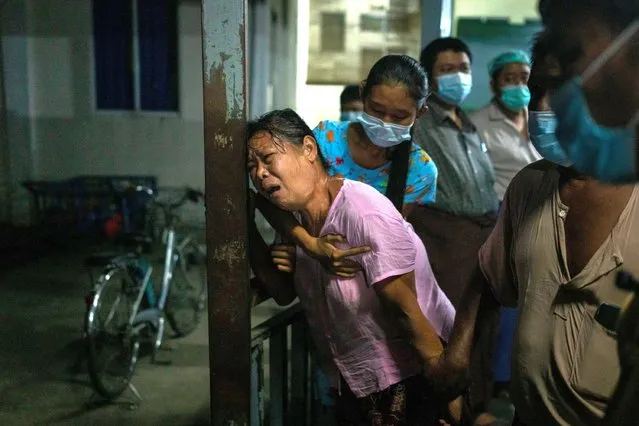
The mother of a protester mourns at a hospital after her son was killed was killed during clashes on March 03, 2021 in Yangon, Myanmar. Medics and health workers have found themselves on the front lines and under intense pressure, as they try to help anti-coup protesters as resistance continues to erupt across the country, to be met with deadly force by the military junta. The military government has intensified a crackdown on protesters in recent days, using tear gas and live ammunition, charging at and arresting protesters and journalists. At least 25 people have been killed so far, according to monitoring organizations, leaving ill-equipped medics to help scores of the injured. (Photo by Stringer/Getty Images)

The mother of a protester mourns at a hospital after her son was killed was killed during clashes on March 03, 2021 in Yangon, Myanmar. Medics and health workers have found themselves on the front lines and under intense pressure, as they try to help anti-coup protesters as resistance continues to erupt across the country, to be met with deadly force by the military junta. (Photo by Stringer/Getty Images)
Details
04 Mar 2021 08:45:00