Loading...
Done
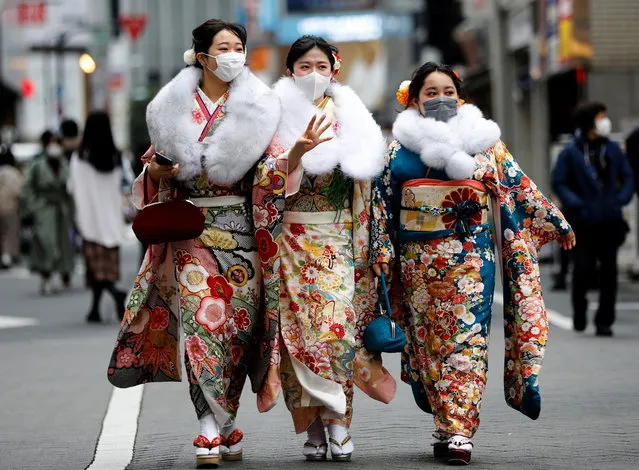
Women wearing kimono and protective masks make their way to Coming of Age Day celebration ceremony, amid the coronavirus disease (COVID-19) outbreak, in Tokyo, Japan, January 10, 2022. (Photo by Kim Kyung-Hoon/Reuters)

Women wearing kimono and protective masks make their way to Coming of Age Day celebration ceremony, amid the coronavirus disease (COVID-19) outbreak, in Tokyo, Japan, January 10, 2022. (Photo by Kim Kyung-Hoon/Reuters)
Details
11 Jan 2022 07:40:00
A member of team Japan performs during the women's team free final at the FINA World Championships in Budapest, Hungary on June 24, 2022. (Photo by Marton Monus/Reuters)

A member of team Japan performs during the women's team free final at the FINA World Championships in Budapest, Hungary on June 24, 2022. (Photo by Marton Monus/Reuters)
Details
04 Jul 2022 04:31:00
Camille Kovalev and Pavel Kovalev of France compete in the Pairs Short Program during the ISU World Figure Skating Championships at Saitama Super Arena on March 22, 2023 in Saitama, Japan. (Photo by Kim Kyung-Hoon/Reuters)

Camille Kovalev and Pavel Kovalev of France compete in the Pairs Short Program during the ISU World Figure Skating Championships at Saitama Super Arena on March 22, 2023 in Saitama, Japan. (Photo by Kim Kyung-Hoon/Reuters)
Details
29 Mar 2023 03:59:00
Kimono-clad young women take their selfies near a venue during the Coming of Age Day celebration ceremony in Yokohama, Japan on January 9, 2023. (Photo by Kim Kyung-Hoon/Reuters)

Kimono-clad young women take their selfies near a venue during the Coming of Age Day celebration ceremony in Yokohama, Japan on January 9, 2023. (Photo by Kim Kyung-Hoon/Reuters)
Details
26 Mar 2024 06:32:00
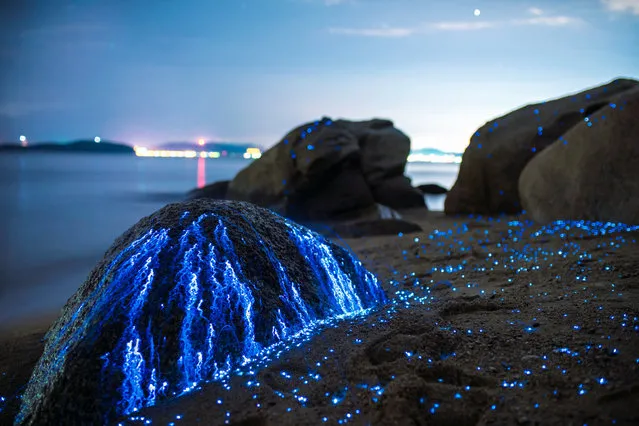
Bioluminescent sea fireflies glittering like diamonds on the rocks and sand. Okayama, Japan. July 2016. (Photo by Trevor Williams/Jonathan Galione/Getty Images)

Those lights are actually bioluminescent shrimp, better known as sea fireflies, or, in Japan, as “umibotaru”. Visible every year from May until the end of October, they live in the sand around very shallow sea water and are often seen floating between the extremes of high and low tides. Here: Bioluminescent sea fireflies glittering like diamonds on the rocks and sand. Okayama, Japan. July 2016. (Photo by Trevor Williams/Jonathan Galione/Getty Images)
Details
23 Aug 2016 10:13:00
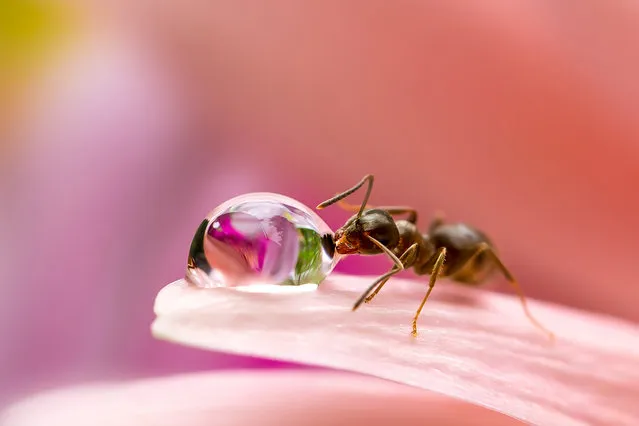
A macro view of an ant taking a sip from a water droplet on the edge of a flower in Obihiro, Japan. Animal-Lover Miki Asai has gone a step beyond feeding bread to the ducks – by syringe-feeding water to tiny ants. The office worker from Obihiro City, Japan, squirts droplets near the tiny insects and then uses a macro lens to capture quenching their thirst. The amateur photographer started capturing these images near her house in July 2013 after spotting an ant struggling in the rain. (Photo by Miki Asai/Barcroft Media)

A macro view of an ant taking a sip from a water droplet on the edge of a flower in Obihiro, Japan. Animal-Lover Miki Asai has gone a step beyond feeding bread to the ducks – by syringe-feeding water to tiny ants. The office worker from Obihiro City, Japan, squirts droplets near the tiny insects and then uses a macro lens to capture quenching their thirst. The amateur photographer started capturing these images near her house in July 2013 after spotting an ant struggling in the rain. (Photo by Miki Asai/Barcroft Media)
Details
09 Sep 2014 08:34:00
For her series “Japanese Whispers”, Belgian photographer Zaza Bertrand headed inside the intimate world of rabuhos – Japanese love hotels. Love hotels became popular in Japan from the 1960s onwards, due to a lack of privacy in many family homes. There are now around 37,000 of these hotels in Japan, allowing short daytime “rests” or overnight stays. (Photo by Zaza Bertrand/The Guardian)

For her series “Japanese Whispers”, Belgian photographer Zaza Bertrand headed inside the intimate world of rabuhos – Japanese love hotels. Love hotels became popular in Japan from the 1960s onwards, due to a lack of privacy in many family homes. There are now around 37,000 of these hotels in Japan, allowing short daytime “rests” or overnight stays. (Photo by Zaza Bertrand/The Guardian)
Details
02 Dec 2016 11:30:00


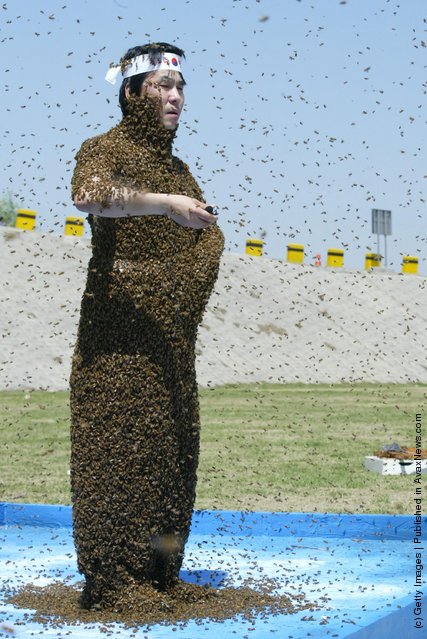
South Korean bee farmer Ahn Sang-Kyu protests Japan's claim of sovereignty over disputed islets May 2, 2006 in Seoul, South Korea. Ahn, a local bee farmer, released over 140,000 bees and attracted them to his body to protest Japan's sovereignty claims over a tiny group of islands located off the east coast of South Korea, called the Dokdo islets by the Koreans and Takeshima by the Japanese. The volcanic islets located about 90 kilometres east of South Korea's Ullung Island, have been a source of diplomatic friction between South Korea and Japan for years. (Photo by Chung Sung-Jun/Getty Images)

Details
05 May 2011 10:32:00