Loading...
Done
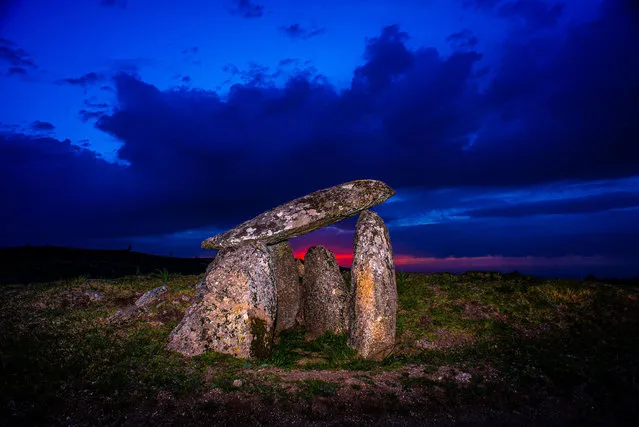
Serra da Aboboreira Megalithic Set (Meninas do Crasto) on September 24, 2023 in Baiao, Portugal. Since 1978 that Serra da Aboboreira (Aboboreira Mountains) has been the scene of a systematic study of its archeological values, among which are the monuments known as megalithic. These are funerary monuments designing the landscape. These dolmens were constructed with stones (lithos) of medium or large dimensions (mega), which were laid in a, more or less, vertical position. Over these, it was still placed a lid, also of stone. These containers were covered by an artificial mound of earth and stones (dolmen). (Photo by Octavio Passos/Getty Images)

Serra da Aboboreira Megalithic Set (Meninas do Crasto) on September 24, 2023 in Baiao, Portugal. Since 1978 that Serra da Aboboreira (Aboboreira Mountains) has been the scene of a systematic study of its archeological values, among which are the monuments known as megalithic. These are funerary monuments designing the landscape. These dolmens were constructed with stones (lithos) of medium or large dimensions (mega), which were laid in a, more or less, vertical position. Over these, it was still placed a lid, also of stone. These containers were covered by an artificial mound of earth and stones (dolmen). (Photo by Octavio Passos/Getty Images)
Details
28 Dec 2023 21:07:00
Festival goer with phallus logo t-shirt during the Kanamara Matsuri Steel Phallus Festival at Kawasaki, Japan on April 2, 2017. The Kanamara Matsuri or Festival of the Steel Phallus is held on the first Sunday of April at the Kanayama shrine. The shrine celebrates a legend of a steel pen*s and was frequented by prostitutes who wished to pray for protection from sexually transmitted diseases. Visitors now wish for easy delivery, marriage and matrimonial harmony. Because of the large steel phallus the unusual festival has become a tourist attraction attracting many overseas visitors and is used to raise money for HIV charities. Phallus shaped candy, carved vegetables, decorations, and a big parade are all part of the festival. (Photo by DELETREE/SIPA Press/Rex Features/Shutterstock)

Festival goer with phallus logo t-shirt during the Kanamara Matsuri Steel Phallus Festival at Kawasaki, Japan on April 2, 2017. The Kanamara Matsuri or Festival of the Steel Phallus is held on the first Sunday of April at the Kanayama shrine. The shrine celebrates a legend of a steel pen*s and was frequented by prostitutes who wished to pray for protection from sexually transmitted diseases. Visitors now wish for easy delivery, marriage and matrimonial harmony. Because of the large steel phallus the unusual festival has become a tourist attraction attracting many overseas visitors and is used to raise money for HIV charities. Phallus shaped candy, carved vegetables, decorations, and a big parade are all part of the festival. (Photo by DELETREE/SIPA Press/Rex Features/Shutterstock)
Details
04 Apr 2017 09:48:00
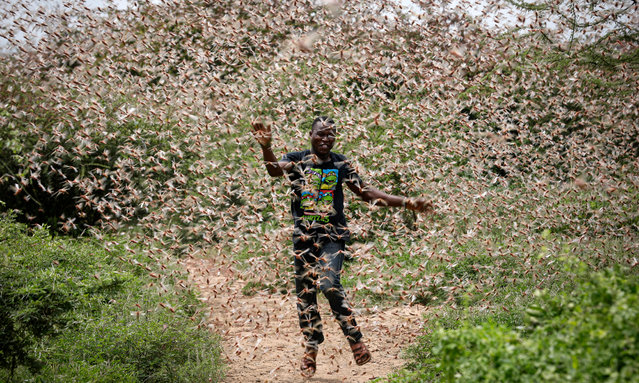
A local farmer Theophilus Mwendwa runs through a swarm of desert locusts to chase them away in the bush near Enziu, Kitui County, some 200km east of the capital Nairobi, Kenya, 24 January 2020. Large swarms of desert locusts have been invading Kenya for weeks, after having infested some 70 thousand hectares of land in Somalia which the United Nations Food and Agriculture Organisation (FAO) has termed the “worst situation in 25 years” in the Horn of Africa. FAO cautioned that it poses an “unprecedented threat” to food security and livelihoods in the region. (Photo by Dai Kurokawa/EPA/EFE)

A local farmer Theophilus Mwendwa runs through a swarm of desert locusts to chase them away in the bush near Enziu, Kitui County, some 200km east of the capital Nairobi, Kenya, 24 January 2020. Large swarms of desert locusts have been invading Kenya for weeks, after having infested some 70 thousand hectares of land in Somalia which the United Nations Food and Agriculture Organisation (FAO) has termed the “worst situation in 25 years” in the Horn of Africa. FAO cautioned that it poses an “unprecedented threat” to food security and livelihoods in the region. (Photo by Dai Kurokawa/EPA/EFE)
Details
22 Feb 2020 00:01:00
People of the LGBTQI community pose for a photo on a large rainbow colored flag as they take part in the parade to mark Thailand Pride Festival 2022 in Bangkok, Thailand, 27 November 2022. Thailand's LGBTQI groups and foreigners attended the Pride festival to raise awareness and promote sexual diversity and equal rights for the Lesbian, Gay, Bisexual, Transgender and Queer (LGBTQ) community. The festival also aims to promote tourism in Thailand as Covid-19 restrictions are being lifted, with hopes to becomes an annual and sustainable event in November. (Photo by Narong Sangnak/EPA/EFE/Rex Features/Shutterstock)

People of the LGBTQI community pose for a photo on a large rainbow colored flag as they take part in the parade to mark Thailand Pride Festival 2022 in Bangkok, Thailand, 27 November 2022. Thailand's LGBTQI groups and foreigners attended the Pride festival to raise awareness and promote sexual diversity and equal rights for the Lesbian, Gay, Bisexual, Transgender and Queer (LGBTQ) community. The festival also aims to promote tourism in Thailand as Covid-19 restrictions are being lifted, with hopes to becomes an annual and sustainable event in November. (Photo by Narong Sangnak/EPA/EFE/Rex Features/Shutterstock)
Details
28 Nov 2022 04:31:00
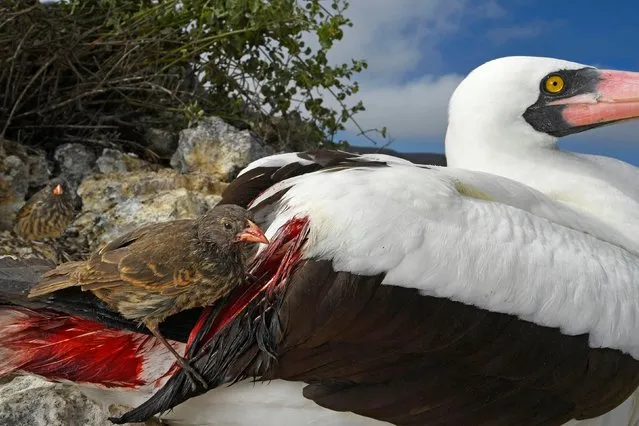
Bloodthirsty by Thomas P Peschak, Germany/South Africa — winner, Behaviour: birds. When rations run short on Wolf Island, in the remote northern Galápagos, the sharp-beaked ground finches become vampires. Their sitting targets are Nazca boobies and other large birds. The finches rely on a scant diet of seeds and insects, which regularly dries up, so they drink blood to survive. ‘I’ve seen more than half a dozen finches drinking from a single Nazca booby,’ says Tom. Rather than leave their nests the boobies tolerate the vampires, and the blood loss doesn’t seem to cause permanent harm. (Photo by Thomas P Peschak/2018 Wildlife Photographer of the Year)

Bloodthirsty by Thomas P. Peschak, Germany/South Africa — winner, Behaviour: birds. When rations run short on Wolf Island, in the remote northern Galápagos, the sharp-beaked ground finches become vampires. Their sitting targets are Nazca boobies and other large birds. The finches rely on a scant diet of seeds and insects, which regularly dries up, so they drink blood to survive. ‘I’ve seen more than half a dozen finches drinking from a single Nazca booby,’ says Tom. Rather than leave their nests the boobies tolerate the vampires, and the blood loss doesn’t seem to cause permanent harm. (Photo by Thomas P. Peschak/2018 Wildlife Photographer of the Year)
Details
19 Oct 2018 00:05:00
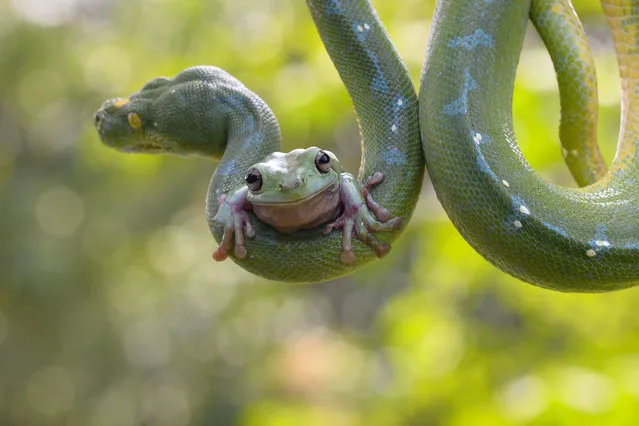
The frog and snake. Clinging on with sticky toes, a green tree frog sits bravely on its unlikely friend – a large tree python. Curled around the branches of a small coconut tree, the snake appears relatively undisturbed by the bold passenger that has clambered onto its skin. Grown in captivity together, the pair display no signs of aggression or fear, comfortable with their encounters high up in the leafy branches.  Photo enthusiast Fahmi Bhs watched in surprise as the frog slowly climbed along the scales of the metre long snake in a zoo in Jakarta, Indonesia. (Photo by Fahmi Bhs/Solent News/SIPA Press)

Clinging on with sticky toes, a green tree frog sits bravely on its unlikely friend – a large tree python. Curled around the branches of a small coconut tree, the snake appears relatively undisturbed by the bold passenger that has clambered onto its skin. Grown in captivity together, the pair display no signs of aggression or fear, comfortable with their encounters high up in the leafy branches. Photo enthusiast Fahmi Bhs watched in surprise as the frog slowly climbed along the scales of the metre long snake in a zoo in Jakarta, Indonesia. (Photo by Fahmi Bhs/Solent News/SIPA Press)
Details
08 Aug 2014 11:09:00
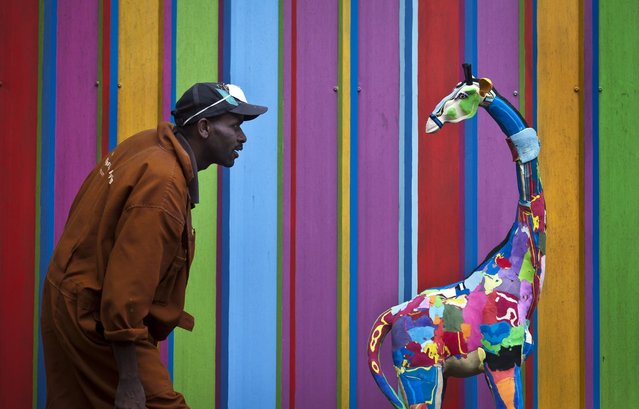
In this photo taken Monday, April 29, 2013, carver Jackson Mbatha, 40, poses next to a an unfinished large toy giraffe he is making from pieces of discarded flip-flops, in front of a painted workshop wall at the Ocean Sole flip-flop recycling company in Nairobi, Kenya. The company is cleaning the East African country's beaches of used, washed-up flip-flops and the dirty pieces of rubber that were once cruising the Indian Ocean's currents are now being turned into colorful handmade giraffes, elephants and other toy animals. (Ben Curtis/AP Photo)

In this photo taken Monday, April 29, 2013, carver Jackson Mbatha, 40, poses next to a an unfinished large toy giraffe he is making from pieces of discarded flip-flops, in front of a painted workshop wall at the Ocean Sole flip-flop recycling company in Nairobi, Kenya. The company is cleaning the East African country's beaches of used, washed-up flip-flops and the dirty pieces of rubber that were once cruising the Indian Ocean's currents are now being turned into colorful handmade giraffes, elephants and other toy animals. (Ben Curtis/AP Photo)
Details
09 May 2013 09:01:00
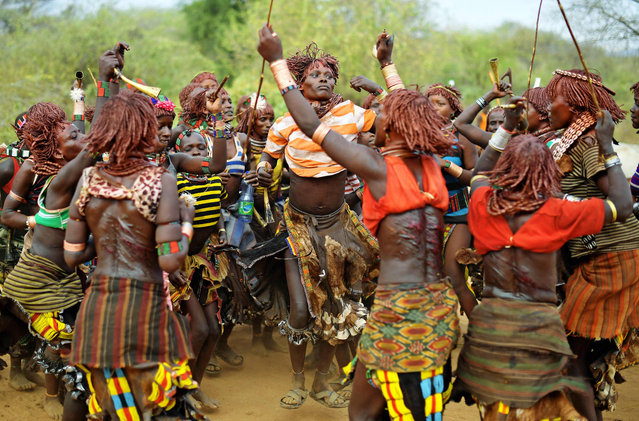
Hamar women dance before a bull jumping ceremony in Ethiopia's southern Omo Valley region near Turmi on September 19, 2016. The Hamar are a Nilotic ethnic group in Ethiopia. The construction of the Gibe III dam, the third largest hydroelectric plant in Africa, and large areas of very “thirsty” cotton and sugar plantations and factories along the Omo river are impacting heavily on the lives of tribes living in the Omo Valley who depend on the river for their survival and way of life. Human rights groups fear for the future of the tribes if they are forced to scatter, give up traditional ways through loss of land or ability to keep cattle as globalisation and development increases. (Photo by Carl De Souza/AFP Photo)

Hamar women dance before a bull jumping ceremony in Ethiopia's southern Omo Valley region near Turmi on September 19, 2016. The Hamar are a Nilotic ethnic group in Ethiopia. The construction of the Gibe III dam, the third largest hydroelectric plant in Africa, and large areas of very “thirsty” cotton and sugar plantations and factories along the Omo river are impacting heavily on the lives of tribes living in the Omo Valley who depend on the river for their survival and way of life. (Photo by Carl De Souza/AFP Photo)
Details
02 Oct 2016 08:45:00