Loading...
Done
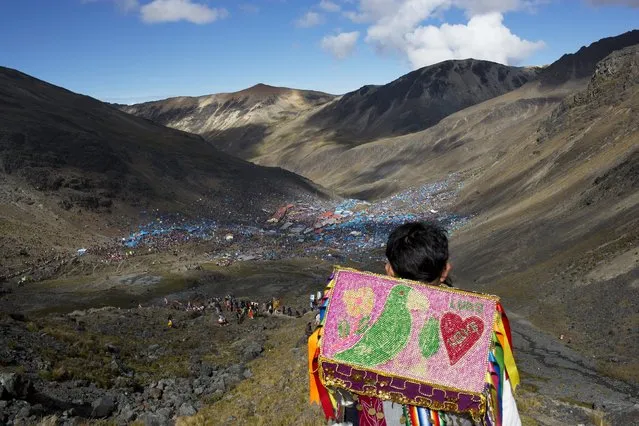
In this May 24, 2016 photo, a young boy descends the Qullqip'unqu mountain looking out at the tens of thousands of pilgrims gathered to celebrate the three-day festival Qoyllur Rit’i, translated from the Quechua language as Snow Star, in the Andean Sinakara Valley, in Peru's Cusco region. The celebration that mixes Catholic and indigenous beliefs honors Jesus as well as the area’s glacier, which is considered sacred among some indigenous people. While the native celebration is far older, the Christian part of the ritual stretches back to the 1700s, when Jesus is said to have appeared to a young shepherd in the form of another boy. (Photo by Rodrigo Abd/AP Photo)

In this May 24, 2016 photo, a young boy descends the Qullqip'unqu mountain looking out at the tens of thousands of pilgrims gathered to celebrate the three-day festival Qoyllur Rit’i, translated from the Quechua language as Snow Star, in the Andean Sinakara Valley, in Peru's Cusco region. The celebration that mixes Catholic and indigenous beliefs honors Jesus as well as the area’s glacier, which is considered sacred among some indigenous people. While the native celebration is far older, the Christian part of the ritual stretches back to the 1700s, when Jesus is said to have appeared to a young shepherd in the form of another boy. (Photo by Rodrigo Abd/AP Photo)
Details
04 Jun 2016 11:52:00
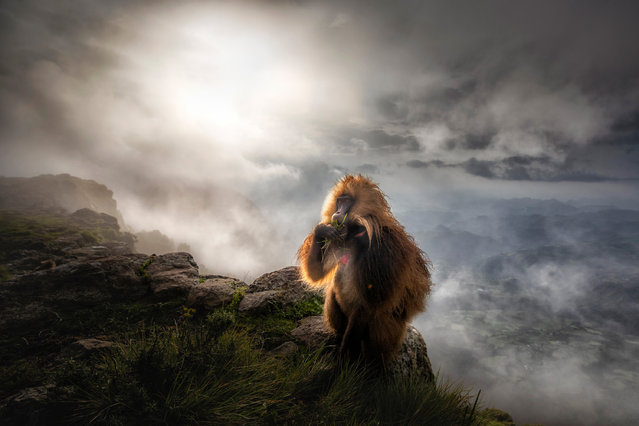
Highly commended, mammals: Gelada after the storm – Marco Gaiotti (Italy). “Gelada baboons are the only monkey species in the world that feed on grasses. They are native to the tableland of Ethiopia. Every morning large family groups wander from their sleeping places in the steep rock face, up to 1,000 metres high, to the feeding grounds at the tablelands. This image clearly depicts their feeding strategy: they pull out bunches of grass, sort the stalks and then lift them to their mouth. This shot was taken towards the end of the rainy season after a heavy storm”. (Photo by Marco Gaiotti/2019 GDT European Wildlife Photographer of the Year)

Highly commended, mammals: Gelada after the storm – Marco Gaiotti (Italy). “Gelada baboons are the only monkey species in the world that feed on grasses. They are native to the tableland of Ethiopia. Every morning large family groups wander from their sleeping places in the steep rock face, up to 1,000 metres high, to the feeding grounds at the tablelands. This image clearly depicts their feeding strategy: they pull out bunches of grass, sort the stalks and then lift them to their mouth. This shot was taken towards the end of the rainy season after a heavy storm”. (Photo by Marco Gaiotti/2019 GDT European Wildlife Photographer of the Year)
Details
31 Oct 2019 00:03:00
Tridacna Gigas, or Giant Clams

“The giant clam, Tridacna gigas (known as pā’ua in Cook Islands Māori), is the largest living bivalve mollusc. T. gigas is one of the most endangered clam species. It was mentioned as early as 1825 in scientific reports. One of a number of large clam species native to the shallow coral reefs of the South Pacific and Indian oceans, they can weigh more than 200 kilograms (440 lb) measure as much as 120 cm (47 in) across, and have an average lifespan in the wild of 100 years or more”. – Wikipedia

Photo: Tridacna Gigas, or Giant Clams spew water as a traditional fisherman passes by a small sanctuary on January 23, 2004 near Bolinao in the Northern Philippines. The clams, prime builders for coral reefs and providing shelter for spawning fish and other marine life, are exposed by low tides in the sanctuary. Overfishing and pollution throughout the country are not only threatening food security, but are also starting to choke one of the few working clam sanctuaries in the world. (Photo by David Greedy/Getty Images)
Details
01 Oct 2011 13:10:00
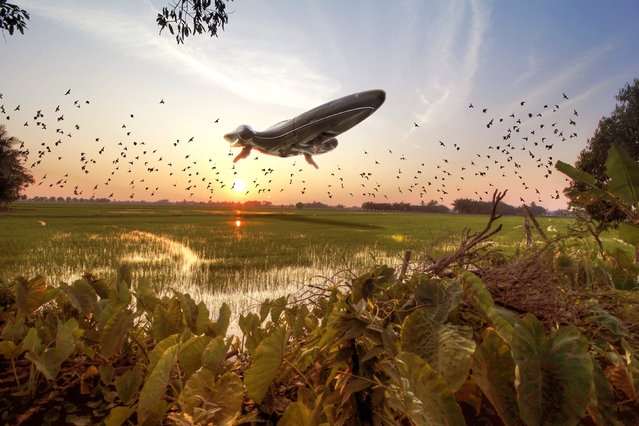
A Nubian Royal Starship hovers over the Malaysian rice fields. (Photo by Zahir Batin/Mercury Press)

A “Star Wars” superfan has brought the universe to his backyard. Amateur photographer Zahir Batin, from Selangor in Malaysia, added stormtroopers, X-wings and other famous sights to his native Tanjong Karang rice fields. The Malaysian snapper decided to combine his love for his hometown with his passion for the out-of-this-world space opera and, in particular, the toys. The amazing shots show TIE fighters on fire flying overhead and AT-AT walking tanks towering over tiny children, as well as Dark Side forces marching through the countryside. Here: a Nubian Royal Starship hovers over the Malaysian rice fields. (Photo by Zahir Batin/Mercury Press)
Details
30 Jun 2015 12:41:00
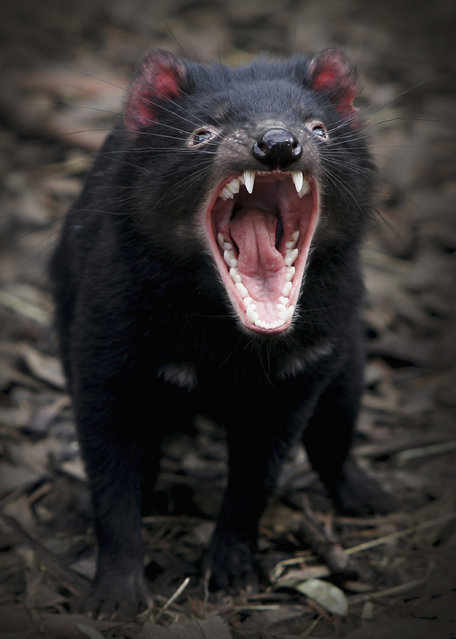
A Tasmanian Devil bears it's teeth at a quarantine facility August 31, 2005 in Hobart, Australia. The Devil, a native marsupial unique to Tasmania, is under threat from Devil Facial Tumor Disease (DFTD) which is decimating numbers throughout Tasmania. (Photo by Ian Waldie/Getty Images)

“The Tasmanian devil (Sarcophilus harrisii) is a carnivorous marsupial of the family Dasyuridae now found in the wild only in the Australian island state of Tasmania. The size of a small dog, it became the largest carnivorous marsupial in the world following the extinction of the thylacine in 1936. It is characterised by its stocky and muscular build, black fur, pungent odour, extremely loud and disturbing screech, keen sense of smell, and ferocity when feeding”. – Wikipedia. Photo: A Tasmanian Devil bears it's teeth at a quarantine facility August 31, 2005 in Hobart, Australia. (Photo by Ian Waldie/Getty Images)
Details
27 Jan 2014 09:45:00
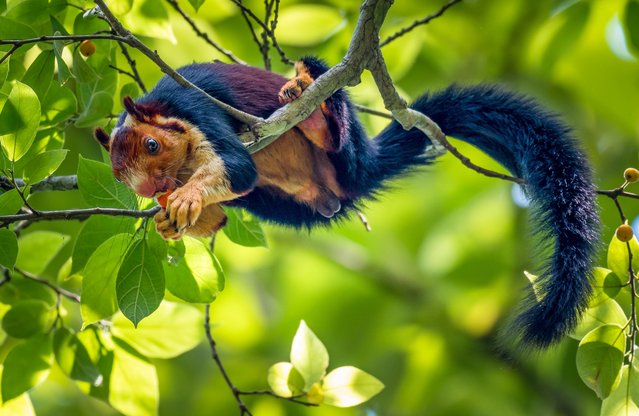
Its main predators are the birds of prey and the leopard. The Giant Squirrel is mostly active in the early hours of the morning and in the evening, resting in the midday. They are typically solitary animals that only come together for breeding. (Photo by Kaushik Vijayan/South West News Service)

The Malabar Giant squirrel – double the size of their grey relatives and measuring up to 36 inches (91.5 cm) from head to tail – lives deep in the forests of India. The athletic animals can leap an incredible 20 feet (6 m) between trees. Photographer Kaushik Vijayan, 39, snapped the animals in their native habit to produce these stunning images. Kaushik, from Kerala State, India, said: “Up until that point I had never heard about a squirrel like that or seen one. The sight was an absolute feast for my eyes. The squirrels fascinated me and I got excited to capture this beauty on my camera”. (Photo by Kaushik Vijayan/South West News Service)
Details
04 Apr 2019 00:03:00


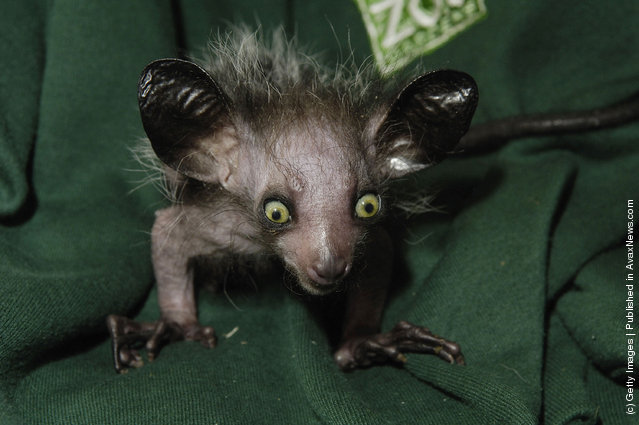
“The aye-aye (Daubentonia madagascariensis) is a lemur, a strepsirrhine primate native to Madagascar that combines rodent-like teeth and a special thin middle finger to fill the same ecological niche as a woodpecker. It is the world's largest nocturnal primate, and is characterized by its unusual method of finding food; it taps on trees to find grubs, then gnaws holes in the wood and inserts its narrow middle finger to pull the grubs out. The only other animal species known to find food in this way is the striped possum. From an ecological point of view the aye-aye fills the niche of a woodpecker as it is capable of penetrating wood to extract the invertebrates within”. – Wikipedia

Photo: In this handout image from Bristol Zoo is seen the first captive bred aye-aye in the UK named “Kintana” (meaning star in Malagasy) April 15, 2005 at Bristol Zoo Gardens, England. The zoo announced today only the second baby aye-aye to be hand-reared in the world (the first was in Jersey Zoo) and has now made his first public appearance since his birth on 11 February 2005. (Photo by Rob Cousins/Bristol Zoo via Getty Images)
Details
13 Apr 2011 13:33:00
Festival goer practice yoga during the O.Z.O.R.A. festival on August 4, 2016 in Tolna, Hungary. Ozora is a village in Tolna County. In recent times it has become famous for the O.Z.O.R.A. psychedelic trance festival which has been held on an estate in Ozora near small village Dadpuszta every year since 2004. The first party was called Solipse and took place during the Solar eclipse of August 11, 1999. The Ozora festival (with Solar United Natives festival) is one of the two big psytrance festivals in Hungary, and is fastest growing psytrance festivals on the world, achieving incredible 60 000 visitors in 2015. (Photo by Mohai Balázs/MTI/MTVA)

Festival goer practice yoga during the O.Z.O.R.A. festival on August 4, 2016 in Tolna, Hungary. Ozora is a village in Tolna County. In recent times it has become famous for the O.Z.O.R.A. psychedelic trance festival which has been held on an estate in Ozora near small village Dadpuszta every year since 2004. The first party was called Solipse and took place during the Solar eclipse of August 11, 1999. (Photo by Mohai Balázs/MTI/MTVA)
Details
05 Aug 2016 13:40:00