Loading...
Done
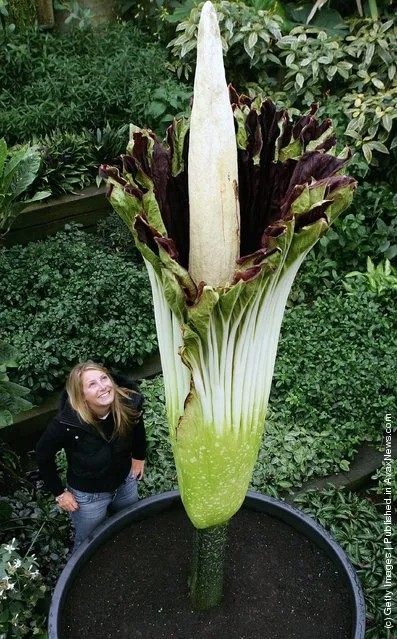
Kew Gardens employee Lauren Bird Royal examines the flowering of the Titan Arum lily at the Botanical Gardens

“The titan arum or Amorphophallus titanum (from Ancient Greek amorphos, “without form, misshapen” + phallos, “phallus”, and titan, “giant”) is a flowering plant with the largest unbranched inflorescence in the world. The titan arum's inflorescence is not as large as that of the Talipot palm, Corypha umbraculifera, but the inflorescence of the Talipot palm is branched rather than unbranched”. – Wikipedia

Photo: Kew Gardens employee Lauren Bird Royal examines the flowering of the Titan Arum lily at the Botanical Gardens at Kew on September 30, 2005 in London, England. For the first time in horticultural history, the Titan Arum lily can be seen at all three active stages in its lifecycle – in flower, fruit and leaf.The flowering corm is nearly three metres tall and weighs 91kg and is very rarely seen outside of the rainforests of Sumatra, Indonesia. (Photo by Scott Barbour/Getty Images)
Details
20 Sep 2011 11:13:00
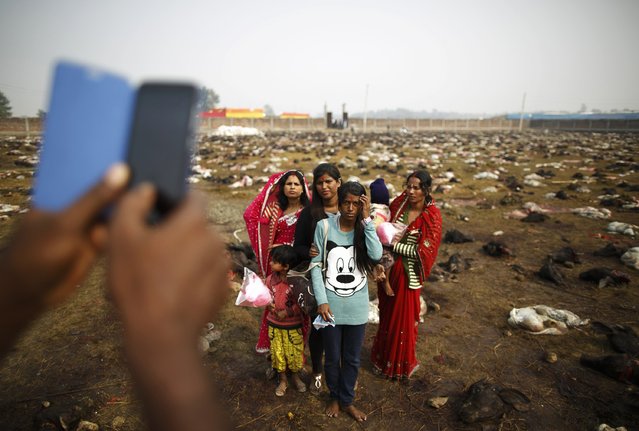
A family poses for a picture in front of the carcasses of sacrificed buffalos a day after the sacrificial ceremony of the “Gadhimai Mela” festival held in Bariyapur November 29, 2014. Sword-wielding Hindu devotees in Nepal began slaughtering thousands of animals and birds in a ritual sacrifice on Friday, ignoring calls by animal rights activists to halt what they described as the world's largest such exercise. (Photo by Navesh Chitrakar/Reuters)

A family poses for a picture in front of the carcasses of sacrificed buffalos a day after the sacrificial ceremony of the “Gadhimai Mela” festival held in Bariyapur November 29, 2014. Sword-wielding Hindu devotees in Nepal began slaughtering thousands of animals and birds in a ritual sacrifice on Friday, ignoring calls by animal rights activists to halt what they described as the world's largest such exercise. (Photo by Navesh Chitrakar/Reuters)
Details
30 Nov 2014 12:35:00
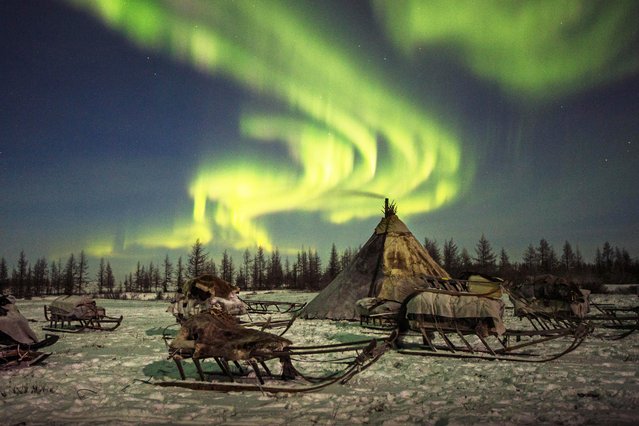
An empty camp is shown beneath a colourful sky in Siberia, December 2016. (Photo by Timothy Allen/Barcroft Productions)

A British photographer has captured life at the “edge of the world”. Timothy Allen, best known for his work on BBC's Human Planet, trekked through the freezing Siberian wilderness for 16 days as he joined part of an 800km migration of reindeer in the Yamal-Nenets region – a name that roughly translates to “edge of the world”. The stunning pictures feature the nomadic Nenets tribe, who drink blood to survive in -45°C temperatures. Timothy's epic journey, which will be revealed in an eight-minute documentary on Animal Planet USA, saw him travel across the bleak terrain of the frozen Ob River with the Nenets people in December last year. Here: An empty camp is shown beneath a colourful sky in Siberia, December 2016. (Photo by Timothy Allen/Barcroft Productions)
Details
19 Sep 2017 07:48:00
Vendors selling vegetables wait for customers under a flyover in the early morning in Ahmedabad, February 1, 2017. (Photo by Amit Dave/Reuters)

Vendors selling vegetables wait for customers under a flyover in the early morning in Ahmedabad, India on February 1, 2017. (Photo by Amit Dave/Reuters)
Details
25 Mar 2017 08:11:00
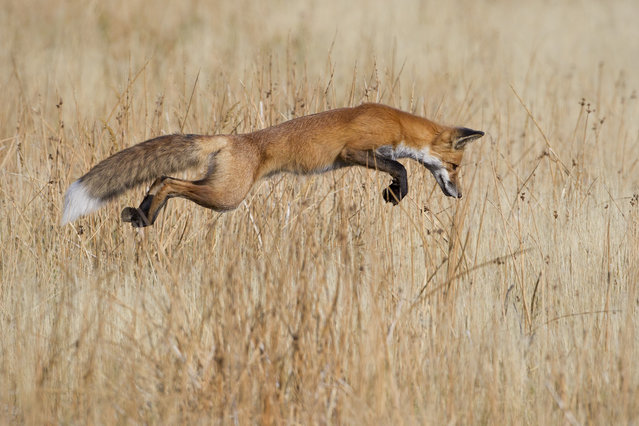
Canada: “Lucky pounce”. (Photo by Connor Stefanison/Wildlife Photographer of the Year 2013)

The winners of The London’s Natural History Museum's prestigious Wildlife Photographer of the Year for 2013 have finally been unveiled. Selected from almost 43,000 entries from 96 countries, the winners offer a glimpse of the stunning array of natural beauty on our planet. Photo: Canada: “Lucky pounce”. “Anticipating the pounce – that was the hardest part”, says Connor, who had come to Yellowstone National Park, Wyoming, USA, in search of wildlife as much as the spectacular landscape. He had found this fox, his first ever, on his last day in the park. It was so absorbed in hunting that Connor had plenty of time to get out of the car and settle behind a rock. It quartered the grassland, back and forth, and then started staring intently at a patch of ground, giving Connor just enough warning of the action to come. When it sprung up, Connor got his shot. And when it landed, the fox got his mouse. (Photo by Connor Stefanison/Wildlife Photographer of the Year 2013)
Details
17 Oct 2013 08:12:00
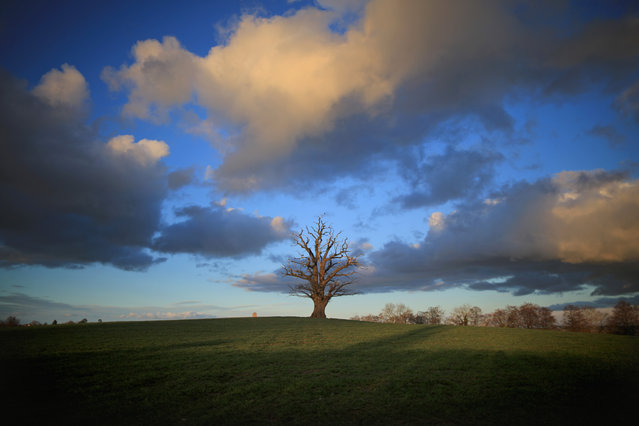
An ancient oak tree sits in a Shropshire field as the first signs of Spring begin to show across the United Kingdom on February 19, 2014 in Bridgnorth, England. (Photo by Christopher Furlong/Getty Images)

An ancient oak tree sits in a Shropshire field as the first signs of Spring begin to show across the United Kingdom on February 19, 2014 in Bridgnorth, England. (Photo by Christopher Furlong/Getty Images)
Details
24 Feb 2014 10:51:00
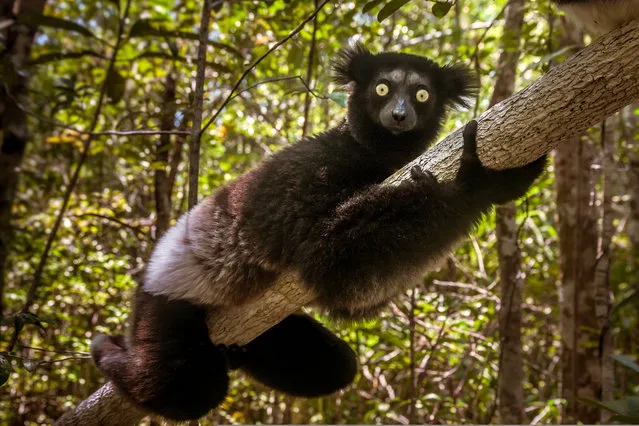
The secretive indri (Indri indri) of Madagascar, the largest living lemur. It is also critically endangered and highly evolutionarily distinct with no close relatives, which makes its branch one of most precarious on the mammal evolutionary tree. In the likely event that the indri goes extinct, we will lose 19m years of unique evolutionary history from the mammal tree of life. (Photo by Pierre-Yves Babelon/Aarhus University)

The secretive indri (Indri indri) of Madagascar, the largest living lemur. It is also critically endangered and highly evolutionarily distinct with no close relatives, which makes its branch one of most precarious on the mammal evolutionary tree. In the likely event that the indri goes extinct, we will lose 19m years of unique evolutionary history from the mammal tree of life. (Photo by Pierre-Yves Babelon/Aarhus University)
Details
18 Nov 2018 00:02:00
Participants dance during the West Indian Day Parade in the Brooklyn borough of New York September 5, 2016. (Photo by Eric Thayer/Reuters)

Participants dance during the West Indian Day Parade in the Brooklyn borough of New York September 5, 2016. The Labor Day Carnival (or West Indian Carnival) is an annual celebration held on American Labor Day (the first Monday in September) in Crown Heights, Brooklyn, in New York City. (Photo by Eric Thayer/Reuters)
Details
06 Sep 2016 10:24:00