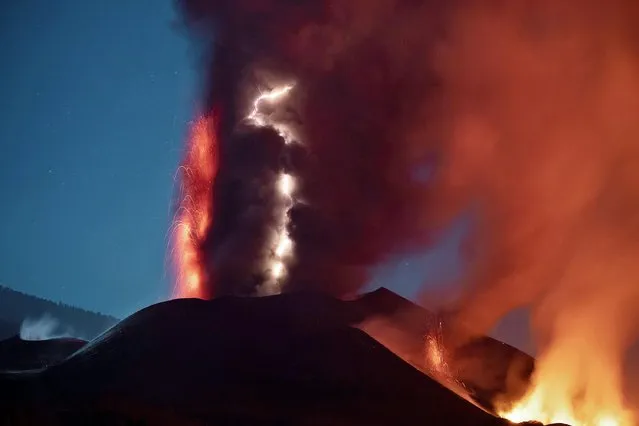
A handout photo made available by Jose Juan Rodriguez Rocha, on 17 November 2021 shows lightning over Cumbre vieja Volcano as seen from El Paso, La Palma, Canary Islands Spain, 14 November 2021. The lightning over a volcano is sometimes seen due to the charge of electricity caused by the friction of the expelled particles within the column of ashes and pyroclastic rocks. (Photo by Jose Juan Rodríguez Rocha/EPA/EFE)
A traffic police woman whistles at a pedestrian, Monday, July 27, 2015, in Pyongyang, North Korea where its citizens are having a one-day national holiday to celebrate the country's 62nd anniversary of the armistice that ended the Korean War. (Photo by Wong Maye-E/AP Photo)
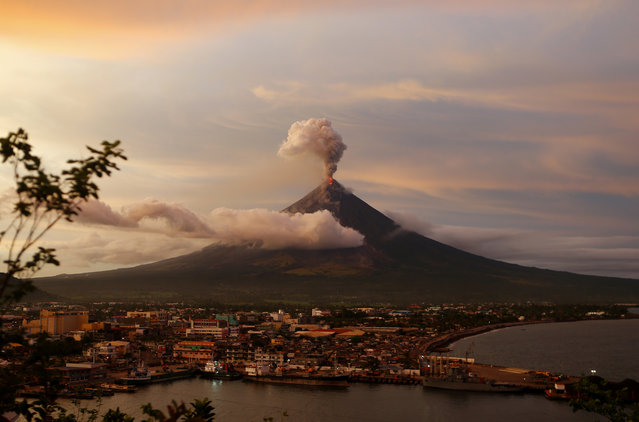
The Mayon volcano continues to erupt as the sun sets behind Legazpi city, Thursday, January 25, 2018 in Albay province, roughly 340 kilometers, (200 miles) southeast of Manila, Philippines. (Photo by Bullit Marquez/AP Photo)
“A girl arrives at the parking lot wearing tiny leather shorts and sits on the back of a bike with a horse power of more than 1,000 CC. Next to her a man gets ready to ride, wearing a skeleton mask. It’s more than a fashion show, it’s an extravaganza on two wheels along Chinese roads”. – Carlos Barria. Photo: A couple rides their motorcycle at the Qian Dao Lake rally, on May 11, 2013. (Photo by Carlos Barria/Reuters)
A photographer with a passion for wild animals was able to get up close and personal with one of nature’s deadliest creatures. Alex Suh has traveled to Mexico’s Banco Chinchorro reef twice in the past three years to get into the waters and capture the crocodiles in their natural habitat after an invitation from Yucatan Dive Trek. (Photo by Alex Suh/Caters News Agency)
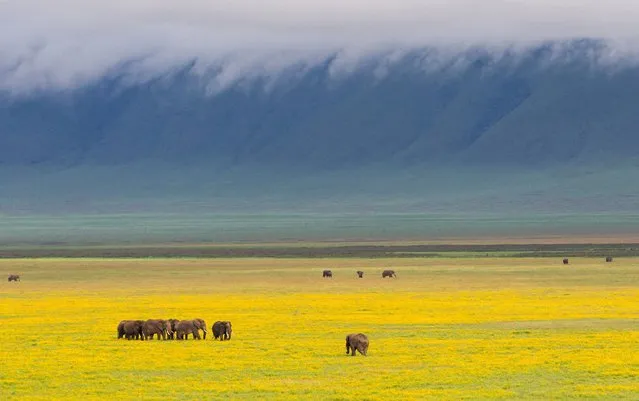
Ngorongoro Crater (Tanzania). At 610m deep and 260 sq km, this is the largest unflooded caldera in the world. A blue-green vision from above it's a haven for engangered wildlife and Maasai livestock. The crater was formed three million years ago when a giant volcano, which could have been as high as Kilimanjaro, exploded and collapsed. The caldera formed the concentric fractures in the crust cracked down to a magma reservoir deep underground. (Photo by John Bryant/Getty Images)
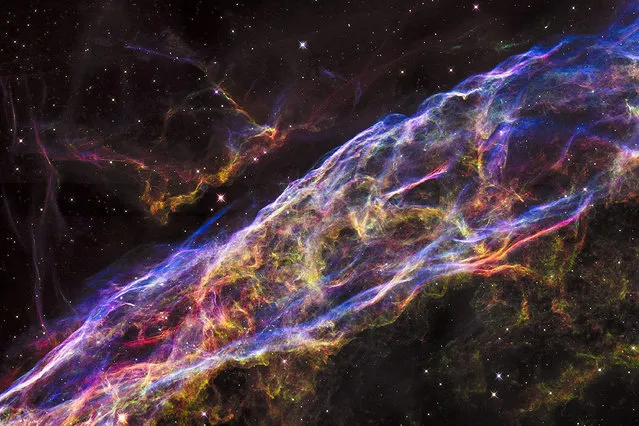
A small section of the expanding remains of the Veil Nebula, a massive star that exploded about 8,000 years ago. The entire nebula is 110 light-years across, covering six full moons on the sky as seen from Earth, and resides about 2,100 light-years away in the constellation Cygnus, the Swan. (Photo by Reuters/NASA/ESA/Hubble)