Loading...
Done
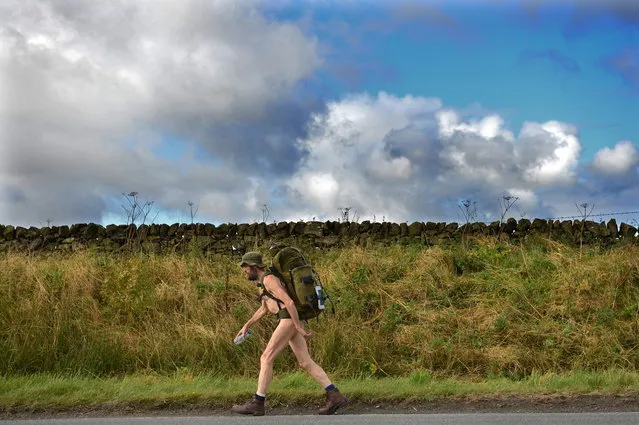
Stephen Gough the naked rambler makes his way south through Peebles in the Scottish Borders, following his release from Saughton Prison yesterday after serving his latest sentence on October 6, 2012 in Peebles, Scotland. The rambler has 18 convictions and has been in prison on and off since 2006 with offences ranging from not wearing clothes in front of the sheriff, breach of the peace and contempt of court. (Photo by Jeff J. Mitchell)

“Stephen Gough (born c. 1959), also known as Steve Gough and the Naked Rambler, is an activist, and a British former Royal Marine. In 2003-2004, he walked the length of Great Britain naked. He did it again in 2005-2006, but was arrested in England and in Scotland. He subsequently spent six years in prison, having been repeatedly rearrested for public nudity within a short period, each time he was released. He has spent most of his sentences in Saughton and Perth prisons, in Scotland”. – Wikipedia

Photo: Stephen Gough the naked rambler makes his way south through Peebles in the Scottish Borders, following his release from Saughton Prison yesterday after serving his latest sentence on October 6, 2012 in Peebles, Scotland. (Photo by Jeff J. Mitchell)
Details
07 Oct 2012 08:18:00
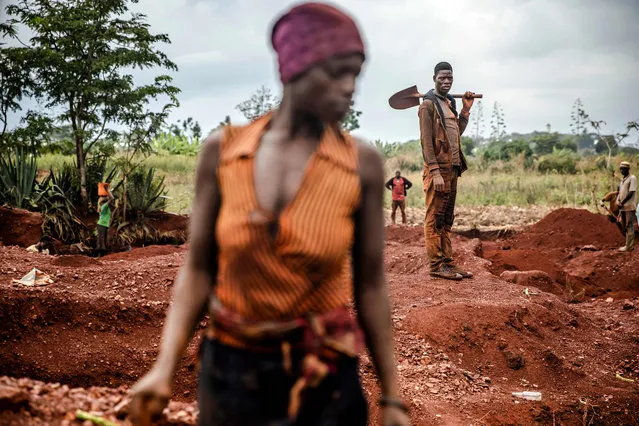
A gold miner observes from the distance how some women miners work at an open-pit gold mine in Nyarugusu, Geita Region, Tanzania on May 27, 2022. Tanzania is a land rich in minerals and one of the main gold producers in Africa, with gold representing more than 90% of the country's mineral exports. Artisanal and small-scale gold mining have culturally and historically relegated women's participation. The extractive sector in Tanzania has historically been a male-dominated industry with high levels of harassment, sеxual abuse, discrimination and misconceptions over women's involvement, and contributions following traditional beliefs. (Photo by Luis Tato/AFP Photo)

A gold miner observes from the distance how some women miners work at an open-pit gold mine in Nyarugusu, Geita Region, Tanzania on May 27, 2022. Tanzania is a land rich in minerals and one of the main gold producers in Africa, with gold representing more than 90% of the country's mineral exports. Artisanal and small-scale gold mining have culturally and historically relegated women's participation. The extractive sector in Tanzania has historically been a male-dominated industry with high levels of harassment, sеxual abuse, discrimination and misconceptions over women's involvement, and contributions following traditional beliefs. (Photo by Luis Tato/AFP Photo)
Details
13 Jun 2022 04:31:00
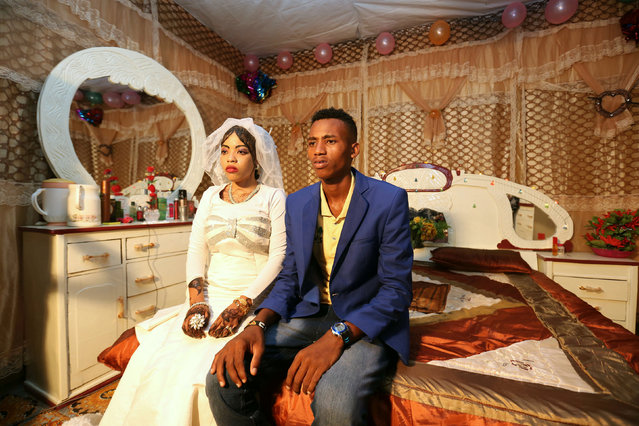
Somali couple Mohamed Noor (L) and Huda Omar pose for a photograph at their makeshift home during their wedding ceremony in Mogadishu's Rajo camp, Somalia August 17, 2016. Having met two years ago, the pair have just married at Rajo camp, where some 400 families live. Most, like Noor's parents, came here in the early 1990s to flee famine. They stayed on as years of conflict ravaged the Horn of Africa nation. As at any wedding, there is plenty of dancing and sweet treats for the young couple as they start married life in Noor's simple home, made of iron and plastic sheets. Noor works as a mason with his father. Others here are builders or sell sweets, nuts and stick toothbrushes to make money. Some beg around the seaside city, which like the rest of Somalia has been gripped by violence since the toppling of dictator Mohamed Siad Barre in 1991. (Photo by Feisal Omar/Reuters)

Somali couple Mohamed Noor (L) and Huda Omar pose for a photograph at their makeshift home during their wedding ceremony in Mogadishu's Rajo camp, Somalia August 17, 2016. Having met two years ago, the pair have just married at Rajo camp, where some 400 families live. Most, like Noor's parents, came here in the early 1990s to flee famine. (Photo by Feisal Omar/Reuters)
Details
14 Sep 2016 10:35:00
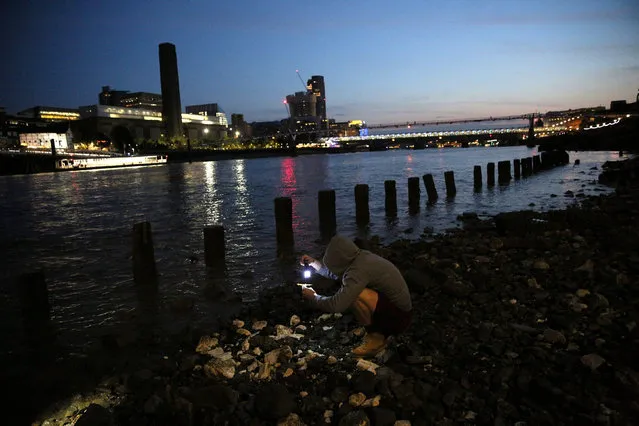
A mudlark uses a torch to look for items on the bank of the River Thames in London, Britain June 06, 2016. Mudlarking is believed to trace its origins to the 18th and 19th century, when scavengers searched the Thames' shores for items to sell. These days, history and archaeology fans are the ones hoping to find old relics such as coins, ceramics, artifacts or everyday items from across centuries. They wait for the low tide and then scour specific areas of exposed shores. "If you're in a field you could be out all day long, with the river you're restricted to about two or three hours," mudlark Nick Stevens said. While many just use the naked eye for their searches, others rely on metal detectors for which a permit from the Port of London Authority is needed. Digging also requires consent. (Photo by Neil Hall/Reuters)

A mudlark uses a torch to look for items on the bank of the River Thames in London, Britain June 06, 2016. Mudlarking is believed to trace its origins to the 18th and 19th century, when scavengers searched the Thames' shores for items to sell. These days, history and archaeology fans are the ones hoping to find old relics such as coins, ceramics, artifacts or everyday items from across centuries. their finds with the Portable Antiquities Scheme. Any item over 300 years old must be recorded. (Photo by Neil Hall/Reuters)
Details
27 Aug 2016 10:43:00
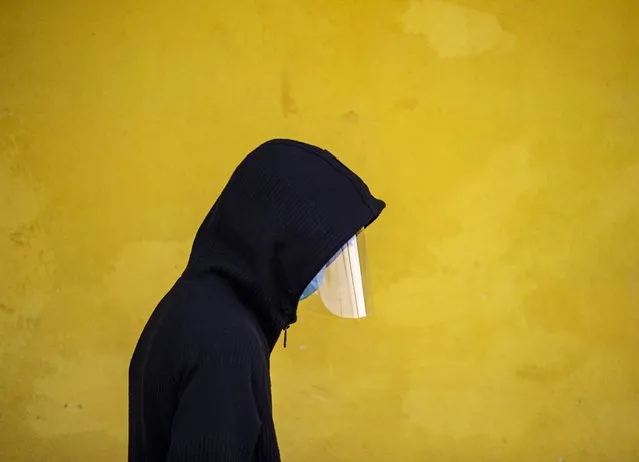
A Student of Yuba Pratibha School, wearing a face shield and masks at school during a coronavirus pandemic in Kathmandu, Nepal, 26 November 2020. The head Teacher of Yuba Pratibha School, Yanga Raj Dahal, started to conduct classes for students, who can’t afford and attend online classes, with strict sanitary regime, providing also free face masks and shields for students. However majority of schools have been conducting online classes in Nepal from 19 March 2020 as part of precautionary measures against the spread of the coronavirus Covid-19. (Photo by Narendra Shrestha/EPA/EFE)

A Student of Yuba Pratibha School, wearing a face shield and masks at school during a coronavirus pandemic in Kathmandu, Nepal, 26 November 2020. The head Teacher of Yuba Pratibha School, Yanga Raj Dahal, started to conduct classes for students, who can’t afford and attend online classes, with strict sanitary regime, providing also free face masks and shields for students. However majority of schools have been conducting online classes in Nepal from 19 March 2020 as part of precautionary measures against the spread of the coronavirus Covid-19. (Photo by Narendra Shrestha/EPA/EFE)
Details
03 Dec 2020 00:05:00
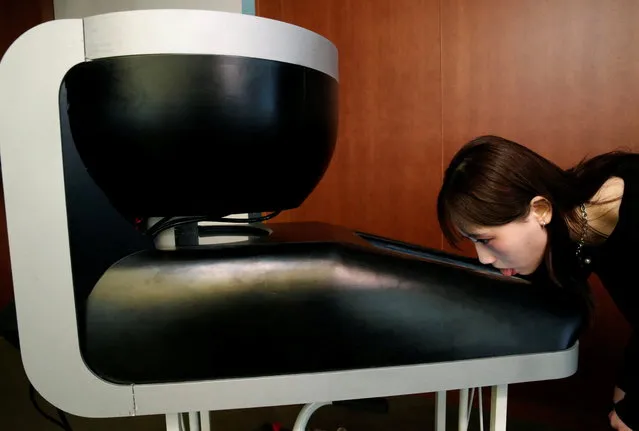
Student of Meiji University Yuki Hou licks a screen of Taste the TV (TTTV), a prototype lickable TV screen that can imitate the flavours of various foods, during its demonstration at the university in Tokyo, Japan, December 22, 2021. (Photo by Kim Kyung-Hoon/Reuters)

Student of Meiji University Yuki Hou licks a screen of Taste the TV (TTTV), a prototype lickable TV screen that can imitate the flavours of various foods, during its demonstration at the university in Tokyo, Japan, December 22, 2021. (Photo by Kim Kyung-Hoon/Reuters)
Details
25 Sep 2022 04:29:00
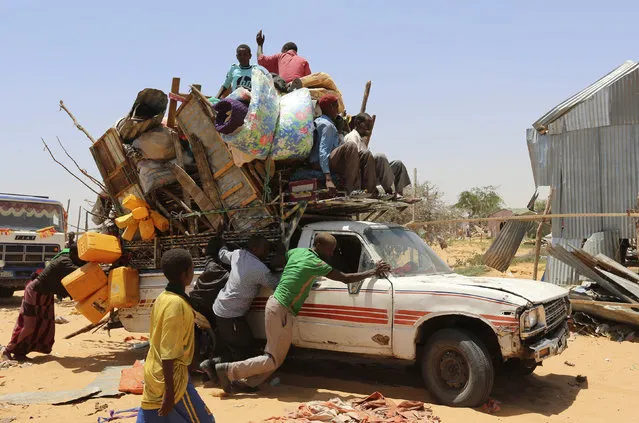
More than 6 billion people live in countries where serious levels of public sector corruption are fueling inequality and exploitation, according to Transparency International's 2015 index of perceived public sector corruption. The group's annual report measures perceptions of corruption due to the secrecy surrounding most corrupt dealings. Two thirds of the 168 countries assessed were identified as having a serious corruption problem. Somalia, which has been mired in conflict since civil war broke out in 1991, ranks bottom of the list. (Photo by Feisal Omar/Reuters)

More than 6 billion people live in countries where serious levels of public sector corruption are fueling inequality and exploitation, according to Transparency International's 2015 index of perceived public sector corruption. The group's annual report measures perceptions of corruption due to the secrecy surrounding most corrupt dealings. Two thirds of the 168 countries assessed were identified as having a serious corruption problem. Somalia, which has been mired in conflict since civil war broke out in 1991, ranks bottom of the list. (Photo by Feisal Omar/Reuters)
Details
13 May 2016 12:10:00
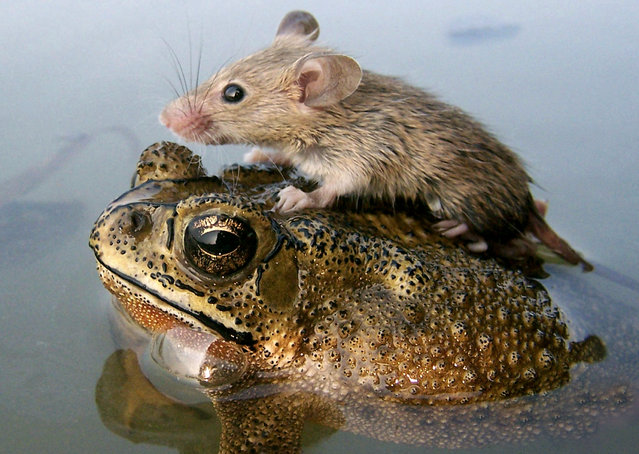
A mouse rides on the back of a frog in floodwaters in the northern Indian city Lucknow June 30, 2006. (Photo by Pawan Kumar/Reuters)

A mouse rides on the back of a frog in floodwaters in the northern Indian city Lucknow June 30, 2006. (Photo by Pawan Kumar/Reuters)
Details
15 Jul 2017 08:23:00