Loading...
Done
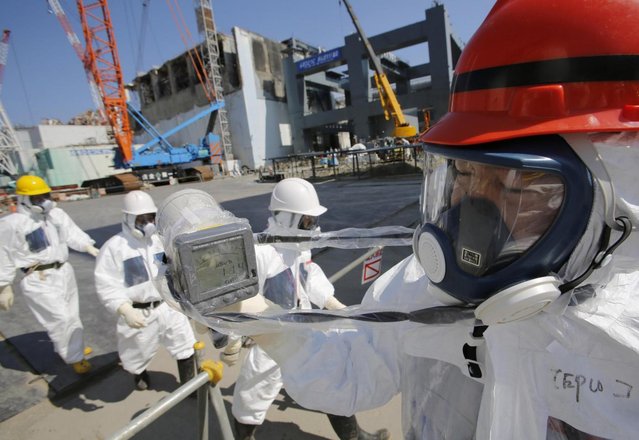
A radiation monitor indicates 114.00 microsieverts per hour near the building housing the plant's No. 4 reactor, center, and an under construction foundation, right, which will store the reactor's melted fuel rods at Tokyo Electric Power Co.'s tsunami-crippled Fukushima Dai-ichi nuclear power plant in Okuma, Fukushima prefecture, Wednesday, March 6, 2013, ahead of the second anniversary of the March 11, 2011 tsunami and earthquake. (Photo by Issei Kato/AP Photo/Pool)

A radiation monitor indicates 114.00 microsieverts per hour near the building housing the plant's No. 4 reactor, center, and an under construction foundation, right, which will store the reactor's melted fuel rods at Tokyo Electric Power Co.'s tsunami-crippled Fukushima Dai-ichi nuclear power plant in Okuma, Fukushima prefecture, Wednesday, March 6, 2013, ahead of the second anniversary of the March 11, 2011 tsunami and earthquake. Some 110,000 people living around the nuclear plant were evacuated after the massive March 11, 2011, earthquake and tsunami knocked out the plant's power and cooling systems, causing meltdowns in three reactors and spewing radiation into the surrounding air, soil and water. (Photo by Issei Kato/AP Photo/Pool)
Details
06 Mar 2013 13:19:00
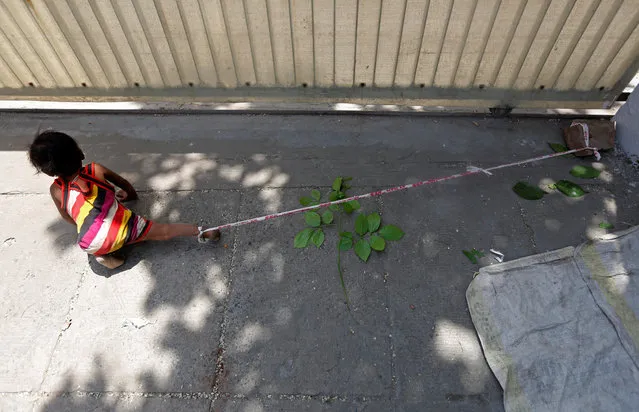
Barrier tape is tied around 15-month-old Shivani's ankle to prevent her from running away, while her mother Sarta Kalara works at a construction site nearby, in Ahmedabad, India, April 19, 2016. Kalara says she has no option but to tether her daughter Shivani to a stone despite her crying, while she and her husband work for 250 rupees ($3.8) each a shift digging holes for electricity cables in the city of Ahmedabad. There are about 40 million construction workers in India, at least one in five of them women, and the majority poor migrants who shift from site to site, building infrastructure for India's booming cities. Across the country it is not uncommon to see young children rolling in the sand and mud as their parents carry bricks or dig for new roads or luxury houses. (Photo by Amit Dave/Reuters)

Barrier tape is tied around 15-month-old Shivani's ankle to prevent her from running away, while her mother Sarta Kalara works at a construction site nearby, in Ahmedabad, India, April 19, 2016. Kalara says she has no option but to tether her daughter Shivani to a stone despite her crying, while she and her husband work for 250 rupees ($3.8) each a shift digging holes for electricity cables in the city of Ahmedabad. There are about 40 million construction workers in India, at least one in five of them women, and the majority poor migrants who shift from site to site, building infrastructure for India's booming cities. Across the country it is not uncommon to see young children rolling in the sand and mud as their parents carry bricks or dig for new roads or luxury houses. (Photo by Amit Dave/Reuters)
Details
14 Dec 2016 07:39:00
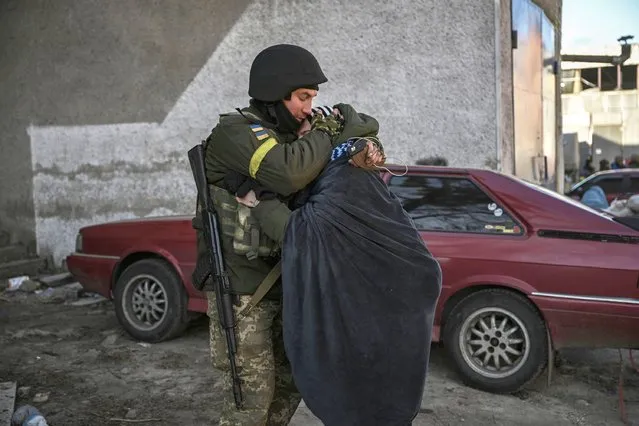
A Ukranian soldier hugs his wife in the city of Irpin, north of Kyiv, on March 10, 2022. Russian forces on March 10, 2022 rolled their armoured vehicles up to the northeastern edge of Kyiv, edging closer in their attempts to encircle the Ukrainian capital. Kyiv's northwest suburbs such as Irpin and Bucha have been enduring shellfire and bombardments for more than a week, prompting a mass evacuation effort. (Photo by Aris Messinis/AFP Photo)

A Ukranian soldier hugs his wife in the city of Irpin, north of Kyiv, on March 10, 2022. Russian forces on March 10, 2022 rolled their armoured vehicles up to the northeastern edge of Kyiv, edging closer in their attempts to encircle the Ukrainian capital. Kyiv's northwest suburbs such as Irpin and Bucha have been enduring shellfire and bombardments for more than a week, prompting a mass evacuation effort. (Photo by Aris Messinis/AFP Photo)
Details
11 Mar 2022 06:00:00
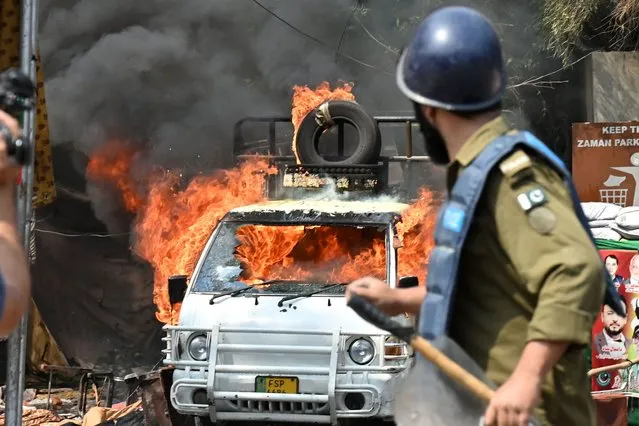
A policeman stands near a burning vehicle during clashes between supporters of former prime minister Imran Khan and riot police near Khan's house to prevent officers from arresting him, in Lahore on early March 15, 2023. Pakistan police appeared on March 15 to have given up an attempt to arrest former prime minister Imran Khan, ending a siege of his residence after violent clashes with hundreds of his supporters. (Photo by Arif Ali/AFP Photo)

A policeman stands near a burning vehicle during clashes between supporters of former prime minister Imran Khan and riot police near Khan's house to prevent officers from arresting him, in Lahore on early March 15, 2023. Pakistan police appeared on March 15 to have given up an attempt to arrest former prime minister Imran Khan, ending a siege of his residence after violent clashes with hundreds of his supporters. (Photo by Arif Ali/AFP Photo)
Details
22 Mar 2023 04:26:00
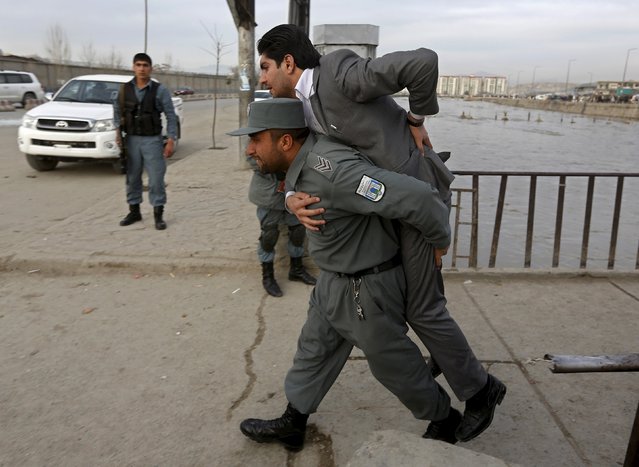
An Afghan policeman carries a wounded man at the site of a suicide attack in Kabul March 25, 2015. Six people were killed and more than 30 injured in the suicide bombing in the Afghan capital on Wednesday that struck close to the presidential palace in the heart of the city, the Interior Ministry said. The suicide bomber had been travelling in a vehicle packed with explosives and it was not immediately clear what the target of the attack had been. (Photo by Omar Sobhani/Reuters)

An Afghan policeman carries a wounded man at the site of a suicide attack in Kabul March 25, 2015. Six people were killed and more than 30 injured in the suicide bombing in the Afghan capital on Wednesday that struck close to the presidential palace in the heart of the city, the Interior Ministry said. The suicide bomber had been travelling in a vehicle packed with explosives and it was not immediately clear what the target of the attack had been. (Photo by Omar Sobhani/Reuters)
Details
26 Mar 2015 12:33:00
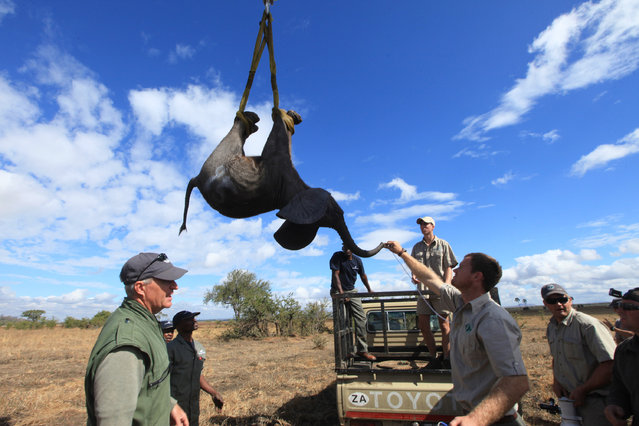
In this Tuesday July 12, 2016 photo, an elephant is lifted by a crane in an upside down position in Lilongwe, Malawi, in the first step of an assisted migration of 500 of the threatened species. African Parks, which manages three Malawian reserves is moving the 500 elephants from Liwonde National Park, this month and next, and again next year when vehicles can maneuver on the rugged terrain during Southern Africa's dry winter. (Photo by Tsvangirayi Mukwazhi/AP Photo)

In this Tuesday July 12, 2016 photo, an elephant is lifted by a crane in an upside down position in Lilongwe, Malawi, in the first step of an assisted migration of 500 of the threatened species. African Parks, which manages three Malawian reserves is moving the 500 elephants from Liwonde National Park, this month and next, and again next year when vehicles can maneuver on the rugged terrain during Southern Africa's dry winter. (Photo by Tsvangirayi Mukwazhi/AP Photo)
Details
20 Jul 2016 10:19:00
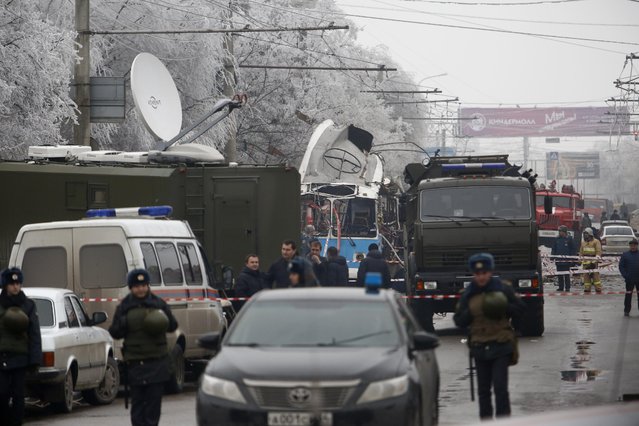
Military vehicles surround a wreckage of a trolleybus, in Volgograd, Russia, Monday, December 30, 2013. A bomb blast tore through a trolleybus in the city of Volgograd on Monday morning, killing at least 10 people a day after a suicide bombing that killed at least 17 at the city's main railway station. Volgograd is about 650 kilometers (400 miles) northeast of Sochi, where the Olympics are to be held. (Photo by Denis Tyrin/AP Photo)

Military vehicles surround a wreckage of a trolleybus, in Volgograd, Russia, Monday, December 30, 2013. A bomb blast tore through a trolleybus in the city of Volgograd on Monday morning, killing at least 10 people a day after a suicide bombing that killed at least 17 at the city's main railway station. Volgograd is about 650 kilometers (400 miles) northeast of Sochi, where the Olympics are to be held. (Photo by Denis Tyrin/AP Photo)
Details
30 Dec 2013 10:50:00
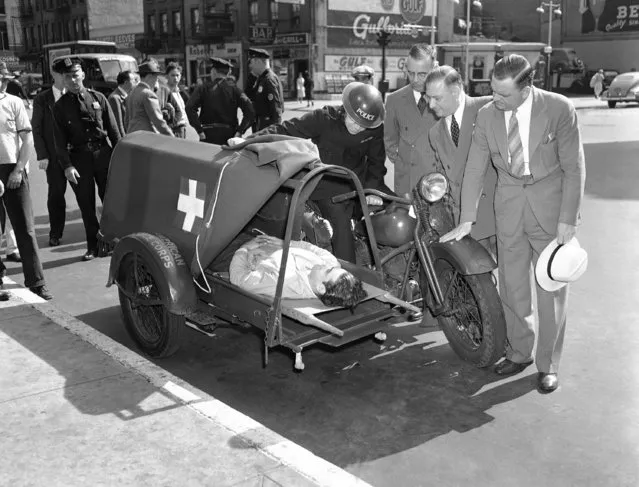
Developed for the British American Ambulance Corps, this new motorcycle ambulance is capable of speeding wounded soldiers 90 miles an hour from the front lines to field hospitals. Its springs are synchronized with the patient?s heartbeat to avoid increasing fever when traveling over various Terrain. Viewing it in New York  August 27, 1941, are left to right: constable Herbert Scott of England, driver; William E. Detlor, whose firm developed the vehicle; M. W. Stand, inspector-general of Civilian Defense, and Maj. Edward Riekert, also. (Photo by AP Photo)

Developed for the British American Ambulance Corps, this new motorcycle ambulance is capable of speeding wounded soldiers 90 miles an hour from the front lines to field hospitals. Its springs are synchronized with the patient's heartbeat to avoid increasing fever when traveling over various Terrain. Viewing it in New York August 27, 1941, are left to right: constable Herbert Scott of England, driver; William E. Detlor, whose firm developed the vehicle; M. W. Stand, inspector-general of Civilian Defense, and Maj. Edward Riekert, also. (Photo by AP Photo)
Details
28 Aug 2015 11:51:00