Loading...
Done
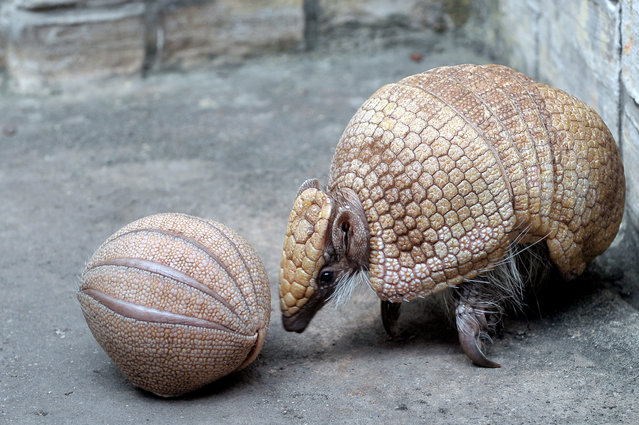
A four-week old southern three-banded armadillo (Tolypeutes matacus) is rolled up into a ball next to its mother in the tropical house of Budapest Zoo in Budapest, Hungary on May 3, 2019. The South American insect-eating mammal and its close relative, the Brasilian three-banded armadillo (Tolypeutes tricinctus) are the only two species of armadillos capable of rolling into a complete ball to defend themselves when feeling threatened. (Photo by Attila Kovács/EPA/EFE)

A four-week old southern three-banded armadillo (Tolypeutes matacus) is rolled up into a ball next to its mother in the tropical house of Budapest Zoo in Budapest, Hungary on May 3, 2019. The South American insect-eating mammal and its close relative, the Brasilian three-banded armadillo (Tolypeutes tricinctus) are the only two species of armadillos capable of rolling into a complete ball to defend themselves when feeling threatened. (Photo by Attila Kovács/EPA/EFE)
Details
05 May 2019 00:03:00
Visitors watch as members of a local winter swimmers club pour buckets of cold water over their daughters, 7-year-old Liza Broverman and 2-year-old Alisa Smagina during a celebration of Polar Bear Day at the Royev Ruchey zoo, with the air temperature at about minus 5 degrees Celsius (23 degrees Fahrenheit), in Krasnoyarsk, Russia, November 27, 2016. (Photo by Ilya Naymushin/Reuters)

Visitors watch as members of a local winter swimmers club pour buckets of cold water over their daughters, 7-year-old Liza Broverman and 2-year-old Alisa Smagina during a celebration of Polar Bear Day at the Royev Ruchey zoo, with the air temperature at about minus 5 degrees Celsius (23 degrees Fahrenheit), in Krasnoyarsk, Russia, November 27, 2016. (Photo by Ilya Naymushin/Reuters)
Details
28 Nov 2016 12:20:00
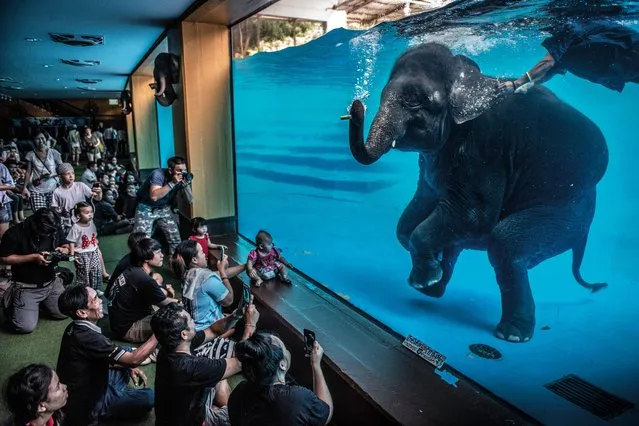
Winner, photojournalism. Elephant in the room, by Adam Oswell, Australia Zoo. Visitors watch a young elephant performing underwater. Oswell was disturbed by this scene, and organisations concerned with the welfare of captive elephants say performances like this encourage unnatural behaviour. In Thailand, there are now more elephants in captivity than in the wild. With the Covid pandemic causing tourism to collapse, elephant sanctuaries are becoming overwhelmed with animals that can no longer be looked after by their owners. (Photo by Adam Oswell/Wildlife Photographer of the Year 2021)

Winner, photojournalism. Elephant in the room, by Adam Oswell, Australia Zoo. Visitors watch a young elephant performing underwater. Oswell was disturbed by this scene, and organisations concerned with the welfare of captive elephants say performances like this encourage unnatural behaviour. In Thailand, there are now more elephants in captivity than in the wild. With the Covid pandemic causing tourism to collapse, elephant sanctuaries are becoming overwhelmed with animals that can no longer be looked after by their owners. (Photo by Adam Oswell/Wildlife Photographer of the Year 2021)
Details
30 Oct 2021 08:40:00
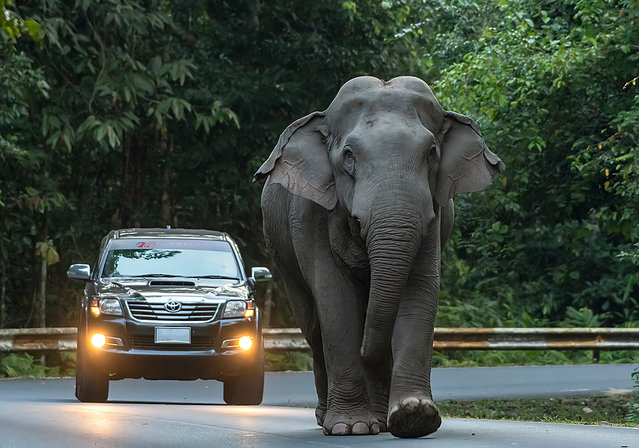
An Asian elephant called “Plai Deaw” goes for a walk on a mountain road in Nakhon Nayok, Thailand on July 11, 2022. The bull has become well known in the area for his taste for venturing out from the deep forest and emerging among cars and village homes. Thailand has an estimated 2,000 Asian elephants living in the wild but there is often conflict when they come into contact with humans on roads and in villages. A similar number of elephants are kept captive where they work in zoos and are hired out for religious festivals and weddings. (Photo by Mongkol Pitakmoo/ViralPress)

An Asian elephant called “Plai Deaw” goes for a walk on a mountain road in Nakhon Nayok, Thailand on July 11, 2022. The bull has become well known in the area for his taste for venturing out from the deep forest and emerging among cars and village homes. Thailand has an estimated 2,000 Asian elephants living in the wild but there is often conflict when they come into contact with humans on roads and in villages. A similar number of elephants are kept captive where they work in zoos and are hired out for religious festivals and weddings. (Photo by Mongkol Pitakmoo/ViralPress)
Details
04 Aug 2022 04:55:00
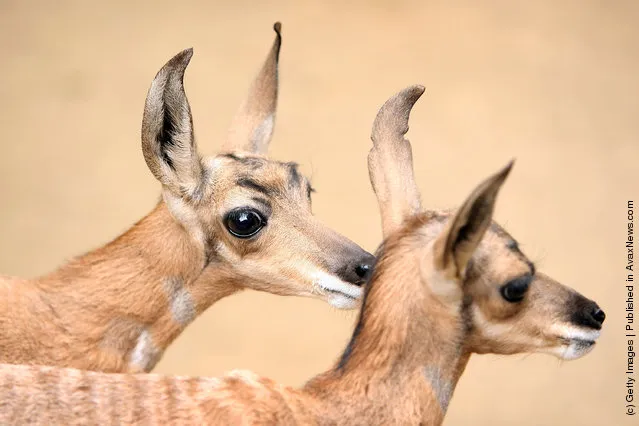
Two rare Peninsular pronghorns

“The Baja California Pronghorn or Peninsular Pronghorn (Antilocapra americana peninsularis) is a critically endangered pronghorn, endemic to Mexico. The wild population is estimated at 200”. – Wikipedia

Photo: Two rare Peninsular pronghorns, male twins was born at the Los Angeles Zoo on April 24, 2009 in Los Angeles, California. Only 250 antelope-like Peninsular pronghorns are believed to exist in the wild. (Photo by David McNew/Getty Images)
Details
07 Nov 2011 11:18:00
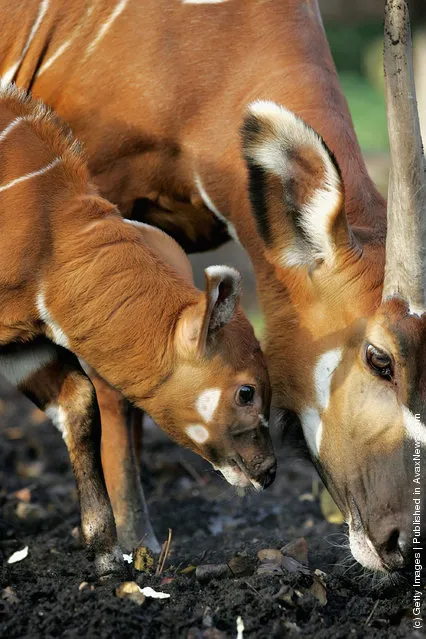
The one month old newborn Bongo Antelope

“The western or lowland bongo is a herbivorous, mostly nocturnal forest ungulate and among the largest of the African forest antelope species. Bongos are characterised by a striking reddish-brown coat, black and white markings, white-yellow stripes and long slightly spiralled horns”. – Wikipedia

Photo: The one month old newborn Bongo Antelope Calf ventures out in the cold with his mother in their enclosure at London Zoo on December 9, 2005 in London, England. (Photo by Christopher Lee/Getty Images)
Details
21 Feb 2012 12:17:00


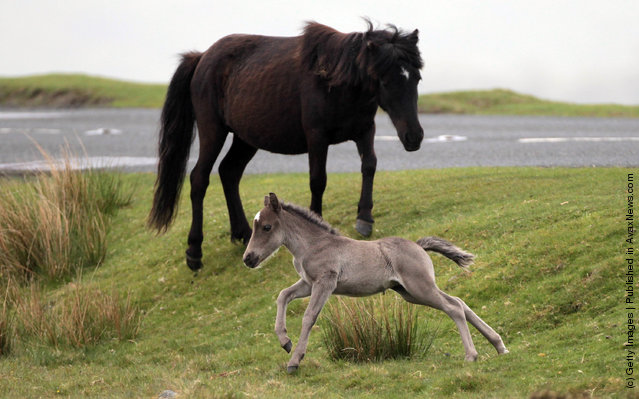
A Dartmoor Hill pony foal runs on the moor on Dartmoor on May 17, 2011 in Princetown England. Although a tourist attraction, especially during the foaling season and often seen as part of the landscape of Dartmoor, many ponies face an uncertain future due to unsustainable breeding and their falling market values. The charity South West Equine Protection estimates that last year 1500 ponies were slaughtered – with many being sold for lion meat to nearby zoos. Along with other equine charities, they are calling for the removal of stallions from the moor to bring numbers down to sustainable levels. (Photo by Matt Cardy/Getty Images)
Details
18 May 2011 11:15:00


In this photo illustration, an endangered Chinese box turtle which hatched at Bristol Zoo is placed on a box of matches on August 12, 2008 in Bristol, England. It weighs just 15 grams and measures around 4cm long whereas an adult box turtle weighs around 800 grams, measures around 16 cm long and can live up to 50 years. Chinese box turtles are hunted for their meat for use in medicine or as pets and have been listed as endangered on the International Union for Endangered Species Red List. (Photo by Matt Cardy/Getty Images)
Details
09 Jul 2011 12:16:00