Loading...
Done
Second Place Winner: “Thunderstorm at False Kiva”. I hiked out to these ruins at night hoping to photograph them with the Milky Way, but instead a thunderstorm rolled through, creating this dramatic image. – Max Seigal. (Photo and caption by Max Seigal/National Geographic Traveler Photo Contest)

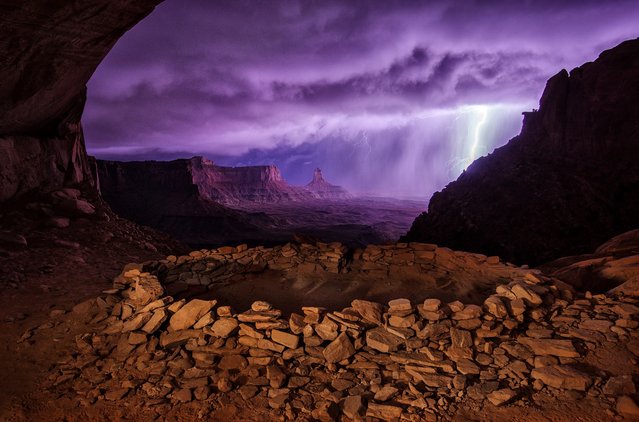
Second Place Winner: “Thunderstorm at False Kiva”. I hiked out to these ruins at night hoping to photograph them with the Milky Way, but instead a thunderstorm rolled through, creating this dramatic image. – Max Seigal. National Geographic Traveler Director of Photography Dan Westergren, one of this year's judges, shares his thoughts on the second place winner: “This photo combines two different scenes into one: the small kiva in a cliff dwelling and the grand vista of Canyonlands National Park across the valley. I really like the two different color palettes – warm inside and purple outside. This two-for-one scene was caused by the lightning storm outside the dwelling, which lit up the landscape like it was a huge electronic flash. Looking at this picture I can imagine what a wonderful sight it must have been for the ancient people who lived here. It doesn't seem too amazing now in our modern world, but might have been mind-blowing for the prehistoric residents”. Location: Utah. (Photo and caption by Max Seigal/National Geographic Traveler Photo Contest)
Details
02 Aug 2013 06:16:00
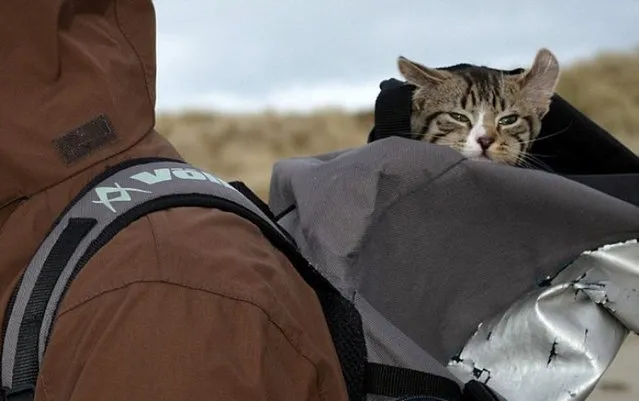
Kitten Who Likes To Travel In A Backpack

Higgs the kitten loves exploring the great outdoors - by going on holiday in his owner’s rucksack.
The adorable five-month-old took his first steps outdoors while holidaying in the Highlands with owners Christian Witte and Kimia Mohammadi last month. But scared by the strong winds along the coastline of Sanna Bay, he scrambled up on Christian's back before hopping into his backpack.
Details
22 Mar 2014 13:30:00
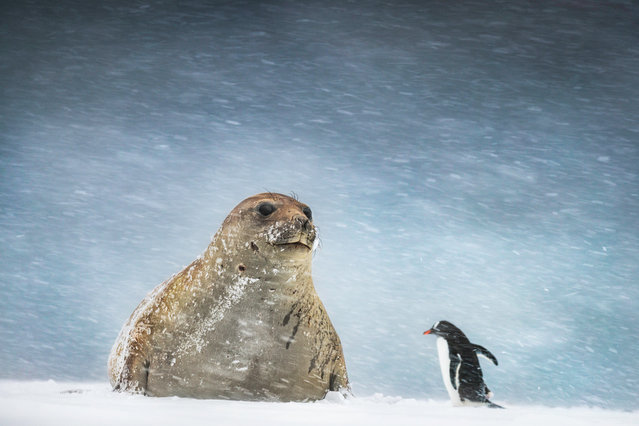
This photo of an elephant seal and Gentoo penguin shot by Andrew James in Yankee Harbour, Antarctica. (Photo by Andrew James/Travel Photographer of the Year)

This photo of an elephant seal and Gentoo penguin shot by Andrew James in Yankee Harbour, Antarctica. (Photo by Andrew James/Travel Photographer of the Year)
Details
12 Apr 2019 00:05:00
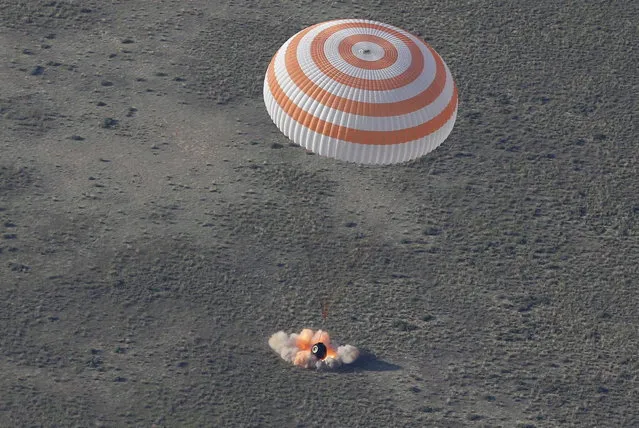
The Soyuz TMA-11M capsule with the International Space Station (ISS) crew members Japanese astronaut Koichi Wakata, Russian cosmonaut Mikhail Tyurin and U.S. astronaut Rick Mastracchio lands south-east of the town of Dzhezkazgan in central Kazakhstan, May 14, 2014. The first Japanese to command a space mission and crewmates from the United States and Russia landed safely in Kazakhstan on Wednesday, wrapping up a 188-day stay aboard the International Space Station. (Photo by Dmitry Lovetsky/Reuters)

The Soyuz TMA-11M capsule with the International Space Station (ISS) crew members Japanese astronaut Koichi Wakata, Russian cosmonaut Mikhail Tyurin and U.S. astronaut Rick Mastracchio lands south-east of the town of Dzhezkazgan in central Kazakhstan, May 14, 2014. The first Japanese to command a space mission and crewmates from the United States and Russia landed safely in Kazakhstan on Wednesday, wrapping up a 188-day stay aboard the International Space Station. (Photo by Dmitry Lovetsky/Reuters)
Details
15 May 2014 07:56:00
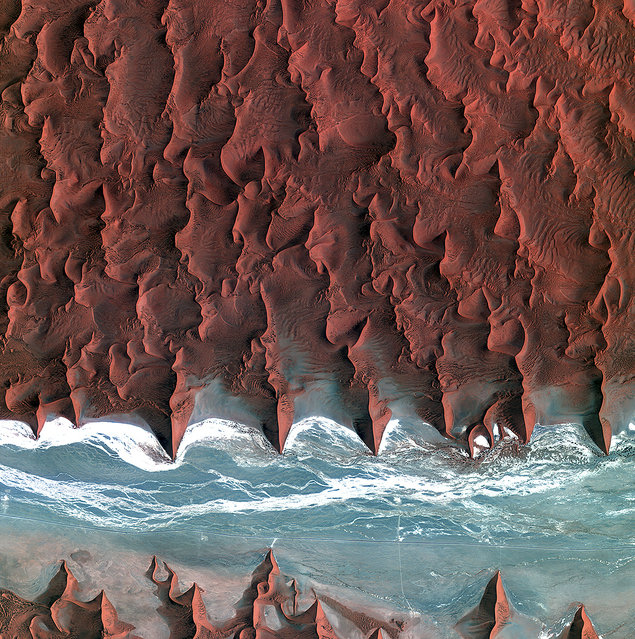
These are the dunes of the Namib Desert, taken by Korea's Kompstat-2 satellite. The blue and white area is the dried riverbed of the Tsauchab river. (Photo by The European Space Agency)

These are the dunes of the Namib Desert, taken by Korea's Kompstat-2 satellite. The blue and white area is the dried riverbed of the Tsauchab river. (Photo by The European Space Agency)
Details
17 Aug 2014 09:13:00
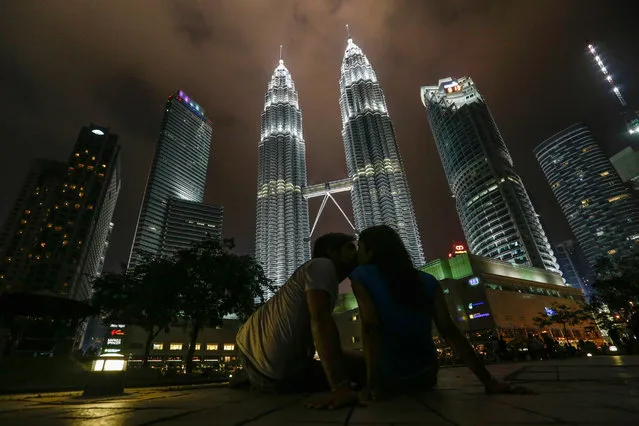
Tourists kissing front of Malaysia's landmark Petronas Twin Towers with lights on before turned off to mark Earth Hour 2016 in Kuala Lumpur, Malaysia, 19 March 2016. Earth Hour takes place worldwide at 8.30 p.m. local time and is a global call to turn off lights for 60 minutes to raise awareness of the danger of global climatic change  (Photo by Fazry Ismail/EPA)

Tourists kissing front of Malaysia's landmark Petronas Twin Towers with lights on before turned off to mark Earth Hour 2016 in Kuala Lumpur, Malaysia, 19 March 2016. Earth Hour takes place worldwide at 8.30 p.m. local time and is a global call to turn off lights for 60 minutes to raise awareness of the danger of global climatic change (Photo by Fazry Ismail/EPA)
Details
20 Mar 2016 11:47:00
Travel Images by Photographer Dougie Wallace

London-based, award winning, Scottish, documentary and street photographer Dougie Wallace, “Glasweegee” grew up in Glasgow. He has lived in east London for 15 years but spends a lot of time travelling abroad in search of subjects.

P.S. Unfortunately, the author doesn't make comments on the photos, therefore it's necessary to guess where there are events: in Thailand, India, Russia or France. On the other hand, photos are very fine in itself, therefore it's absolutely unimportant. Seriously – the magnificent photographer. Enjoy!
Details
19 May 2013 07:25:00
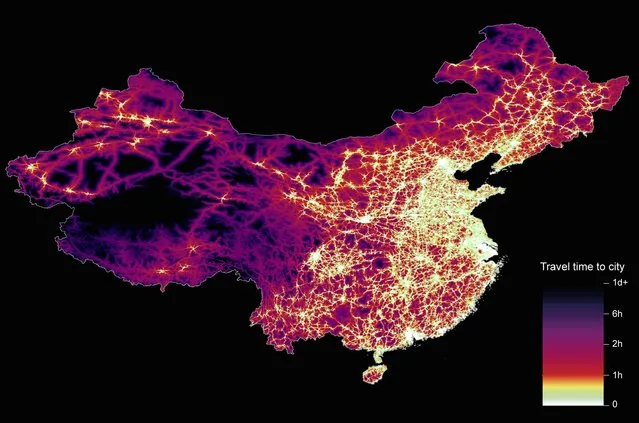
From Britain to China to Mali, new maps showing travel times to the nearest urban centre reveal huge differences between countries. Using Open Street Map and Google, a University of Oxford team have created a visual breakdown that suggests major inequalities when it comes to commuting. Here: China. The dataset used for China was unique as it relied solely on Open Street Map, due to restrictions on accessing Google data. The population is densely concentrated in the east and accessibility is increased, whereas rural provinces in the west remain remote. (Photo by Daniel Weiss/Jennifer Rozier/Malaria Atlas Project/University of Oxford )

From Britain to China to Mali, new maps showing travel times to the nearest urban centre reveal huge differences between countries. Using Open Street Map and Google, a University of Oxford team have created a visual breakdown that suggests major inequalities when it comes to commuting. Here: China. The dataset used for China was unique as it relied solely on Open Street Map, due to restrictions on accessing Google data. The population is densely concentrated in the east and accessibility is increased, whereas rural provinces in the west remain remote. (Photo by Daniel Weiss/Jennifer Rozier/Malaria Atlas Project/University of Oxford)
Details
12 Jan 2018 06:43:00