Loading...
Done
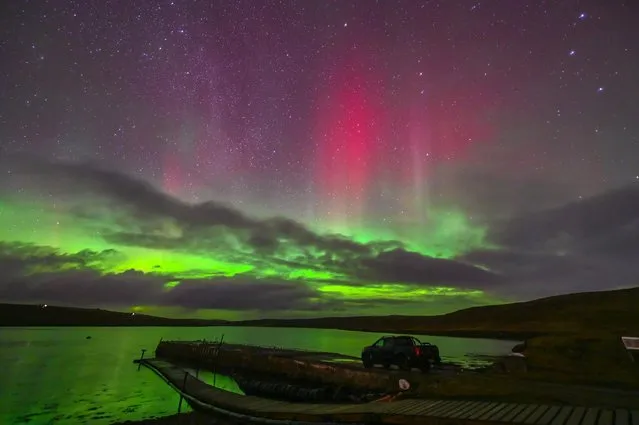
The northern lights as seen from from Yell in the Shetland Islands, Scotland on January 15, 2023. The aurora borealis is caused by collisions between electrically charged particles released from the sun that enter the Earth’s atmosphere and collide with gases such as oxygen and nitrogen. (Photo by Ryan Nisbet/Capture Media Agency)

The northern lights as seen from from Yell in the Shetland Islands, Scotland on January 15, 2023. The aurora borealis is caused by collisions between electrically charged particles released from the sun that enter the Earth’s atmosphere and collide with gases such as oxygen and nitrogen. (Photo by Ryan Nisbet/Capture Media Agency)
Details
23 Feb 2023 04:42:00
On the morning of February 14, 2025, the arrival of spring was celebrated in a festive atmosphere under the Bakul tree at the Faculty of Fine Arts, University of Dhaka. Dressed in vibrant shades of yellow and orange, people welcomed the season with music, dance, and traditional attire, embracing the warmth and joy of new beginnings. (Photo by Rubel Karmaker/ZUMA Press Wire/Alamy Live News)

On the morning of February 14, 2025, the arrival of spring was celebrated in a festive atmosphere under the Bakul tree at the Faculty of Fine Arts, University of Dhaka. Dressed in vibrant shades of yellow and orange, people welcomed the season with music, dance, and traditional attire, embracing the warmth and joy of new beginnings. (Photo by Rubel Karmaker/ZUMA Press Wire/Alamy Live News)
Details
15 Mar 2025 02:01:00
A Brazil fan enjoys the atmosphere prior to the 2014 FIFA World Cup Brazil Semi Final match between Brazil and Germany at Estadio Mineirao in Belo Horizonte, Brazil, on Jule 8, 2014. (Photo by Robert Cianflone/Getty Images)

A Brazil fan enjoys the atmosphere prior to the 2014 FIFA World Cup Brazil Semi Final match between Brazil and Germany at Estadio Mineirao in Belo Horizonte, Brazil, on Jule 8, 2014. (Photo by Robert Cianflone/Getty Images)
Details
12 Jul 2014 16:10:00
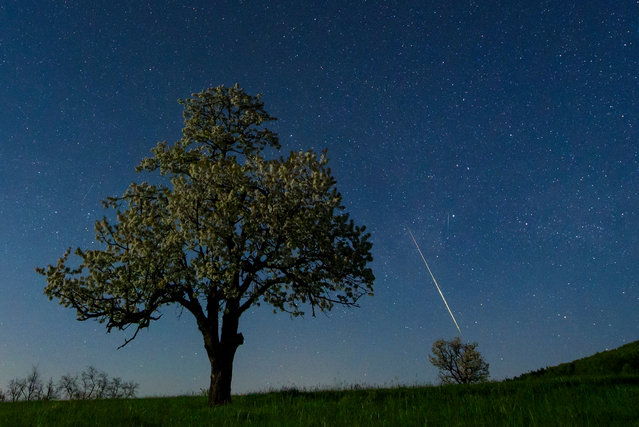
Tiny pieces of space rocks, called meteorites, are seen burning in the atmosphere over the night sky near Salgótarján, some 109km northeast of Budapest, Hungary, 21 April 2018 (issued 22 April 2018). (Photo by Peter Komka/EPA/EFE)

Tiny pieces of space rocks, called meteorites, are seen burning in the atmosphere over the night sky near Salgótarján, some 109km northeast of Budapest, Hungary, 21 April 2018 (issued 22 April 2018). (Photo by Peter Komka/EPA/EFE)
Details
24 Apr 2018 00:03:00
On August 31, 2012, a long filament of solar material that had been hovering in the sun's atmosphere, the corona, erupted out into space at 4:36 p.m. EDT. The coronal mass ejection, or CME, traveled at over 900 miles per second. The CME did not travel directly toward Earth, but did connect with Earth's magnetic environment, or magnetosphere, causing aurora to appear on the night of Monday, September 3. (Photo by NASA/GSFC/SDO)

On August 31, 2012, a long filament of solar material that had been hovering in the sun's atmosphere, the corona, erupted out into space at 4:36 p.m. EDT. The coronal mass ejection, or CME, traveled at over 900 miles per second. The CME did not travel directly toward Earth, but did connect with Earth's magnetic environment, or magnetosphere, causing aurora to appear on the night of Monday, September 3. (Photo by NASA/GSFC/SDO via The Atlantic)
Details
14 Sep 2012 09:01:00
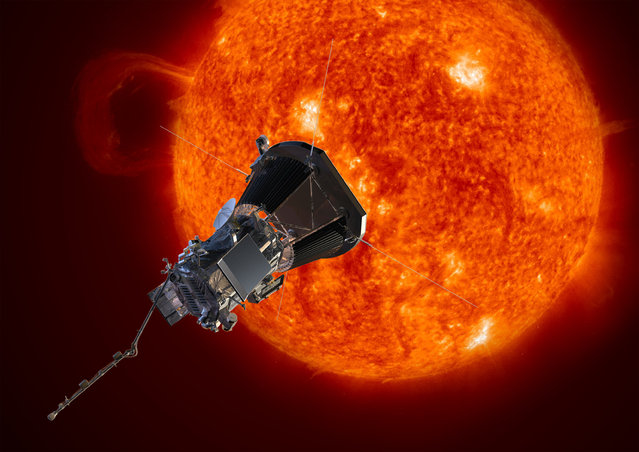
This image made available by the Johns Hopkins University Applied Physics Laboratory on Wednesday, May 31, 2017 depicts NASA's Solar Probe Plus spacecraft approaching the sun. On Wednesday, NASA announced it will launch the probe in summer 2018 to explore the solar atmosphere. It will be subjected to brutal heat and radiation like no other man-made structure before. (Photo by Johns Hopkins University Applied Physics Laboratory via AP Photo)

This image made available by the Johns Hopkins University Applied Physics Laboratory on Wednesday, May 31, 2017 depicts NASA's Solar Probe Plus spacecraft approaching the sun. On Wednesday, NASA announced it will launch the probe in summer 2018 to explore the solar atmosphere. It will be subjected to brutal heat and radiation like no other man-made structure before. (Photo by Johns Hopkins University Applied Physics Laboratory via AP Photo)
Details
08 Sep 2017 09:42:00
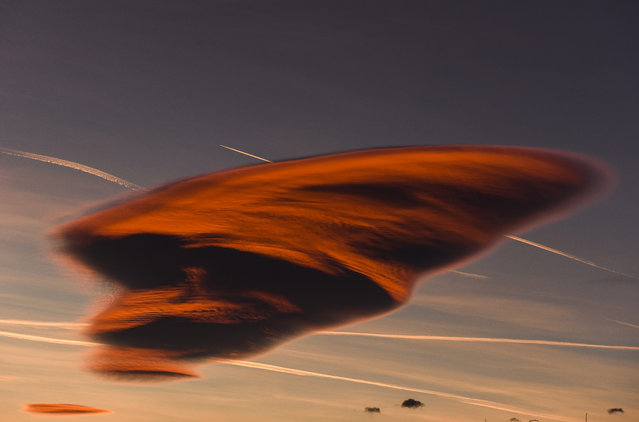
This photo taken on December 2, 2015 shows a lenticular cloud forming as white streaks from airplanes mark the blue sky, in a rare atmospheric phenomena above the town of Gevgelija on December 2, 2015. Lenticular clouds have been regularly confused for UFOs throughout history due to the their smooth, round or oval lens-shaped structure. (Photo by Armend Nimani/AFP Photo)

This photo taken on December 2, 2015 shows a lenticular cloud forming as white streaks from airplanes mark the blue sky, in a rare atmospheric phenomena above the town of Gevgelija on December 2, 2015. Lenticular clouds have been regularly confused for UFOs throughout history due to the their smooth, round or oval lens-shaped structure. (Photo by Armend Nimani/AFP Photo)
Details
31 Dec 2019 00:03:00
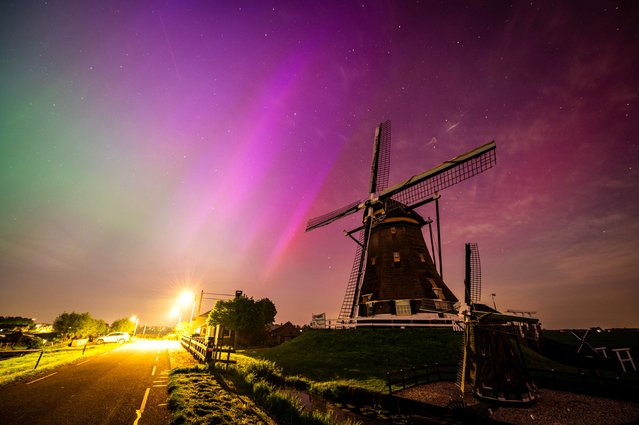
The Northern lights (aurora borealis) lights up the night sky above the Molenviergang in Aarlanderveen, the Netherlands, early on 11 May 2024. The National Oceanic and Atmospheric Administration (NOAA) of America has warned that the strongest geomagnetic storm for 20 years is set to hit Earth, making the Aurora Borealis, or Northern Lights, visible at much lower geomagnetic latitudes than usual. (Photo by Josh Walet/EPA/EFE/Rex Features/Shutterstock)

The Northern lights (aurora borealis) lights up the night sky above the Molenviergang in Aarlanderveen, the Netherlands, early on 11 May 2024. The National Oceanic and Atmospheric Administration (NOAA) of America has warned that the strongest geomagnetic storm for 20 years is set to hit Earth, making the Aurora Borealis, or Northern Lights, visible at much lower geomagnetic latitudes than usual. (Photo by Josh Walet/EPA/EFE/Rex Features/Shutterstock)
Details
17 Aug 2024 04:31:00