Loading...
Done
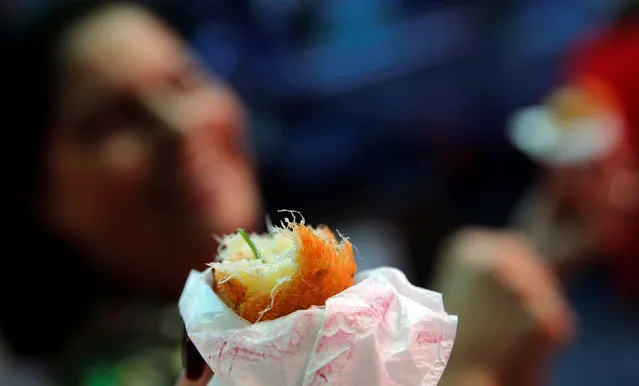
A view of traditional bolinhos de bacalhau (fried codfish balls) in Rio de Janeiro, Brazil, May 7, 2016. (Photo by Sergio Moraes/Reuters)

If the most popular foods of Rio de Janeiro have one thing in common, it is their informality. You can find fine restaurants in the city, but they do not set Rio apart from other places. What does set it apart, and what invariably brings its residents, known as "Cariocas," together is the unpretentious food they eat in bright, loud, crowded bars and restaurants, on busy street corners, or after a day at the beach. Here: A view of traditional bolinhos de bacalhau (fried codfish balls) in Rio de Janeiro, Brazil, May 7, 2016. (Photo by Sergio Moraes/Reuters)
Details
05 Aug 2016 13:20:00
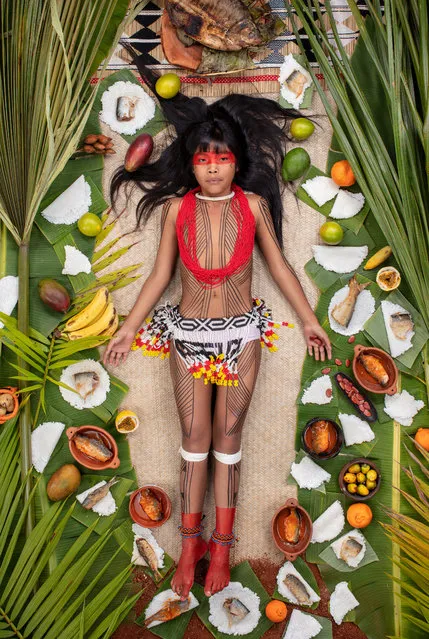
Kawakanih Yawalapiti, 9, Upper Xingu region of Mato Grosso, Brazil, 2018: Kawakanih lives with her tribe, the Yawalapiti, in Xingu national park, a preserve in the Amazon basin of Brazil. The Yawalapiti collect seeds to preserve species unique to their ecosystem, which lies between the rain forest and savannah. Kawakanih’s diet is simple, consisting mainly of fish, cassava, porridge, fruit and nuts. “It takes five minutes to catch dinner”, says Kawakanih. “When you’re hungry, you just go to the river with your net”. (Photo by Gregg Segal/The Guardian)

Photographer Gregg Segal travelled the world to document children and the food they eat in a week. Partly inspired by the increasing problems of childhood obesity, he tracked traditional regional diets as yet unaffected by globalisation, and ironically, found that the healthiest diets were often eaten by the least well off. (Photo by Gregg Segal/The Guardian)
Details
03 Jul 2019 00:03:00
Crowds cheer during a parade before the 23rd annual Wing Bowl at the Wells Fargo Center in Philadelphia, Pennsylvania January 30, 2015. (Photo by Mark Makela/Reuters)

Crowds cheer during a parade before the 23rd annual Wing Bowl at the Wells Fargo Center in Philadelphia, Pennsylvania January 30, 2015. Professional competitive eater from Chicago Patrick “Deep Dish” Bertoletti downed 444 chicken wings in 30 minutes at the 23rd annual Wing Bowl in Philadelphia, narrowly edging out his nearest rival and shattering the record of 363 wings set a year earlier. (Photo by Mark Makela/Reuters)
Details
01 Feb 2015 11:32:00
Polar Bear club swimmers take their annual swim in the sea at Coney Island in New York City on January 1, 2014. (Photo by Curtis Means/ACE/INFphoto.com)

Polar Bear club swimmers take their annual swim in the sea at Coney Island in New York City on January 1, 2014. (Photo by Curtis Means/ACE/INFphoto.com)
Details
03 Jan 2014 10:38:00
A photographer could bear-ly believe his eyes when a bear started waving at him. The friendly animal wandered to the front of his enclosure before sitting back in full view of zoo guests. He then lifts his powerful paw and excitedly waves in an almost human-like way at his new audience. The hilarious encounter was captured by keen photographer Andrey Slepnev, 31, while on a trip to Madrid Zoo, Spain on March 24, 2016. (Photo by Andrey Slepnev/Caters News)

A photographer could bear-ly believe his eyes when a bear started waving at him. The friendly animal wandered to the front of his enclosure before sitting back in full view of zoo guests. He then lifts his powerful paw and excitedly waves in an almost human-like way at his new audience. The hilarious encounter was captured by keen photographer Andrey Slepnev, 31, while on a trip to Madrid Zoo, Spain on March 24, 2016. (Photo by Andrey Slepnev/Caters News)
Details
11 Oct 2016 11:25:00
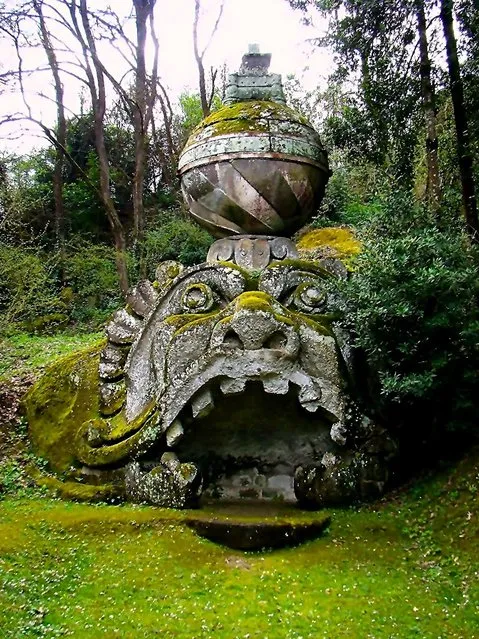
The Park Of Monsters

Bomarzo's main attraction is a garden, usually referred to as the Bosco Sacro (Sacred grove) or, locally, Bosco dei Mostri ("Monsters' Grove"), named after the many larger-than-life sculptures, some sculpted in the bedrock, which populate this predominantly barren landscape.
Details
10 May 2014 11:28:00
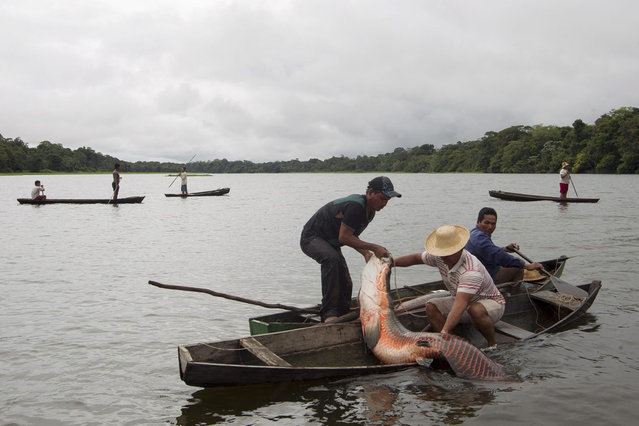
Villagers from the Porto Novo community load into their canoes arapaima or pirarucu, the largest freshwater fish species in South America and one of the largest in the world, while fishing in Poco Fundo lake along a branch of the Solimoes river, one of the main tributaries of the Amazon, in the Mamiraua nature reserve near Fonte Boa about 600 km (373 miles) west of Manaus, November 26, 2013. (Photo by Bruno Kelly/Reuters)

Villagers from the Porto Novo community load into their canoes arapaima or pirarucu, the largest freshwater fish species in South America and one of the largest in the world, while fishing in Poco Fundo lake along a branch of the Solimoes river, one of the main tributaries of the Amazon, in the Mamiraua nature reserve near Fonte Boa about 600 km (373 miles) west of Manaus, November 26, 2013. Catching the arapaima, a fish that is sought after for its meat and is considered by biologists to be a living fossil, is only allowed once a year by Brazil's environmental protection agency. The minimum size allowed for a fisherman to keep an arapaima is 1.5 meters (4.9 feet). (Photo by Bruno Kelly/Reuters)
Details
17 Dec 2013 08:03:00
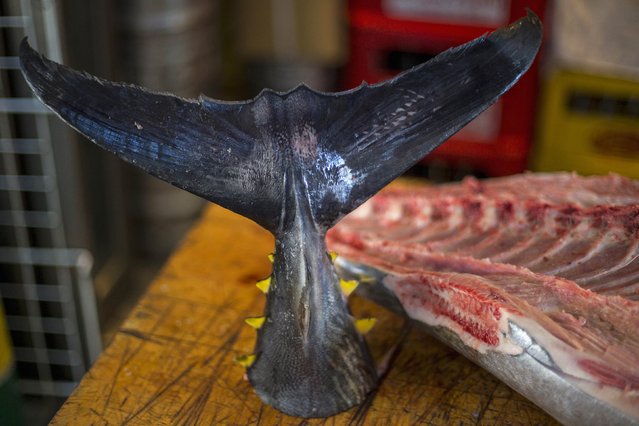
The fin of a tuna is seen on display in the outer part of the Tsukiji fish market, the Jogai Shijo, in Tokyo January 4, 2015. The famous Tsukiji wholesale fish and seafood market, is scheduled to leave its fabled 80-year-old halls to move into bigger, more modern facilities next year ahead of the 2020 Tokyo Olympics. (Photo by Thomas Peter/Reuters)

The fin of a tuna is seen on display in the outer part of the Tsukiji fish market, the Jogai Shijo, in Tokyo January 4, 2015. The famous Tsukiji wholesale fish and seafood market, is scheduled to leave its fabled 80-year-old halls to move into bigger, more modern facilities next year ahead of the 2020 Tokyo Olympics. The outer part of the market, the Jogai Shijo, that caters to the public will stay in its old place, but critics wonder about its chances for survival without the world's biggest fish trading place at its doorsteps. (Photo by Thomas Peter/Reuters)
Details
08 Jan 2015 14:50:00