Loading...
Done
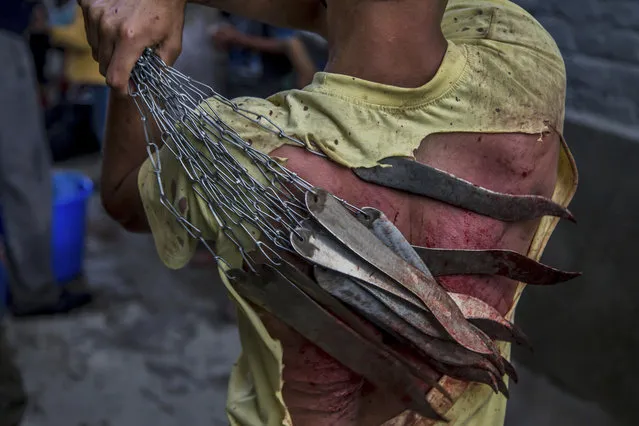
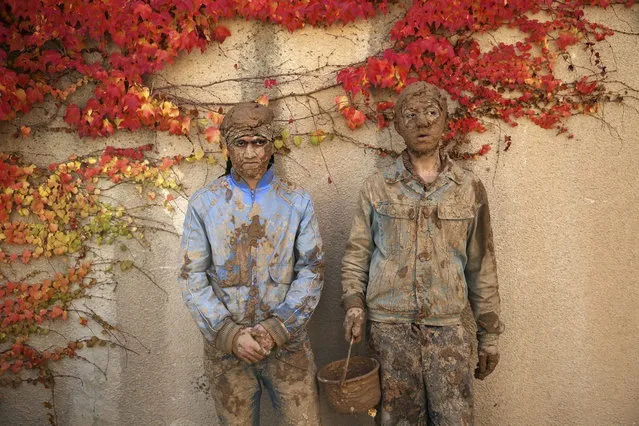
Iranian mourners cover themselves with mud during Ashoura, marking the death anniversary of Imam Hussein, the grandson of Islam's Prophet Muhammad, at the city of Bijar, west of the capital Tehran, Iran, Thursday, November 14, 2013. Hussein, one of Shiite Islam's most beloved saints, was killed in a 7th century battle at Karbala, Iraq. (Photo by Ebrahim Noroozi/AP Photo)

Iranian mourners cover themselves with mud during Ashoura, marking the death anniversary of Imam Hussein, the grandson of Islam's Prophet Muhammad, at the city of Bijar, west of the capital Tehran, Iran, Thursday, November 14, 2013. Hussein, one of Shiite Islam's most beloved saints, was killed in a 7th century battle at Karbala, Iraq. (Photo by Ebrahim Noroozi/AP Photo)
Details
18 Nov 2013 09:13:00
A Syrian boy plays with the head of a sacrificed sheep at a DIP camp for Interally Displaced Persons near the town of Aqrabat in Syria's northern Idlib province on August 12, 2019. Known as the “big” festival, Eid Al-Adha is celebrated each year by Muslims sacrificing various animals according to religious traditions, including cows, camels, goats and sheep. The festival marks the end of the Hajj pilgrimage to Mecca and commemorates Prophet Abraham's readiness to sacrifice his son to show obedience to God. (Photo by Aaref Watad/AFP Photo)

A Syrian boy plays with the head of a sacrificed sheep at a DIP camp for Interally Displaced Persons near the town of Aqrabat in Syria's northern Idlib province on August 12, 2019. Known as the “big” festival, Eid Al-Adha is celebrated each year by Muslims sacrificing various animals according to religious traditions, including cows, camels, goats and sheep. The festival marks the end of the Hajj pilgrimage to Mecca and commemorates Prophet Abraham's readiness to sacrifice his son to show obedience to God. (Photo by Aaref Watad/AFP Photo)
Details
15 Aug 2019 00:05:00
A woman has her hands painted with traditional henna as she attends Eid al-Adha prayers at historical Badshahi mosque in Lahore, Pakistan, Monday, June 17, 2024. Eid al-Adha or Feast of Sacrifice, the most important Islamic holiday, marks the willingness of the Prophet Ibrahim, Abraham to Christians and Jews, to sacrifice his son. During the holiday, which in most places lasts three days, Muslims slaughter goat, sheep or cattle, distribute part of the meat to the poor. (Photo by K.M. Chaudary/AP Photo)

A woman has her hands painted with traditional henna as she attends Eid al-Adha prayers at historical Badshahi mosque in Lahore, Pakistan, Monday, June 17, 2024. Eid al-Adha or Feast of Sacrifice, the most important Islamic holiday, marks the willingness of the Prophet Ibrahim, Abraham to Christians and Jews, to sacrifice his son. During the holiday, which in most places lasts three days, Muslims slaughter goat, sheep or cattle, distribute part of the meat to the poor. (Photo by K.M. Chaudary/AP Photo)
Details
06 Sep 2024 04:02:00
A boy sits next to sacrificial goats resting during Eid al-Adha in New Delhi, India, 29 June 2023. Muslims around the world celebrate Eid al-Adha or feast of sacrifice, by slaughtering sheep, goats and cows to commemorate Prophet Abraham's willingness to sacrifice his son Ismail at God's command. (Photo by Harish Tyagi/EPA)

A boy sits next to sacrificial goats resting during Eid al-Adha in New Delhi, India, 29 June 2023. Muslims around the world celebrate Eid al-Adha or feast of sacrifice, by slaughtering sheep, goats and cows to commemorate Prophet Abraham's willingness to sacrifice his son Ismail at God's command. (Photo by Harish Tyagi/EPA)
Details
07 Jul 2023 02:48:00
Bolshevism - deadly enemy of humanity

Subhuman (book cover) / Germany (1942)


Propaganda is a form of communication aimed towards influencing the attitude of the community toward some cause or position by presenting only one side of an argument. Propaganda statements may be partly false and partly true. Propaganda is usually repeated and dispersed over a wide variety of media in order to create the chosen result in audience attitudes. – Wiki
Details
02 Aug 2013 10:28:00
A fragment of a Koran manuscript is seen in the library at the University of Birmingham in Britain July 22, 2015. A British university said on Wednesday that fragments of a Koran manuscript found in its library were from one of the oldest surviving copies of the Islamic text in the world, possibly written by someone who might have known Prophet Mohammad. (Photo by Peter Nicholls/Reuters)

A fragment of a Koran manuscript is seen in the library at the University of Birmingham in Britain July 22, 2015. A British university said on Wednesday that fragments of a Koran manuscript found in its library were from one of the oldest surviving copies of the Islamic text in the world, possibly written by someone who might have known Prophet Mohammad. Radiocarbon dating indicated that the parchment folios held by the University of Birmingham in central England were at least 1,370 years old, which would make them one of the earliest written forms of the Islamic holy book in existence. (Photo by Peter Nicholls/Reuters)
Details
23 Jul 2015 11:00:00
A woman hangs strips of salted meat she collected from different places during the Muslim's Eid al-Adha or Festival of Sacrifice, in Lahore, Pakistan, Sunday, August 2, 2020. Pakistanis are celebrating the Eid al-Adha, or the Feast of the Sacrifice, to mark the willingness of the Prophet Ibrahim – Abraham to Christians and Jews – to sacrifice his son. During the holiday Muslims slaughter sheep and cattle, distribute part of the meat to the poor. (Photo by K.M. Chaudary/AP Photo)

A woman hangs strips of salted meat she collected from different places during the Muslim's Eid al-Adha or Festival of Sacrifice, in Lahore, Pakistan, Sunday, August 2, 2020. Pakistanis are celebrating the Eid al-Adha, or the Feast of the Sacrifice, to mark the willingness of the Prophet Ibrahim – Abraham to Christians and Jews – to sacrifice his son. During the holiday Muslims slaughter sheep and cattle, distribute part of the meat to the poor. (Photo by K.M. Chaudary/AP Photo)
Details
28 Aug 2020 00:05:00
Shiite Muslims gather, albeit in fewer numbers due to the COVID-19 pandemic, at the Imam Ali shrine in the central Iraqi holy city of Najaf late on May 16, 2020, to mark Lailat al-Qadr, a night in the holy month of Ramadan during which the Koran was first revealed to the Prophet Mohammed in the seventh century. Worshippers placed copies of the Koran on their heads to convey veneration during the overnight prayers in a centuries-old ritual, as they pleaded to God to rid them of the ongoing novel coronavirus pandemic. (Photo by Haidar Hamdani/AFP Photo)

Shiite Muslims gather, albeit in fewer numbers due to the COVID-19 pandemic, at the Imam Ali shrine in the central Iraqi holy city of Najaf late on May 16, 2020, to mark Lailat al-Qadr, a night in the holy month of Ramadan during which the Koran was first revealed to the Prophet Mohammed in the seventh century. Worshippers placed copies of the Koran on their heads to convey veneration during the overnight prayers in a centuries-old ritual, as they pleaded to God to rid them of the ongoing novel coronavirus pandemic. (Photo by Haidar Hamdani/AFP Photo)
Details
19 May 2020 00:07:00