Loading...
Done
The Luminous Lantern Parade on June 10, 2016 in Brisbane, Australia. (Photo by Glenn Hunt/Getty Images)

The Luminous Lantern Parade on June 10, 2016 in Brisbane, Australia. The Luminous Lantern Parade was held at Brisbane’s South Bank on Friday, featuring a parade of glowing animals and characters of all shapes and sizes lighting up the night sky. (Photo by Glenn Hunt/Getty Images)
Details
11 Jun 2016 12:26:00
TomTato Plant Grows Both Tomatoes And Potatoes

Nowadays, crossbreeding and gene splicing are creating things that would never have occurred in nature. Thanks to gene splicing, modern man can witness mice that glow in the dark, goats that produce milk which is then used to make bulletproof vests, and even cows that produce milk that is almost identical to human breast milk. One of the latest feats of human genius is the creation of Thompson and Morgan. By combining the genes of tomatoes and potatoes they were able to create a “TomTato”, which is essentially a plant that grows tomatoes and potatoes at the same time. With creations such as this, the world’s hunger problem may be resolved in a few decades.
Details
12 Dec 2014 12:43:00
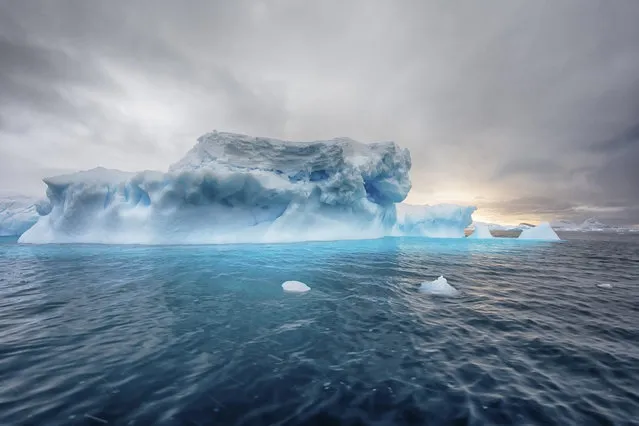
A serene turquoise glow glimmers from underneath these powerful icebergs. Stood in the middle of Antarctica, the giant icebergs appear to be from an unearthly world. These stunning photographs were captured by American photographer Michael Leggero. “My images show pure nature, as that is how I describe Antarctica, simply pure nature”, says the 43 year old, of Carthage, New York. “It is the only place on our planet that humans have not left a presence behind”. (Photo by Michael Leggero/Hotspotmedia/Visual Press Agency)

A serene turquoise glow glimmers from underneath these powerful icebergs. Stood in the middle of Antarctica, the giant icebergs appear to be from an unearthly world. These stunning photographs were captured by American photographer Michael Leggero. “My images show pure nature, as that is how I describe Antarctica, simply pure nature”, says the 43 year old, of Carthage, New York. “It is the only place on our planet that humans have not left a presence behind”. (Photo by Michael Leggero/Hotspotmedia/Visual Press Agency)
Details
07 Aug 2014 10:32:00
This Thursday, January 22, 2015 photo made with a long exposure shows the glow from a Noctiluca scintillans algal bloom along the seashore in Hong Kong. The luminescence, also called Sea Sparkle, is triggered by farm pollution that can be devastating to marine life and local fisheries, according to University of Georgia oceanographer Samantha Joye. (Photo by Kin Cheung/AP Photo)

This Thursday, January 22, 2015 photo made with a long exposure shows the glow from a Noctiluca scintillans algal bloom along the seashore in Hong Kong. The luminescence, also called Sea Sparkle, is triggered by farm pollution that can be devastating to marine life and local fisheries, according to University of Georgia oceanographer Samantha Joye. Noctiluca itself does not produce neurotoxins like other similar organisms do. But its role as both prey and predator tends can eventually magnify the accumulation of toxins in the food chain, according to R. Eugene Turner at Louisiana State University. (Photo by Kin Cheung/AP Photo)
Details
23 Jan 2015 13:12:00
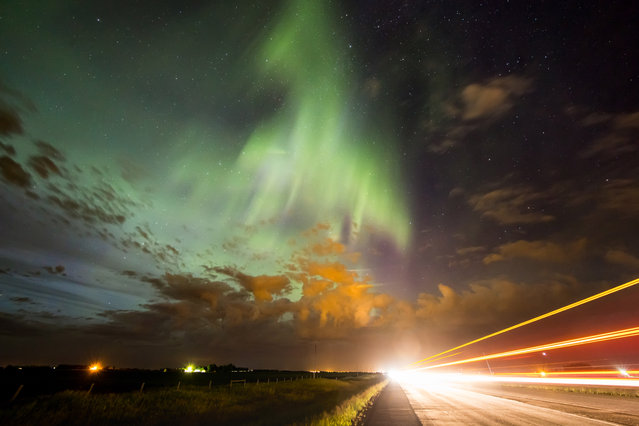
Neil Zeller's snaps were taken across Canada, where he photographs the northern lights dancing across a dark night sky. In one stunning shot, Zeller, 42, even manages to capture a flash of lightning beneath a storm cell while an aurora gives off a magnificent green glow. The photographer, from Calgary, Alberta, describes himself as a night person, and became interested in night photography about 10 years ago. (Photo by Neil Zeller/Caters News)

Neil Zeller's snaps were taken across Canada, where he photographs the northern lights dancing across a dark night sky. In one stunning shot, Zeller, 42, even manages to capture a flash of lightning beneath a storm cell while an aurora gives off a magnificent green glow. The photographer, from Calgary, Alberta, describes himself as a night person, and became interested in night photography about 10 years ago. (Photo by Neil Zeller/Caters News)
Details
01 Jan 2016 08:02:00
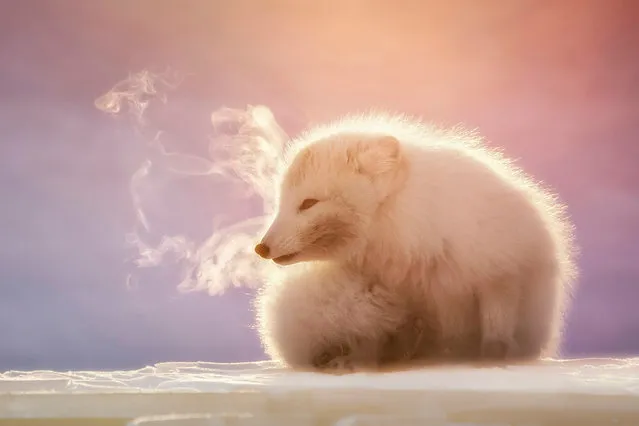
Breath of an Arctic fox by Marco Gaiotti, Italy. Marco was watching this little Arctic fox as it incessantly called another nearby. Gradually he noticed the fox’s wet breath was quickly freezing in the air after each call. It was late winter in Spitsbergen, Svalbard, and the air was -35C (-31F). Photographing Arctic foxes is often frustrating, as they are normally running around fast in search of food, but this one was very relaxed and let Marco get close enough to focus on it, with the light glowing perfectly in the background. (Photo by Marco Gaiotti/Wildlife Photographer of the Year 2021)

Breath of an Arctic fox by Marco Gaiotti, Italy. Marco was watching this little Arctic fox as it incessantly called another nearby. Gradually he noticed the fox’s wet breath was quickly freezing in the air after each call. It was late winter in Spitsbergen, Svalbard, and the air was -35C (-31F). Photographing Arctic foxes is often frustrating, as they are normally running around fast in search of food, but this one was very relaxed and let Marco get close enough to focus on it, with the light glowing perfectly in the background. (Photo by Marco Gaiotti/Wildlife Photographer of the Year 2021)
Details
05 Dec 2021 06:36:00
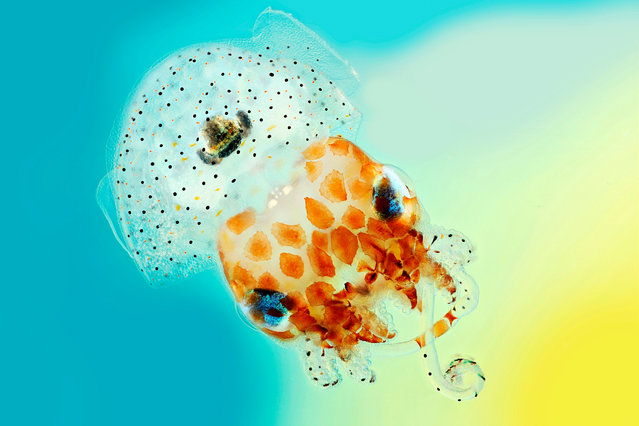
With its huge eyes, comical name and diminutive size, Mark R. Smith’s image of a baby Hawaiian bobtail squid can’t help but raise a smile. A curiously endearing creature, the cephalopod is just 1.5cm across, its mantle cavity bearing more than a passing resemblance to a rather natty shower cap. But it is also a beautiful example of symbiosis – nature’s version of “I’ll scratch your back if you scratch mine” – for on the underside of the squid is a light organ which houses bioluminescent bacteria. The squid offers the bacteria protection and food, while the bacteria emit a glow – a handy trait that the squid uses to offset its silhouette, helping it to evade predators in the depths below. Mark R. Smith’s entry combines several images of a Hawaiian bobtail squid with different focus lengths to create a final picture with greater depth of field than normal. (Photo by Mark R. Smith/Wellcome Images/Macroscopic Solutions)

With its huge eyes, comical name and diminutive size, Mark R. Smith’s image of a baby Hawaiian bobtail squid can’t help but raise a smile. A curiously endearing creature, the cephalopod is just 1.5cm across, its mantle cavity bearing more than a passing resemblance to a rather natty shower cap. But it is also a beautiful example of symbiosis – nature’s version of “I’ll scratch your back if you scratch mine” – for on the underside of the squid is a light organ which houses bioluminescent bacteria. The squid offers the bacteria protection and food, while the bacteria emit a glow – a handy trait that the squid uses to offset its silhouette, helping it to evade predators in the depths below. Mark R. Smith’s entry combines several images of a Hawaiian bobtail squid with different focus lengths to create a final picture with greater depth of field than normal. (Photo by Mark R. Smith/Wellcome Images/Macroscopic Solutions)
Details
08 Mar 2017 00:05:00
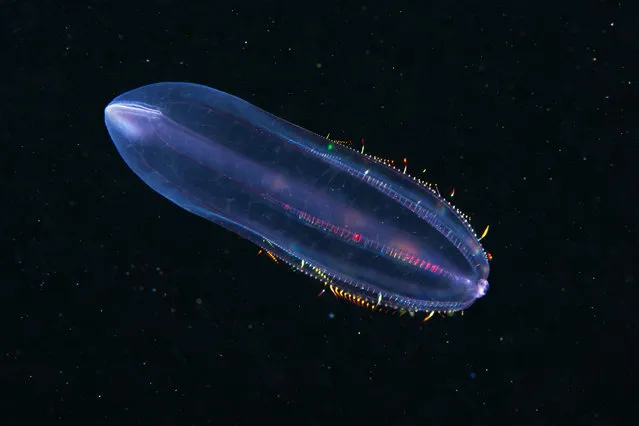
A Comb jelly – Beroe cucumis. (Photo by Alexander Semenovs/Caters News)

Underwater photographer Alexander Semenovs has snapped some of the most stunning, fragile life forms anywhere on planet Earth. Shot in deep, dark conditions, the images continue to provide an insight into what lies beneath, with glowing creatures appearing a lot like aliens in the pitch-black water. Semenovs has shot the likes of bioluminescent jellyfish, aggressive-looking worms and many species that leave a lot to the imagination. The 30-year-old from Moscow does the majority of his work in the White Sea, near the Arctic Circle. Here: A Comb jelly – Beroe cucumis. (Photo by Alexander Semenovs/Caters News)
Details
23 Nov 2015 08:06:00