Syrian refugees sit behind barbed wire as they wait to cross into Macedonia at the Greek-Macedonian border, near the village of Idomeni, August 21, 2015. (Photo by Yannis Behrakis/Reuters)
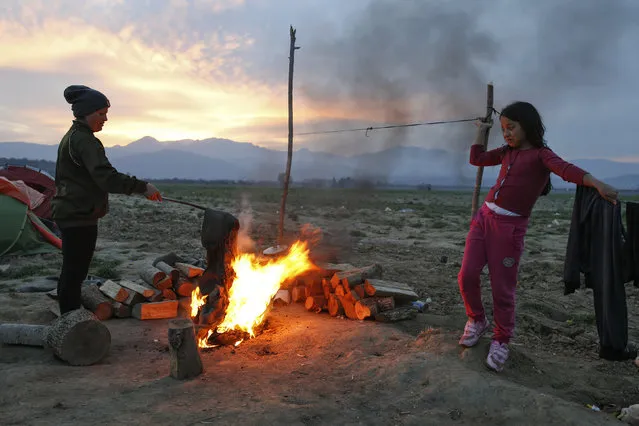
A girl sits on railway tracks at a makeshift camp for refugees and migrants at the Greek-Macedonian border near the village of Idomeni, Greece, March 19, 2016. (Photo by Alkis Konstantinidis/Reuters)
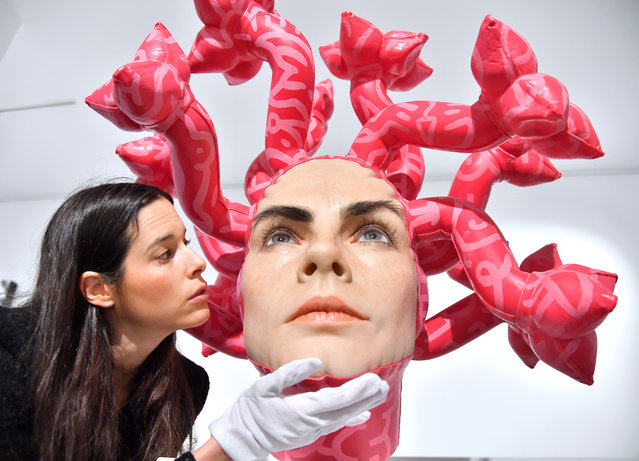
Olympe, the latest creation by artist Aspencrow, is unveiled at JD Malat gallery in London, England on March 27, 2019. It is a sculpture of Cara Delevingne based on the Greek mythological monster Medusa. (Photo by Anthony Harvey/Rex Features/Shutterstock)
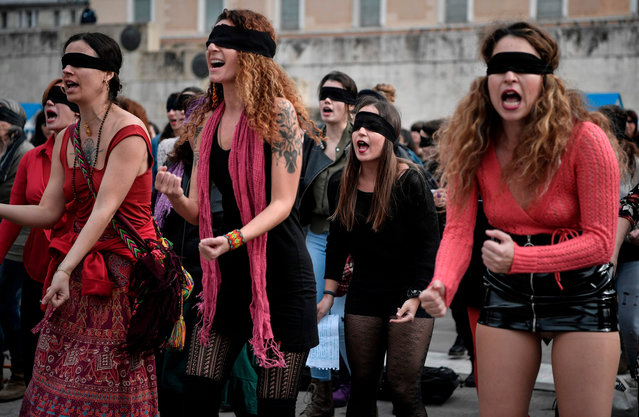
Female activists perform a choreography originated in Chile, and inspired by the Chilean feminist group Las Tesis, to protest against gender violence and patriarchy in front of the Greek parliament at Athens' Syntagma Square on December 22, 2019. (Photo by Louisa Gouliamaki/AFP Photo)
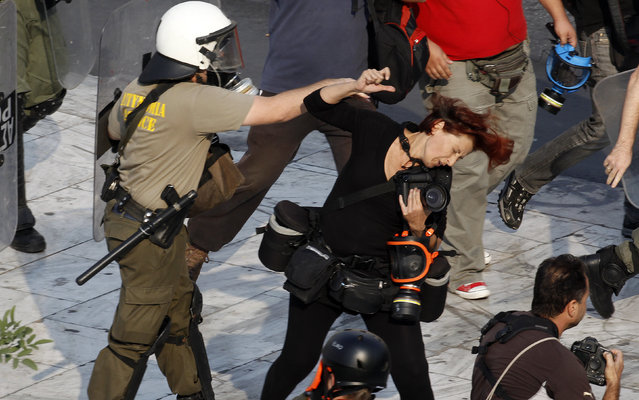
A riot policeman punches Greek photojournalist Tatiana Bolari during a demonstration in Athens' Syntagma (Constitution) square October 5, 2011. Police officers attacked several members of the press covering protests, injuring at least two members of the media. (Photo by Yannis Behrakis/Reuters)
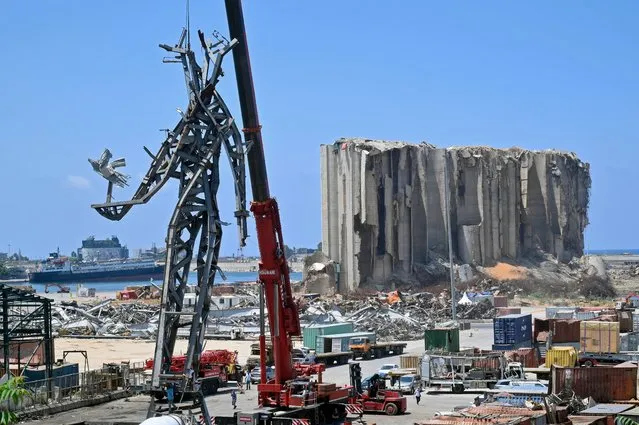
Workers install a monument inside Beirut port as a remembrance for the victims of the 04 August harbor blast in Beirut, Lebanon, 27 July 2021. A massive blast on 04 August 2020 rocked Beirut's port in which at least 200 people were killed and more than 6,000 injured, believed to have been caused by an estimated 2,750 tons of ammonium nitrate stored in a warehouse, devastated the port area of Beirut and several parts of the city. (Photo by Wael Hamzeh/EPA/EFE)
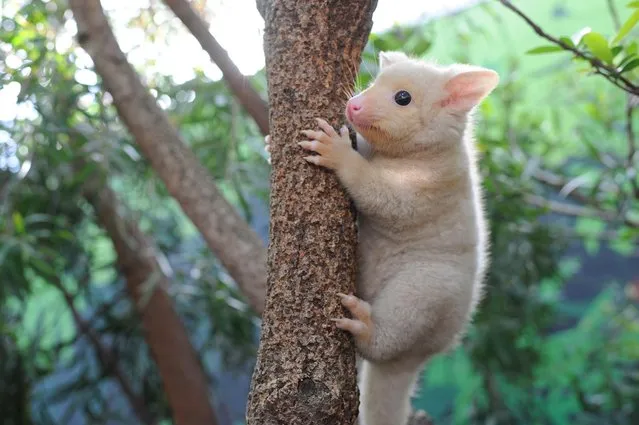
The common brushtail possum (Trichosurus vulpecula, from the Greek for "furry tailed" and the Latin for "little fox", previously in the genus Phalangista) is a nocturnal, semi-arboreal marsupial of the family Phalangeridae, it is native to Australia, and the second largest of the possums.
Few people haven’t heard about the ancient city of Persepolis, which lies at the foot of the Mountain of Mercy (Kuh-I-Rahmat). In ancient times, Persepolis was the capital of the Achaemenid Empire. Regretfully, it was burned by the Greeks in 330 BC after they looted the immense treasure of this city. It is said that Greeks needed 5,000 camels and 20,000 mules to carry all the treasures from Persepolis. The only thing of Persepolis that has survived the wear of time is the ginormous stone terrace 530 by 330 meters adorned by elaborate stone sculptures. It is amazing how intricately detailed some of the sculptures are, despite the fact that they were created many centuries ago.