Loading...
Done
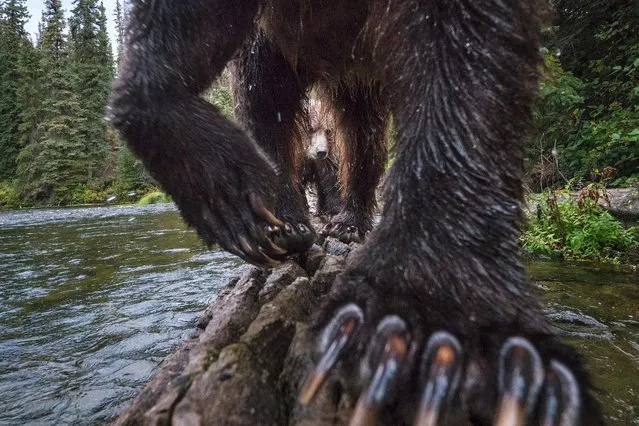
“The Salmon Catchers”. Terrestrial Wildlife. To capture this view of a mother grizzly bear and her cub, photographer Peter Mather set up a camera trap on a log that he knew the bears tended to traverse while fishing for salmon, in the Yukon River watershed in Canada. (Photo by Peter Mather/BigPicture Natural World Photography Competition 2017)

The fourth annual BigPicture Natural World Photography Competition aims to celebrate the diversity of life on Earth, and encourages people to protect and conserve it. Here: “The Salmon Catchers”. Terrestrial Wildlife. To capture this view of a mother grizzly bear and her cub, photographer Peter Mather set up a camera trap on a log that he knew the bears tended to traverse while fishing for salmon, in the Yukon River watershed in Canada. (Photo by Peter Mather/BigPicture Natural World Photography Competition 2017)
Details
02 Jul 2017 07:25:00
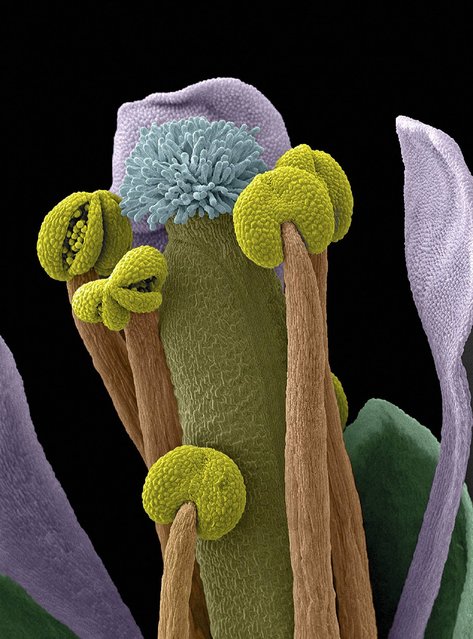
Scanning electron micrograph (SEM) of an Arabidopsis thaliana flower, also commonly known as thale cress. Some of the anthers are open, revealing pollen grains ready for dispersal. Arabidopsis was the first plant to have its entire genome sequenced and is widely used as a model organism in molecular and plant biology. Horizontal width of image is 1200 microns. Magnification 100x. (Photo by Stefan Eberhard/Wellcome Images)

Beautiful, strange and occasionally alarming pictures from the shortlist for this year’s Wellcome image awards – which celebrate the very best in science photography and imaging – from an x-ray of a bat to a micrograph of a kidney stone. The exhibition opens on 12 March at three science centres and the Museum of Science and Industry in Manchester. Photo: Scanning electron micrograph (SEM) of an Arabidopsis thaliana flower, also commonly known as thale cress. Some of the anthers are open, revealing pollen grains ready for dispersal. Arabidopsis was the first plant to have its entire genome sequenced and is widely used as a model organism in molecular and plant biology. Horizontal width of image is 1200 microns. Magnification 100x. (Photo by Stefan Eberhard/Wellcome Images)
Details
11 Mar 2014 05:58:00
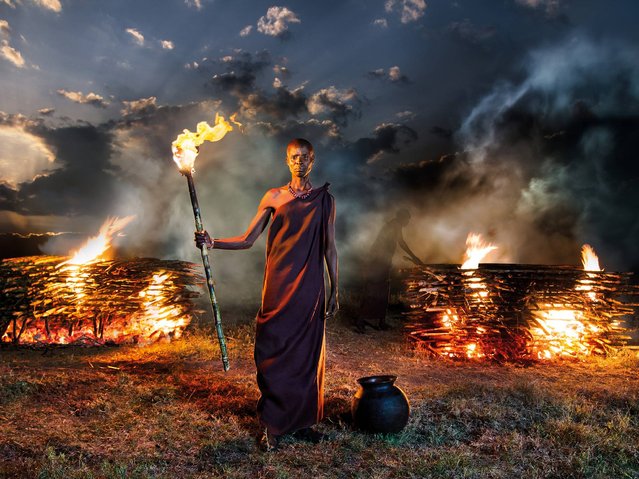
“The Salt of the Presidium”. Andrew Wanyonyi Sikanga is a salt producer in Nabuyole, western Kenya, who produces salt from an aquatic plant. (Photo by Steve McCurry/2015 Lavazza Calendar)

Extraordinary tales of everyday heroism have been illustrated beautifully by renowned US photographer Steve McCurry in the new 2015 Lavazza Calendar. The calendar which has been created in collaboration with the Slow Food movement, features twelve breathtaking pictures, capturing the spirit, strength and humanity of the Earth Defenders – women and men who protect their land and projects in Africa with passion and bravery. The proceeds from sales of the calendar and all donations will be contributed entirely to create 10,000 food gardens in African schools and villages by the end of 2016. (Photo by Steve McCurry/2015 Lavazza Calendar)
Details
27 Oct 2014 12:08:00
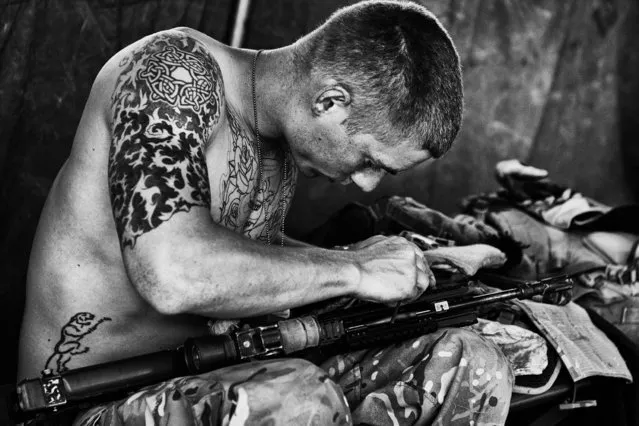
Jamie's overall winning image entitled “Celtic Warrior” and shows Private Ross Cunningham from 1 Scots cleaning his personal weapon. (Photo by Jamie Peters/PA Vire)

A Scots soldier has won a top award for his photos vividly depicting Army life in Afghanistan. Corporal Jamie Peters took the overall first prize for his portfolio in the annual Army Photographic Competition. Photo: Jamie's overall winning image entitled “Celtic Warrior” and shows Private Ross Cunningham from 1 Scots cleaning his personal weapon. (Photo by Jamie Peters/PA Wire)
Details
10 Oct 2013 11:59:00


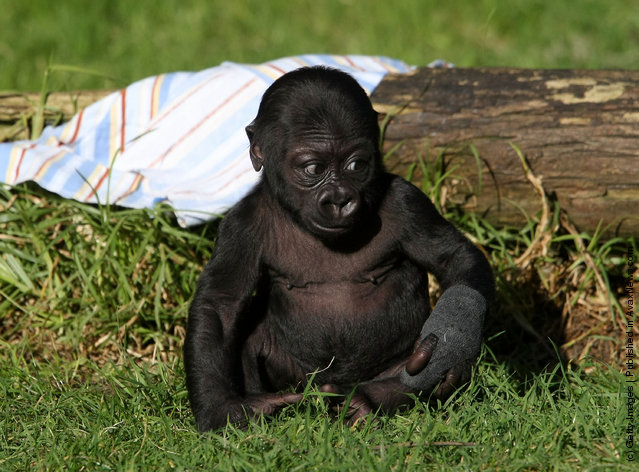
A three month-old baby gorilla named Hasani sits in the grass March 11, 2009 at the San Francisco Zoo in San Francisco, California. The newborn gorilla was given the name Hasani. Hasani's father, a twenty seven year-old gorilla named Oscar Jonsey, picked between five color coded cantaloupes representing the five name finalists to come up with the newborn's name that was submitted by Amanda VerPloeg of Oskaloosa, Iowa. (Photo by Justin Sullivan/Getty Images)
Details
30 Mar 2011 13:46:00


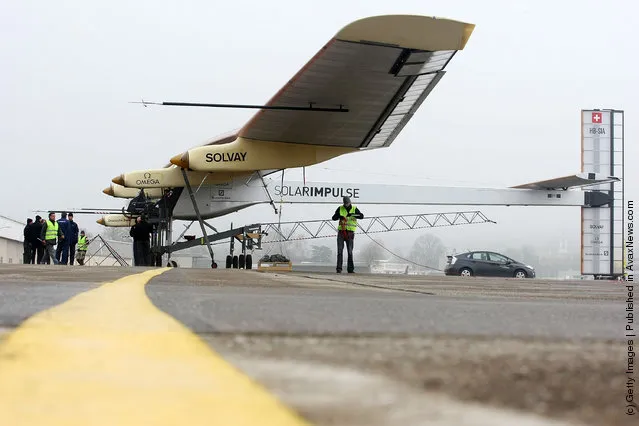
“Solar Impulse is a European long-range solar powered plane project being undertaken by Bertrand Piccard and André Borschberg. The project eventually hopes to succeed in the first circling of the earth with a piloted fixed-wing aircraft using only solar power. The first aircraft, bearing the Swiss aircraft registration code of HB-SIA, is a single-seater, capable of taking off under its own power, and intended to remain airborne up to 36 hours. This aircraft first flew an entire diurnal solar cycle, including nearly 9 hours of night flying, in a 26-hour flight on 7–8 July 2010”. – Wikipedia


Photo: Workers prepare the Solar Impulse airplane HB-SIA for a first runway test on November 19, 2009 in Dubendorf, Switzerland. Solar Impulse chairman Bertrand Piccard, psychatrist and aeronaut, who made the first non-stop round-the-world balloon flight, and CEO and former fighter pilot Andrй Borschberg plan a round-the-world flight, driven only by solar energy, for 2012. (Photo by Johannes Simon/Getty Images)
Details
16 May 2011 08:13:00
Nuclear Football

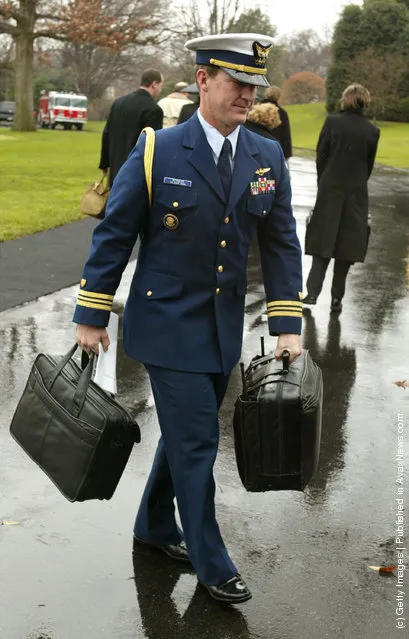
“The nuclear football (also known as the atomic football, the president's emergency satchel, the button, the black box, or just the football) is a briefcase, the contents of which are to be used by the President of the United States of America to authorize a nuclear attack while away from fixed command centers, such as the White House Situation Room. It functions as a mobile hub in the strategic defense system of the United States. It is a metallic Zero Halliburton briefcase carried in a black leather “jacket”. The package weighs around 45 pounds (20 kilograms). A small antenna protrudes from the bag near the handle”. – Wikipedia

Photo: A U.S. Military officer carries the “football”, which carries nuclear launch codes, on South Lawn after returning with U.S. President George W. Bush to the White House January 7, 2002 in Washington, DC. (Photo by Mark Wilson/Getty Images)
Details
06 Aug 2011 12:53:00


“Dover Castle is a medieval castle in the town of the same name in the English county of Kent. It was founded in the 12th century and has been described as the “Key to England” due to its defensive significance throughout history. It is the largest castle in England.

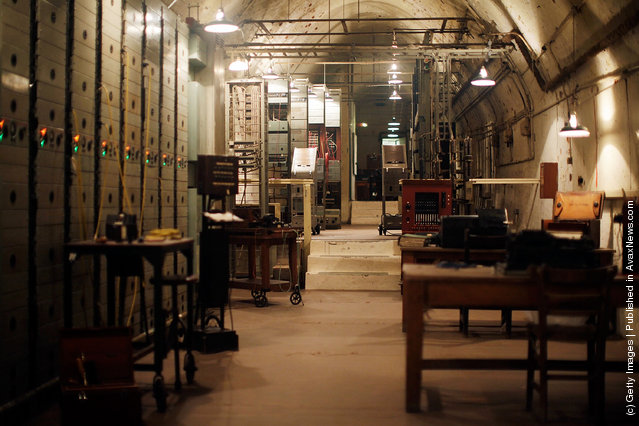
The outbreak of the Second World War in 1939 saw the tunnels converted first into an air-raid shelter and then later into a military command centre and underground hospital. In May 1940, Admiral Sir Bertram Ramsey directed the evacuation of French and British soldiers from Dunkirk, code-named Operation Dynamo, from his headquarters in the cliff tunnels”. – Wikipedia

Photo: The Repeater Station in the subterranean tunnels underneath Dover Castle, which has been restored by English Heritage for a public exhibition on June 3, 2011 in Dover, England. The evacuation of allied soldiers from Dunkirk was masterminded and co-ordinated from the secret command and control centre in the tunnels deep below the castle. (Photo by Matthew Lloyd/Getty Images)
Details
07 Jun 2011 09:26:00