Loading...
Done
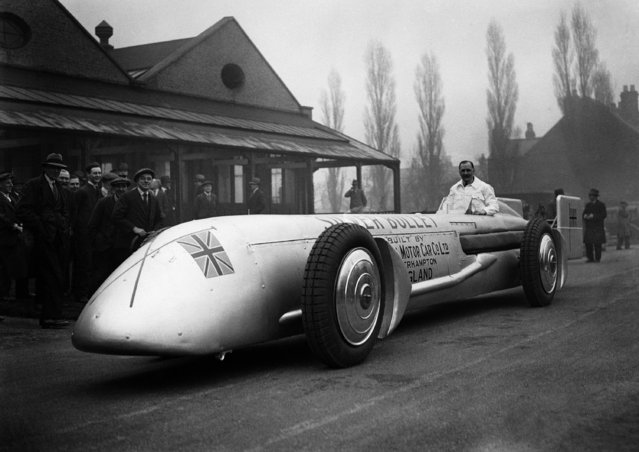
Kaye Don seated in the cockpit of his new racing car the “Silver Bullet” at Wolverhampton, England on February 21, 1930, in which he will attempt to beat world land speed record at Daytona. It has two 12-cylinder V shaped engines and each develops 2,000-h.p. The theoretical speed of the car is 275 m.p.h. but the designer estimated that will be able to reach 250 m.p.h. allowing for wind pressures. (Photo by AP Photo/Staff/Puttnam)

Kaye Don seated in the cockpit of his new racing car the “Silver Bullet” at Wolverhampton, England on February 21, 1930, in which he will attempt to beat world land speed record at Daytona. It has two 12-cylinder V shaped engines and each develops 2,000-h.p. The theoretical speed of the car is 275 m.p.h. but the designer estimated that will be able to reach 250 m.p.h. allowing for wind pressures. (Photo by AP Photo/Staff/Puttnam)
Details
03 Mar 2018 00:03:00
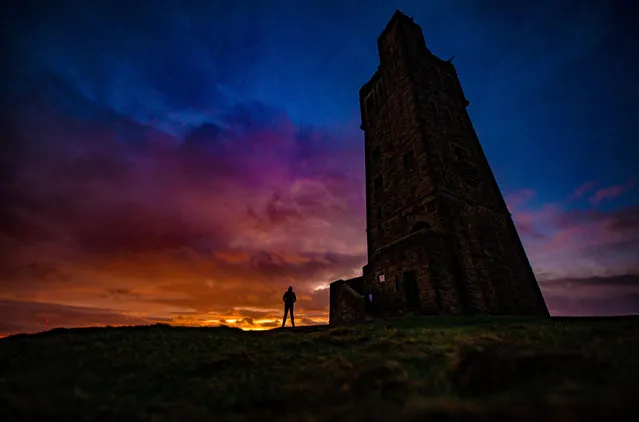
A colourful morning sunrise on Christmas Eve at Victoria Tower on Castle Hill, West Yorkshire, England on December 24, 2017. The history of human activity on the Castle Hill goes back over 4000 years. The site was developed as an iron age hill fort, surrounded by defensive ditches and ramparts. In the Middle Ages there was a castle on the hill, of which the well remains. The present tower was built to commemorate Queen Victoria's Diamond Jubilee of 1897. (Photo by Charlotte Graham/ZUMA Wire/Rex Features/Shutterstock)

A colourful morning sunrise on Christmas Eve at Victoria Tower on Castle Hill, West Yorkshire, England on December 24, 2017. The history of human activity on the Castle Hill goes back over 4000 years. The site was developed as an iron age hill fort, surrounded by defensive ditches and ramparts. In the Middle Ages there was a castle on the hill, of which the well remains. The present tower was built to commemorate Queen Victoria's Diamond Jubilee of 1897. (Photo by Charlotte Graham/ZUMA Wire/Rex Features/Shutterstock)
Details
31 Mar 2018 00:03:00
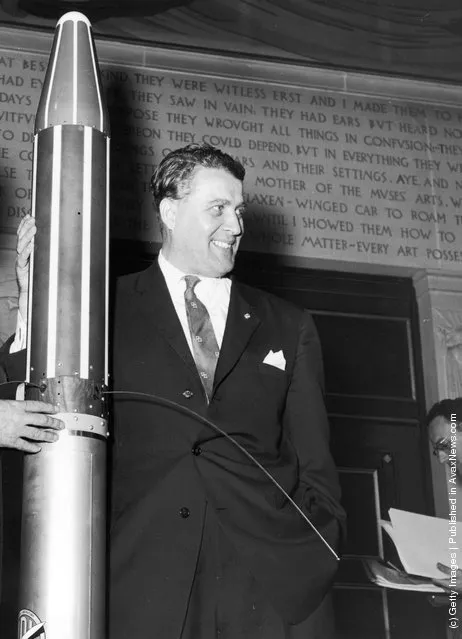
German-born American engineer Dr Wernher von Braun (1912 - 1977) with a model of the Explorer orbiting space satellite which he designed, 1958

“Wernher Magnus Maximilian Freiherr von Braun (March 23, 1912 – June 16, 1977) was a German-born rocket scientist, aerospace engineer, space architect, and one of the leading figures in the development of rocket technology in Nazi Germany during World War II and, subsequently, the United States”. – Wikipedia

Photo: German-born American engineer Dr. Wernher von Braun with a model of the Explorer orbiting space satellite which he designed. (Photo by Keystone/Getty Images). 1958
Details
22 Mar 2012 11:18:00
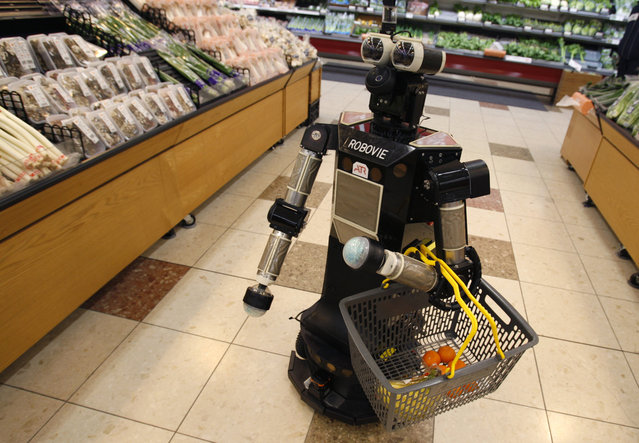
A robot named “Robovie-II”, developed by Japanese robotics research institution ATR, moves around at a grocery store during a shopping assisting experiment by utilizing the robot in an ubiquitous network technology platform in Kyoto, western Japan January 6, 2010. The robot greets the shopper at the entrance of the store, follows him to the shelves while holding a grocery basket and reminds him of the items on a shopping list, which the shopper would have entered beforehand in a specialized mobile device. The experiment is aimed to gather data in order to provide livelihood support for the elderly by using robots and network technologies, ATR's researcher Satoshi Koizumi said. (Photo by Yuriko Nakao/Reuters)

A robot named “Robovie-II”, developed by Japanese robotics research institution ATR, moves around at a grocery store during a shopping assisting experiment by utilizing the robot in an ubiquitous network technology platform in Kyoto, western Japan January 6, 2010. (Photo by Yuriko Nakao/Reuters)
Details
02 Feb 2018 06:54:00
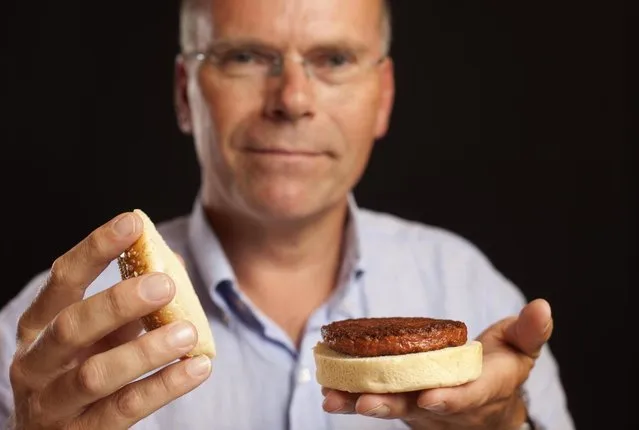
In this handout image provided by Ogilvy, a burger made from cultured beef, which has been developed by Professor Mark Post of Maastricht University in the Netherlands (pictured) is shown to the media during a press conference on August 5, 2013 in London, England. Cultured Beef could help solve the coming food crisis and combat climate change with commercial production of Cultured Beef beginning within ten to twenty years. (Photo by David Parry via Getty Images)

In this handout image provided by Ogilvy, a burger made from cultured beef, which has been developed by Professor Mark Post of Maastricht University in the Netherlands (pictured) is shown to the media during a press conference on August 5, 2013 in London, England. The in-vitro burger, cultured from cattle stem cells, the first example of what its creator says could provide an answer to global food shortages and help combat climate change, was fried in a pan and tasted by two volunteers. The burger is the result of years of research by Dutch scientist Mark Post, a vascular biologist at the University of Maastricht, who is working to show how meat grown in petri dishes might one day be a true alternative to meat from livestock.The meat in the burger has been made by knitting together around 20,000 strands of protein that has been cultured from cattle stem cells in Post's lab. (Photo by David Parry)
Details
06 Aug 2013 08:48:00
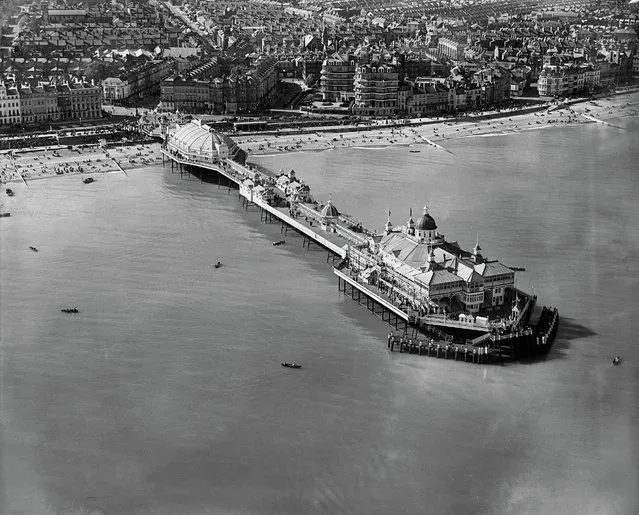
While the lido was described as bringing “modernism to the masses” on the British coast it was just the latest example of a trend that had been developing since Victorian times – transforming seaside towns into resorts for leisure and entertainment. In the latter half of the nineteenth century, the fashion was for local authorities to build great piers stretching from the promenade out into the sea

While the lido was described as bringing “modernism to the masses” on the British coast it was just the latest example of a trend that had been developing since Victorian times – transforming seaside towns into resorts for leisure and entertainment. In the latter half of the nineteenth century, the fashion was for local authorities to build great piers stretching from the promenade out into the sea. The Eastbourne Pier, pictured here in May 1931, was erected between 1866 and 1870 to an ingenious design by Eugenius Birch, which saw the structure sitting on special cups allowing the supporting struts to “move” in bad weather. Arranged on the pier's 1,000-foot length were kiosks, a theatre, a ballroom and a camera obscura. 1931. (Photo by Aerofilms Collection via “A History of Britain From Above”)
Details
25 Feb 2014 12:59:00
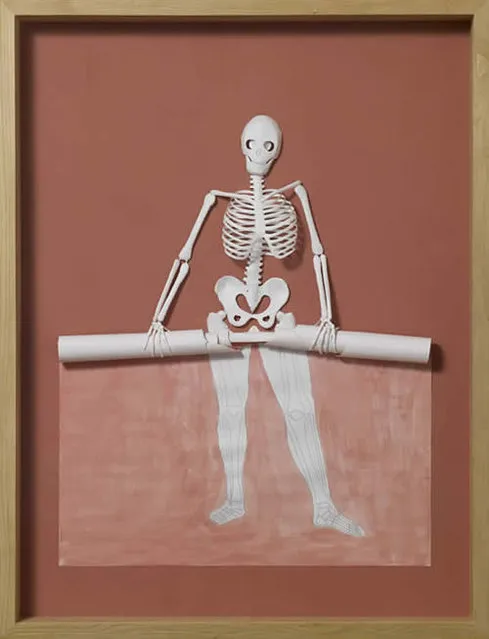
Art by Peter Callesen

Paper was considered to be primary medium for expressing for artistic. Now, Digital Art taken a space of Paper, Writers and designers develop their ideas on Digit media.

Peter Callesen is one of the finest artists which shown its creative and unbelievable paper Art. His paper work has been based around an exploration of the relationship between two and three dimensionality. He find this materialization of a flat piece of paper into a 3D form almost a magic process – or maybe one could call it obvious magic.We hope that you will like this awesome collection, feel free to share your comments.
Details
09 Nov 2012 11:17:00
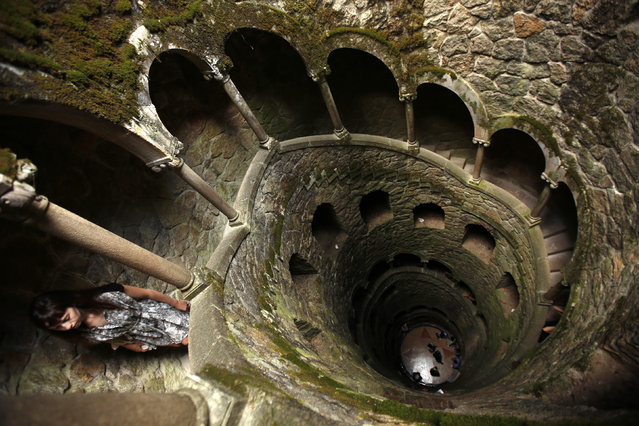
A visitor walks inside the initiation well at Quinta da Regaleira in Sintra October 6, 2014. (Photo by Rafael Marchante/Reuters)

A visitor walks inside the initiation well at Quinta da Regaleira in Sintra October 6, 2014. Sintra became the first centre of European Romantic architecture in the 19th century, which influenced the development of landscape architecture throughout Europe. It was classified as a World Heritage Site by UNESCO in 1995. Its monuments are visited by more than 1.5 million of tourists every year, according to local media. (Photo by Rafael Marchante/Reuters)
Details
28 Oct 2014 12:35:00