Loading...
Done
German artist Ha Schult stands with his trash people below the pyramids May 15, 2002 in Giza, Egypt

“HA Schult, born Hans-Jürgen Schult on June 24, 1939 in Parchim, Mecklenburg is a German installation, happening and conceptual artist known primarily for his object and performance art and more specifically his work with garbage”. – Wikipedia

Photo: German artist Ha Schult stands with his “trash people” below the pyramids May 15, 2002 in Giza, Egypt. Inspired by the statues of the terracotta army of Chinese Emperor Quin Shi Huangdi (247–206 B.C.), the thousand piece sulpture has stood in Red Square in Moscow, La Defense in Paris and the Great Wall in China. Schult, born in 1939 wants to bring the “trash war” to the world's attention beause trash is the greatest battle facing mankind. (Photo by Norbert Schiller/Getty Images)
Details
31 Jul 2011 13:37:00
A car2go employee shows how members can use a smartphone or iPad app to locate and reservec car2go vehicles March 22, 2012 in Washington, DC

“Car2go fleet is located throughout the greater downtown area and can be accessed on-demand or booked 24 hours in advance. The members may use the vehicle for as long as they like, without committing to a specific return time or return location”. – Wikipedia

Photo: A car2go employee shows how members can use a smartphone or iPad app to locate and reservec car2go vehicles March 22, 2012 in Washington, DC. Beginning March 24, car2go will offer the first free-floating car-sharing service in Washington and Portland, Oregon, where customers can use the smartphone app within the 34-square-mile “Home Area”. After paying a one-time $35 membership fee, drivers can then rent the Smart Fortwo vehicles by the minute, paying only for the time they use the vehicle, with discounted rates for hourly and daily use. (Photo by Chip Somodevilla/Getty Images)
Details
23 Mar 2012 10:58:00
Participants take part in the world's first “Pokemon Go” competition in Hong Kong, China, August 6, 2016. (Photo by Tyrone Siu/Reuters)

Participants take part in the world's first “Pokemon Go” competition in Hong Kong, China, August 6, 2016. The competition began around 2 in the afternoon local time when organizers began announcing the rules on their Facebook page. Contestants had to take screenshots of 12 specific Pokémon in three different districts. Apart from the 12 key Pokémon, participants could also catch designated rare Pokemons which would take off some minutes from their total time. The winner was 21 year old Frankie Chu. The champ took home roughly three hundred and eighty six dollars that he says he will use to pay his school fees. (Photo by Tyrone Siu/Reuters)
Details
07 Aug 2016 09:05:00
Bull tamers try to control a bull during the bull-taming sport called Jallikattu, in Palamedu, about 575 kilometers (359 miles) south of Chennai, India, Tuesday, Jan. 15, 2013. (Photo by Arun Sankar K./AP Photo)

“Jallikattu is a bull taming sport played in Tamil Nadu as a part of Pongal celebrations on Mattu Pongal day. Annually, jallikattu is held from January to July, played first in world-famous Palamedu, near Madurai on January 15 followed by “Alanganallur-jallikattu” in Alanganallur, near Madurai on 16 January. There is a specific breed of cattle bred for this purpose known as Jellicut and from the place of a big breeder Pulikulam”. – Wikipedia. Photo: Bull tamers try to control a bull during the bull-taming sport called Jallikattu, in Palamedu, about 575 kilometers (359 miles) south of Chennai, India, Tuesday, January 15, 2013. (Photo by Arun Sankar K./AP Photo)
Details
17 Jan 2014 10:06:00
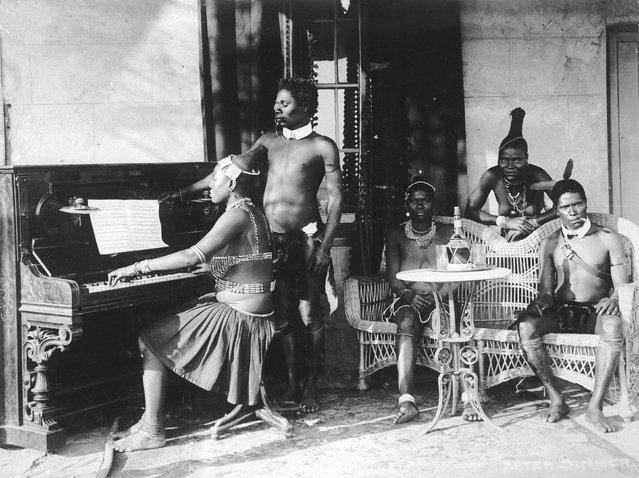
circa 1925:  A Zulu woman playing the piano while a group of others sit and listen.  (Photo by General Photographic Agency/Getty Images)

“The Zulu are the largest South African ethnic group, with an estimated 10–11 million people living mainly in the province of KwaZulu-Natal. Small numbers also live in Zimbabwe, Zambia, and Mozambique. Their language, Zulu, is a Bantu language; more specifically, part of the Nguni subgroup. The Zulu Kingdom played a major role in South African history during the 19th and 20th centuries. Under apartheid, Zulu people were classed as third-class citizens and suffered from state-sanctioned discrimination. They remain today the most numerous ethnic group in South Africa, and now have equal rights along with all other citizens”. – Wikipedia.

Photo: A Zulu woman playing the piano while a group of others sit and listen (to put it briefly, Englishmen scoff over Zulu). South Africa, circa 1925. (Photo by General Photographic Agency)

Details
03 Feb 2014 09:40:00
A mudlark uses a torch to look for items on the bank of the River Thames in London, Britain June 06, 2016. Mudlarking is believed to trace its origins to the 18th and 19th century, when scavengers searched the Thames' shores for items to sell. These days, history and archaeology fans are the ones hoping to find old relics such as coins, ceramics, artifacts or everyday items from across centuries. They wait for the low tide and then scour specific areas of exposed shores. "If you're in a field you could be out all day long, with the river you're restricted to about two or three hours," mudlark Nick Stevens said. While many just use the naked eye for their searches, others rely on metal detectors for which a permit from the Port of London Authority is needed. Digging also requires consent. (Photo by Neil Hall/Reuters)

A mudlark uses a torch to look for items on the bank of the River Thames in London, Britain June 06, 2016. Mudlarking is believed to trace its origins to the 18th and 19th century, when scavengers searched the Thames' shores for items to sell. These days, history and archaeology fans are the ones hoping to find old relics such as coins, ceramics, artifacts or everyday items from across centuries. their finds with the Portable Antiquities Scheme. Any item over 300 years old must be recorded. (Photo by Neil Hall/Reuters)
Details
27 Aug 2016 10:43:00
Factory landlord Lawrence Taylor (L), portraying a Colour Sergeant from the King's Royal Rifle Corps, part of the Rifles Living History Society, performs a drill with Connor Young (R) of the Queen's Own Royal West Kent Regiment Living History Group as they recreate the life of a First World War soldier at the Eden Valley Museum in Edenbridge in southeast England May 10, 2014. (Photo by Luke MacGregor/Reuters)

Factory landlord Lawrence Taylor (L), portraying a Colour Sergeant from the King's Royal Rifle Corps, part of the Rifles Living History Society, performs a drill with Connor Young (R) of the Queen's Own Royal West Kent Regiment Living History Group as they recreate the life of a First World War soldier at the Eden Valley Museum in Edenbridge in southeast England May 10, 2014. Lawrence has always had an interest in military history and specifically “The Rifles” – his veteran father's WWII regiment. When he became a re-enactor he chose not to re-enact WWII as many of the veterans are still alive, and he felt uncomfortable as he remembers his father would have flashbacks and nightmares about the war. United by a fascination with military history and a fondness for dressing up, groups such as the Rifles Living History Society and the Queen's Own Royal West Kent Regiment Living History Group get together to recreate aspects of life during the First World War. Reuters photographer Luke MacGregor photographed members of the groups, both as they took part in living history events and at their day jobs. (Photo by Luke MacGregor/Reuters)
Details
26 Aug 2014 10:12:00
Ocean voyage

Do you think that history is a science? Well, not exactly. First, and foremost, history is the state's “legend of wars”, it’s official regalia. Of course, public historians are not interested in scientific truth – quite the opposite. In this respect, any attempt to present a state’s history as altruistic and benevolent as possible is welcomed and encouraged – as opposed to any revisionism attempts that may be more accurate. In this matter, Chinese have surpassed us all – they revised in highly creative manner (but rather shamelessly) the technology already invented by Europeans, a process that resulted in oldest state on the planet. Here is an interesting paradox: ask any sinologist about the Middle Kingdom during second century B.C., and he will describe it to you in such a vivid manner as if he has been living there all his life – but as soon as you will ask him to describe Chinese history in the 19-20th centuries… let's say, his eagerness will be greatly diminished. However, we will discuss China in a different article, and in the meantime we will try to understand how exactly historic “legend of wars” is formed and functions – based on a specific and well-known example. A great example is Ferdinand Magellan's first voyage around the world.
Details
14 Nov 2011 09:11:00