Loading...
Done
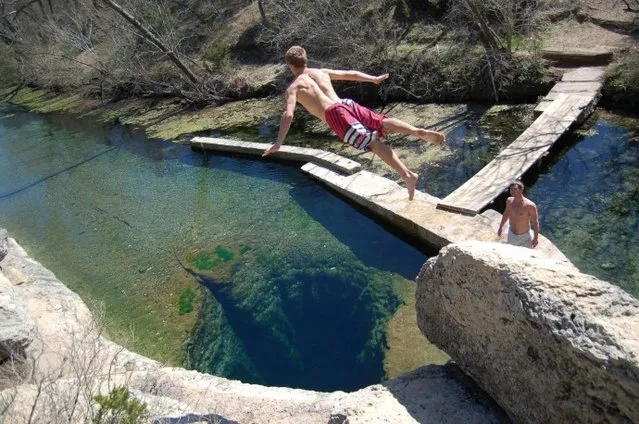
Dive The Deadly Jacob’s Well In Texas

Jacob's Well is a perennial karstic spring in the Texas Hill Country flowing from the bed of Cypress Creek, located northwest of Wimberley, Texas. The twelve foot (four meter) diameter mouth of the spring serves as a popular swimming spot for the local land owners whose properties adjoin Cypress Creek. From the opening in the creek bed, Jacob's Well cave descends vertically for about thirty feet (ten meters), then continues downward at an angle through a series of silted chambers separated by narrow restrictions, finally reaching a depth of one hundred and twenty feet (forty meters). Until the modern era, the Trinity Aquifer-fed natural artesian spring gushed water from the mouth of the cave, with a measured flow in 1924 of one hundred and seventy gallons per second (six hundred and forty liters per second) discharging six feet (two meters) into the air. The spring is the greatest source of water recharging the Edwards Aquifer.
Details
03 Jan 2014 08:20:00
In this photo taken Wednesday, April 30, 2014, a dragonfly sits on the nose of a Gharial, rare crocodile-like creatures, in the River Chambal near Bhopepura village in the northern Indian state of Uttar Pradesh. The narrow 250-mile stretch of the Chambal is a place of crocodiles and jackals, of river dolphins and the occasional wolf. Hundreds of species of birds, storks, geese, babblers, larks, falcons and so many more, nest along the river. (Photo by Altaf Qadri/AP Photo)

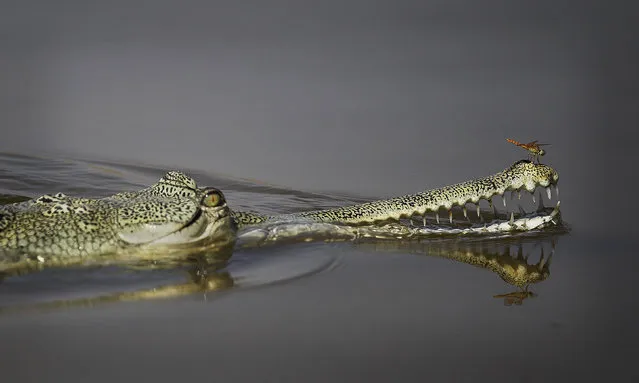
In this photo taken Wednesday, April 30, 2014, a dragonfly sits on the nose of a Gharial, rare crocodile-like creatures, in the River Chambal near Bhopepura village in the northern Indian state of Uttar Pradesh. The narrow 250-mile stretch of the Chambal is a place of crocodiles and jackals, of river dolphins and the occasional wolf. Hundreds of species of birds, storks, geese, babblers, larks, falcons and so many more, nest along the river. Endangered birds lay small speckled eggs in tiny pits they dig in the sandbars. Gharials, rare crocodile-like creatures that look like they swaggered out of the Mesozoic Era, are commonplace here and nowhere else. (Photo by Altaf Qadri/AP Photo)
Details
23 Feb 2015 12:55:00
A Naga man carries fish in his teeth after it was stunned by dynamite, which fishermen threw in a creek between Donhe and Lahe township, in the Naga Self-Administered Zone in northwest Myanmar December 27, 2014. (Photo by Soe Zeya Tun/Reuters)

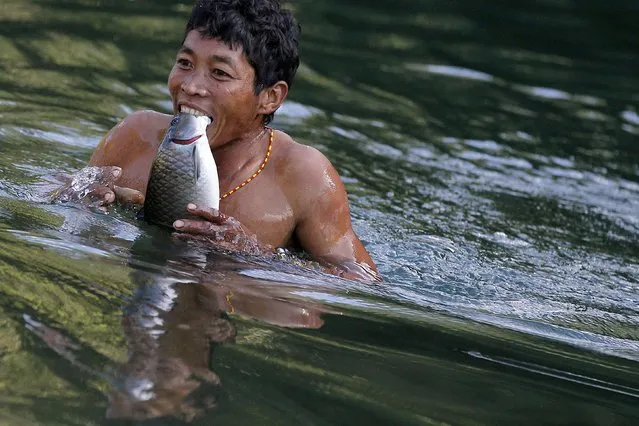
A Naga man carries fish in his teeth after it was stunned by dynamite, which fishermen threw in a creek between Donhe and Lahe township, in the Naga Self-Administered Zone in northwest Myanmar December 27, 2014. (Photo by Soe Zeya Tun/Reuters)
Details
11 Jan 2015 13:18:00
“In the late afternoon after a rain, genji botaru fireflies (luciola cruciate) dance above the swollen creek. The rocks darkened by the rain reflecting the blue sky, and the yellow-green ribbon of the glow from the fireflies, make a beautiful contrast”. – Takehito Miyatake. (Photo by Takehito Miyatake/Steven Kasher Gallery)

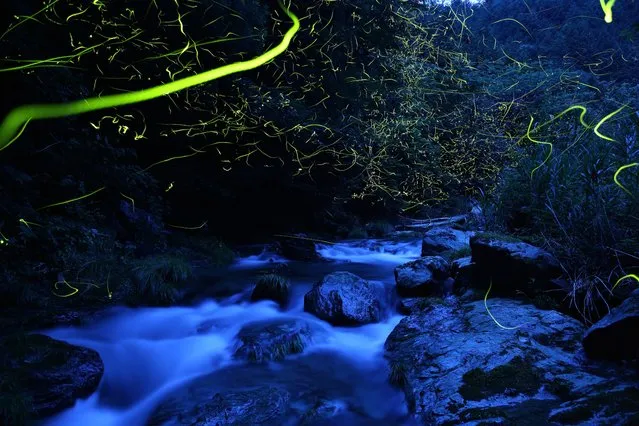
“In the late afternoon after a rain, genji botaru fireflies (luciola cruciate) dance above the swollen creek. The rocks darkened by the rain reflecting the blue sky, and the yellow-green ribbon of the glow from the fireflies, make a beautiful contrast”. – Takehito Miyatake. (Photo by Takehito Miyatake/Steven Kasher Gallery)
Details
19 Jun 2014 09:13:00
Living With Wolves

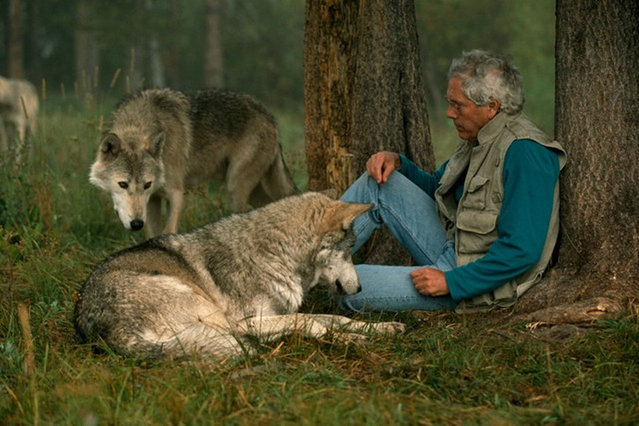
Jim and Jamie Dutcher spent six years in Idaho in a tent within the world’s largest wolf enclosure in order to observe and document the behavior of these wild animals. They got really close to the wolves and made many unique photos of wolves in their natural habitat.
Details
04 Dec 2012 10:40:00
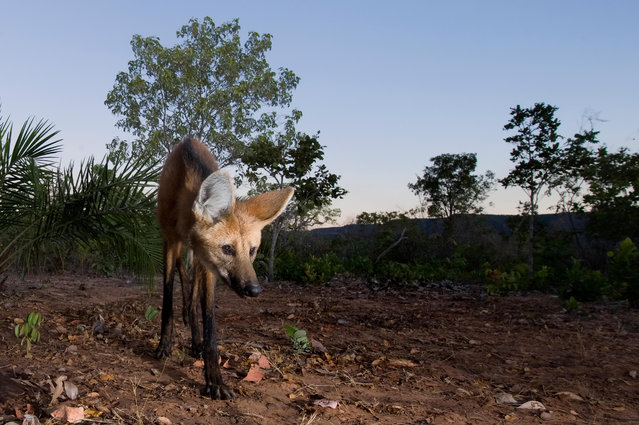
The maned wolf is among the large mammals in the Brazilian Cerrado that are threatened by the increasing conversion of grasslands into farmland for grazing and growing crops. (Photo by Ben Cranke/Nature Picture Library/Alamy Stock Photo)

Global wildlife populations will decline by 67% by 2020 unless urgent action is taken to reduce human impact on species and ecosystems, warns the biennial Living Planet Index report from WWF (World Wide Fund for Nature) and ZSL (Zoological Society of London). From elephants to eels, here are some of the wildlife populations most affected by human activity. Here: The maned wolf is among the large mammals in the Brazilian Cerrado that are threatened by the increasing conversion of grasslands into farmland for grazing and growing crops. (Photo by Ben Cranke/Nature Picture Library/Alamy Stock Photo)
Details
28 Oct 2016 10:47:00
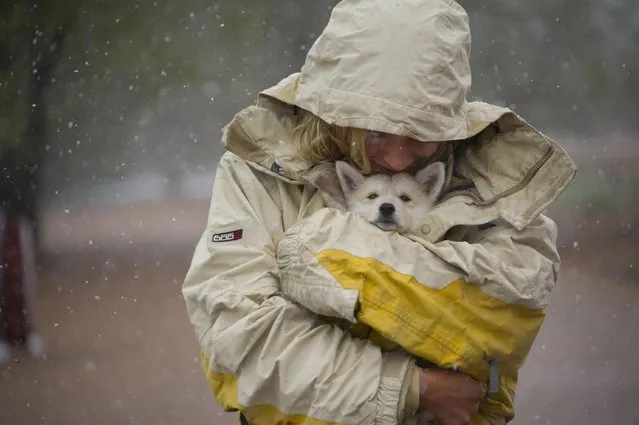
Cassandra Cantu shields her 7-week-old puppy Kamala from the snow as she walks with friends in the Bear Creek Dog Park in Colorado Springs, Colo., Sunday, May 11, 2014. A spring storm that has brought over a foot of snow to parts of Colorado, Wyoming and Nebraska and thunderstorms and tornadoes to the Midwest was slowing down travelers and left some without power Monday morning. (Photo by Mark Reis/AP Photo/The Gazette)

Cassandra Cantu shields her 7-week-old puppy Kamala from the snow as she walks with friends in the Bear Creek Dog Park in Colorado Springs, Colo., Sunday, May 11, 2014. A spring storm that has brought over a foot of snow to parts of Colorado, Wyoming and Nebraska and thunderstorms and tornadoes to the Midwest was slowing down travelers and left some without power Monday morning. (Photo by Mark Reis/AP Photo/The Gazette)
Details
13 May 2014 10:41:00
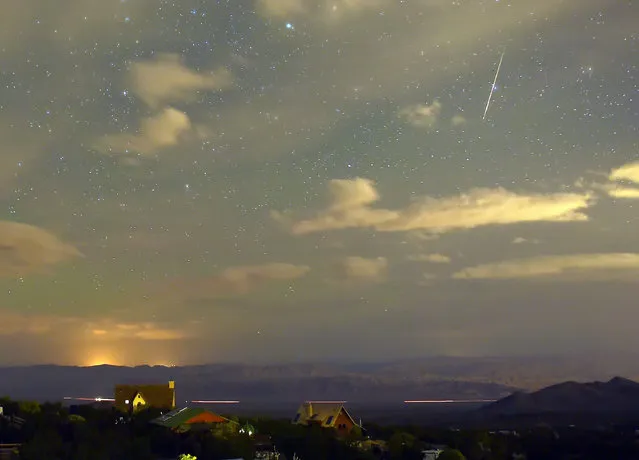
A Perseid meteor streaks across the sky over the community of Cold Creek on August 12, 2015 in the Spring Mountains National Recreation Area, Nevada. The annual display, known as the Perseid shower because the meteors appear to radiate from the constellation Perseus in the northeastern sky, is a result of Earth's orbit passing through debris from the comet Swift-Tuttle. (Photo by Ethan Miller/Getty Images)

A Perseid meteor streaks across the sky over the community of Cold Creek on August 12, 2015 in the Spring Mountains National Recreation Area, Nevada. The annual display, known as the Perseid shower because the meteors appear to radiate from the constellation Perseus in the northeastern sky, is a result of Earth's orbit passing through debris from the comet Swift-Tuttle. (Photo by Ethan Miller/Getty Images)
Details
13 Aug 2015 11:33:00