Loading...
Done
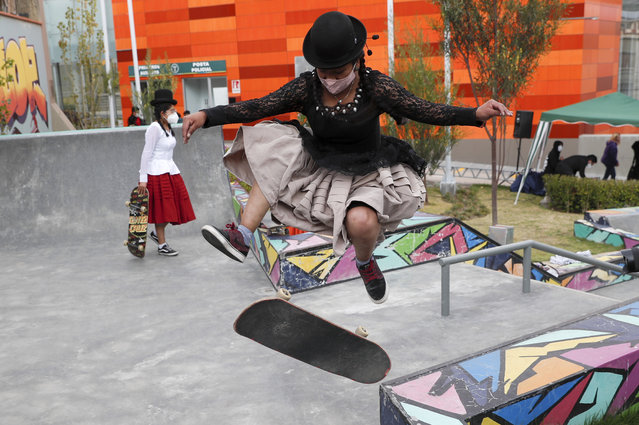
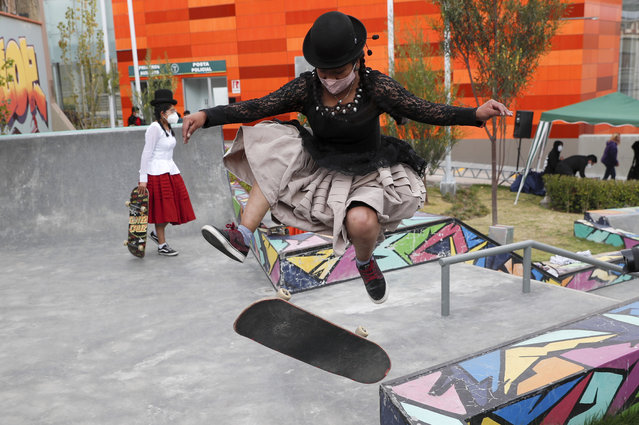
Aide Choque, wearing a mask amid the COVID-19 pandemic, jumps with her skateboard during a youth talent show in La Paz, Bolivia, Wednesday, September 30, 2020. Young women called “Skates Imillas”, using the Aymara word for girl Imilla, use traditional Indigenous clothing as a statement of pride of their Indigenous culture while playing riding their skateboards. (Photo by Juan Karita/AP Photo)

Aide Choque, wearing a mask amid the COVID-19 pandemic, jumps with her skateboard during a youth talent show in La Paz, Bolivia, Wednesday, September 30, 2020. Young women called “Skates Imillas”, using the Aymara word for girl Imilla, use traditional Indigenous clothing as a statement of pride of their Indigenous culture while playing riding their skateboards. (Photo by Juan Karita/AP Photo)
Details
07 Apr 2021 09:51:00
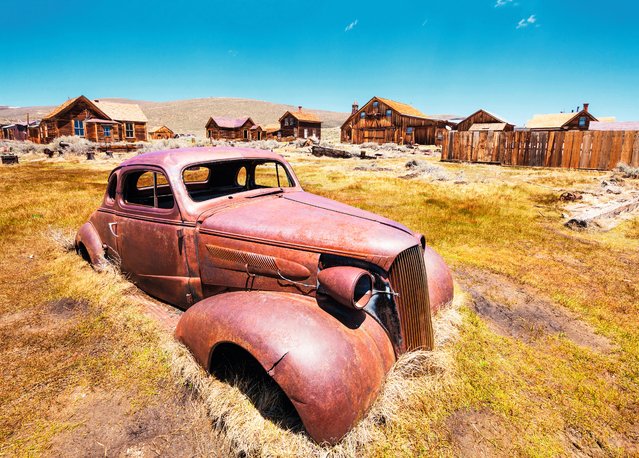
Bodie, Mono County, California. Gold was discovered at Bodie in 1859 (just after the initial California gold rush) and it went from mining camp to boomtown. Its decline began in 1880, when word spread of new boomtowns elsewhere. The Standard Consolidated Mine closed in 1913, and four years later the Bodie Railway was abandoned. By 1940 the population was down to 40. Today, Bodie is maintained in a state of arrested decay as a visitor attraction. (Photo by Alamy Stock Photo)

Kieron Connolly’s new book of photographs of more than 100 once-busy and often elegant buildings gives an idea of how the world might look if humankind disappeared. Here: Bodie, Mono County, California. Gold was discovered at Bodie in 1859 (just after the initial California gold rush) and it went from mining camp to boomtown. Its decline began in 1880, when word spread of new boomtowns elsewhere. The Standard Consolidated Mine closed in 1913, and four years later the Bodie Railway was abandoned. By 1940 the population was down to 40. Today, Bodie is maintained in a state of arrested decay as a visitor attraction. (Photo by Alamy Stock Photo)
Details
07 Sep 2016 09:50:00
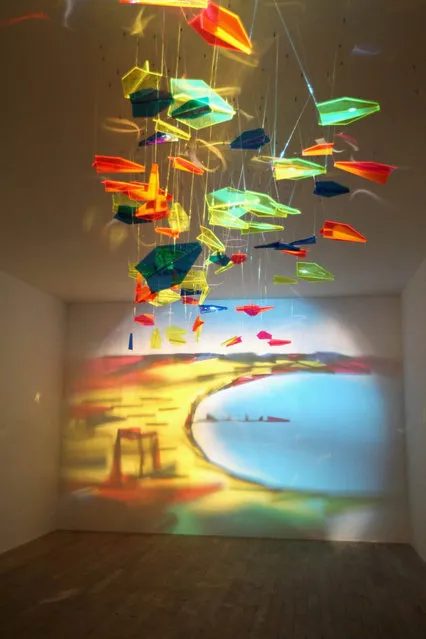
Paints With Shadows And Light By Rashad Alakbarov

The Azerbaijan-based artist’s mixed-media installations include pieces entitled “Looking at two cities from one point of view”, “Plastik portret” and “Crisis haha”. Alakbarov carefully positions multicolored acrylic planes, packaging materials, and other objects of assorted shapes and then projects light upon then to create shadow images of beautiful beaches, cities, people, and even words.
Details
08 Jun 2014 08:46:00
Aide Choque, wearing a mask amid the COVID-19 pandemic, jumps with her skateboard during a youth talent show in La Paz, Bolivia, Wednesday, September 30, 2020. Young women called “Skates Imillas”, using the Aymara word for girl Imilla, use traditional Indigenous clothing as a statement of pride of their Indigenous culture while playing riding their skateboards. (Photo by Juan Karita/AP Photo)

Aide Choque, wearing a mask amid the COVID-19 pandemic, jumps with her skateboard during a youth talent show in La Paz, Bolivia, Wednesday, September 30, 2020. Young women called “Skates Imillas”, using the Aymara word for girl Imilla, use traditional Indigenous clothing as a statement of pride of their Indigenous culture while playing riding their skateboards. (Photo by Juan Karita/AP Photo)
Details
10 Feb 2021 11:11:00
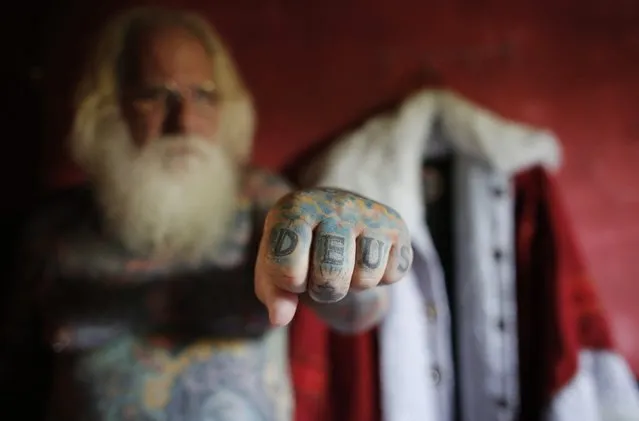
Vitor Martins puts forward his fist, that has the word “God” tattooed on it, in front of his Santa Claus outfit inside his house, before a performance with children in Sao Caetano do Sul's town square, near Sao Paulo, December 7, 2014. Martins has dressed as Santa Claus, working at shopping centres and various events, for fifteen years, and has 94 percent of his body covered in tattoos, with several in reference to Christmas. (Photo by Nacho Doce/Reuters)

Vitor Martins puts forward his fist, that has the word “God” tattooed on it, in front of his Santa Claus outfit inside his house, before a performance with children in Sao Caetano do Sul's town square, near Sao Paulo, December 7, 2014. Martins has dressed as Santa Claus, working at shopping centres and various events, for fifteen years, and has 94 percent of his body covered in tattoos, with several in reference to Christmas. (Photo by Nacho Doce/Reuters)
Details
09 Dec 2014 09:42:00
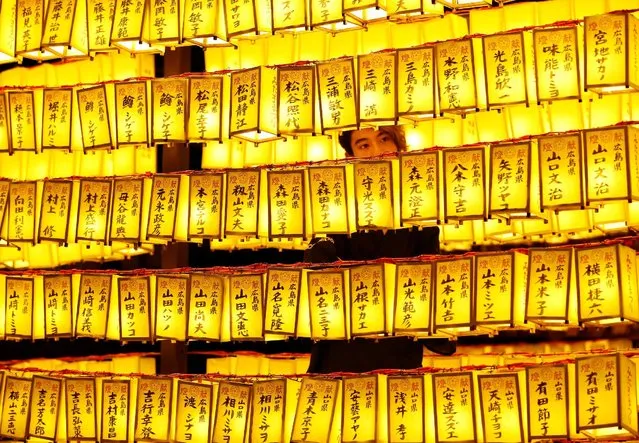
A man stands between thousands of paper lanterns, which were displayed and lit up the precincts of the shrine, where more than 2.4 million war-dead are enshrined, during the Mitama Festival at Yasukuni Shrine in Tokyo, Japan July 13, 2016. “Mitama” is a respectful word that means “the soul of a dead person” in Japanese, and this “Soul Festival” honors just that. The Yasukuni Shrine is dedicated to the honoring of the souls of those who gave their lives to defend Japan, and this festival is an early step towards the Japanese holiday season of Obon, during which Japanese people honor their deceased ancestors. (Photo by Issei Kato/Reuters)

A man stands between thousands of paper lanterns, which were displayed and lit up the precincts of the shrine, where more than 2.4 million war-dead are enshrined, during the Mitama Festival at Yasukuni Shrine in Tokyo, Japan July 13, 2016. “Mitama” is a respectful word that means “the soul of a dead person” in Japanese, and this “Soul Festival” honors just that. (Photo by Issei Kato/Reuters)
Details
14 Jul 2016 09:37:00
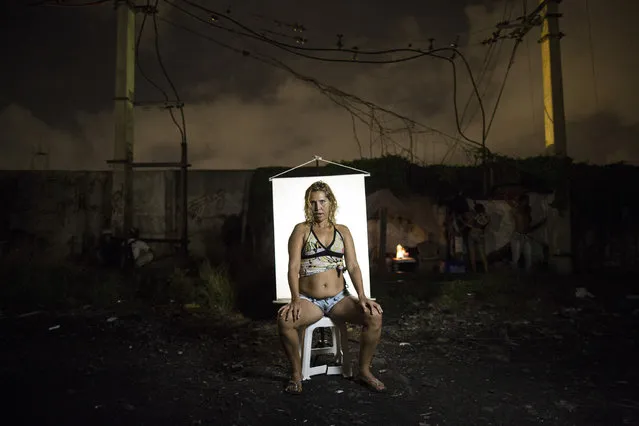
In this March 18, 2015 photo, Andrea, better known as Loira, which is the Portuguese word for 'blonde," poses for a portrait in an open-air crack cocaine market, known as a “cracolandia” or crackland where users can buy crack, and smoke it in plain sight, day or night, in Rio de Janeiro, Brazil. Andrea says she is married and has a home, but she keeps returning to crackland to feed her addiction. (Photo by Felipe Dana/AP Photo)

In this March 18, 2015 photo, Andrea, better known as Loira, which is the Portuguese word for “blonde”, poses for a portrait in an open-air crack cocaine market, known as a “cracolandia” or crackland where users can buy crack, and smoke it in plain sight, day or night, in Rio de Janeiro, Brazil. Andrea says she is married and has a home, but she keeps returning to crackland to feed her addiction. (Photo by Felipe Dana/AP Photo)
Details
09 Apr 2015 13:05:00
Japanese artist Megumi Igarashi, known as Rokudenashiko, holds her artwork after a news conference following a court appearance in Tokyo April 15, 2015. A Japanese artist on trial for obscenity after making figurines and a kayak modeled on her v*gina said on Wednesday that there was nothing wrong with her artwork and her arrest merely showed how far Japan remains behind the west. Words in the artwork read “Centre. 3D scan”. (Photo by Toru Hanai/Reuters)

Japanese artist Megumi Igarashi, known as Rokudenashiko, holds her artwork after a news conference following a court appearance in Tokyo April 15, 2015. A Japanese artist on trial for obscenity after making figurines and a kayak modeled on her v*gina said on Wednesday that there was nothing wrong with her artwork and her arrest merely showed how far Japan remains behind the west. Words in the artwork read “Centre. 3D scan”. (Photo by Toru Hanai/Reuters)
Details
16 Apr 2015 13:09:00