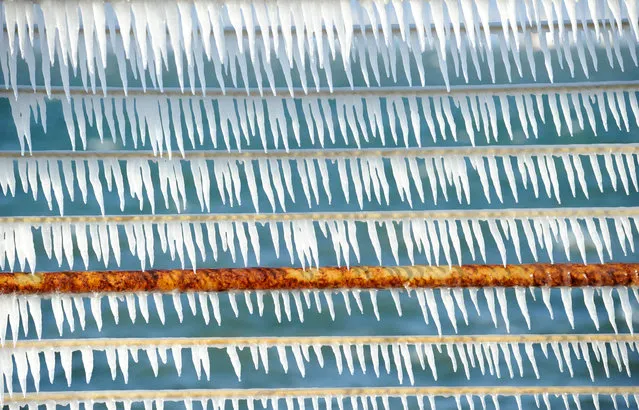
Icicles are seen on a handrail along the coast at Donggang business district in Dalian, Liaoning province, China on December 27, 2018. (Photo by Reuters/China Stringer Network)
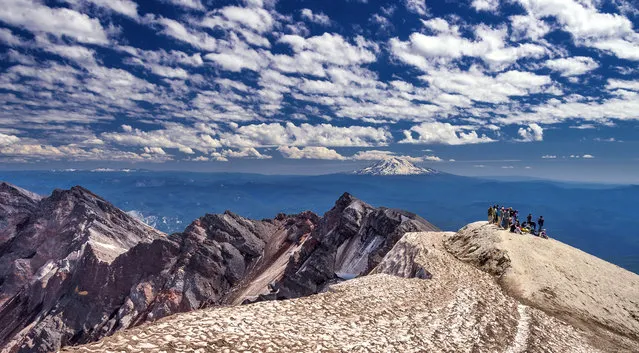
A group of hikers atop Mount St. Helens on July 21, 2016. Mount St. Helens or Louwala-Clough is an active stratovolcano located in Skamania County, Washington, in the Pacific Northwest region of the United States. It is 96 miles south of Seattle, Washington, and 50 miles northeast of Portland, Oregon. (Photo by Raxit Kagalwala)
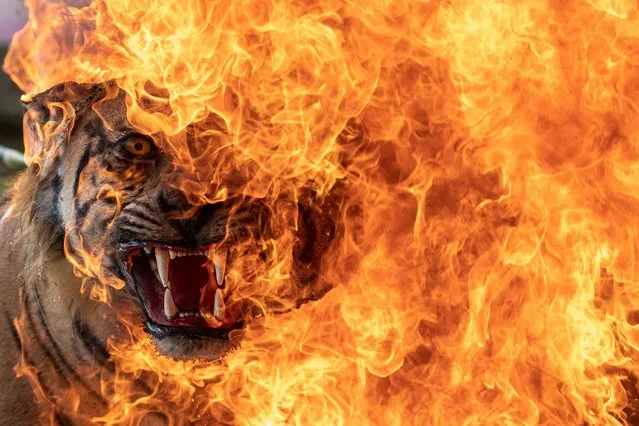
A preserved Sumatran Tiger (Panthera tigris sumatrae) that was collected by the Natural Resources Conservation Board (BKSDA) as evidence is burnt in Palembang, Indonesia on March 18, 2022. (Photo by Novaa Wahyudi/Antara Foto via Reuters)
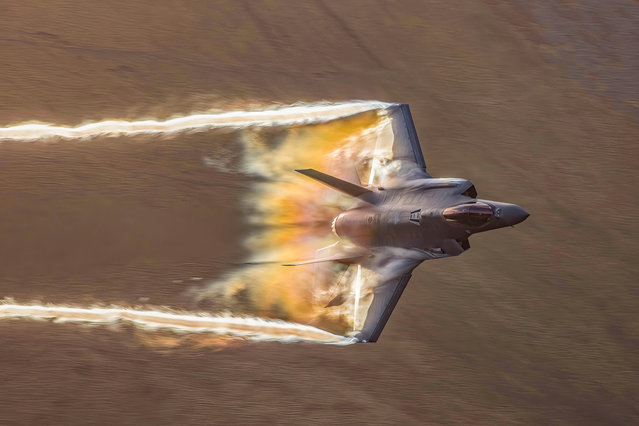
Vapour bounced off the wings of the Lockheed Martin F-35 Lightning II as it sped over the Welsh mountains at a swift 575mph on February 10, 2022. The jet was taking part in a low-level training exercise through the Mach Loop – a series of valleys in North Wales. (Photo by Thomas Winstone/News Images)
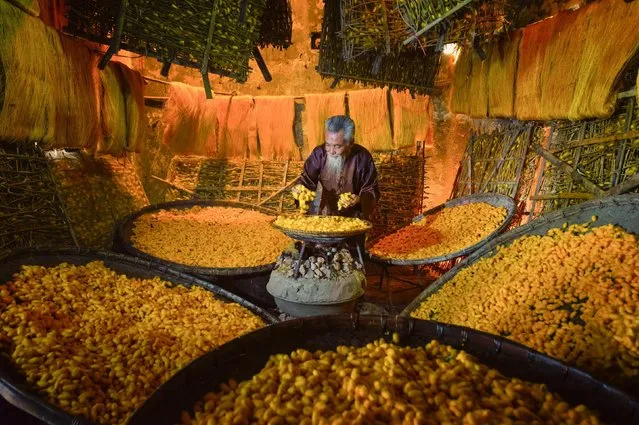
Thousands of bright yellow silkworm cocoons are dried in huge clay bowls in the village of Hong Ly, northern Vietnam in July 2022. Silk fibres are produced by silkworms when they spin themselves into a cocoon on their journey to becoming a silkmoth. The ultra-soft fibres are harvested from the cocoon in their raw state by being boiled in hot water. (Photo by Prabu Mohan/Solent News)
A cosplayer portrays Himiko Toga from “League of Villains” outside the convention center during Comic-Con International 2022 on July 22, 2022 in San Diego, California. (Photo by Robyn Beck/AFP Photo)
People enjoy spring break festivities ahead of an 8pm curfew imposed by local authorities, amid the coronavirus disease (COVID-19) pandemic, in Miami Beach, Florida, U.S., March 27, 2021. (Photo by Marco Bello/Reuters)
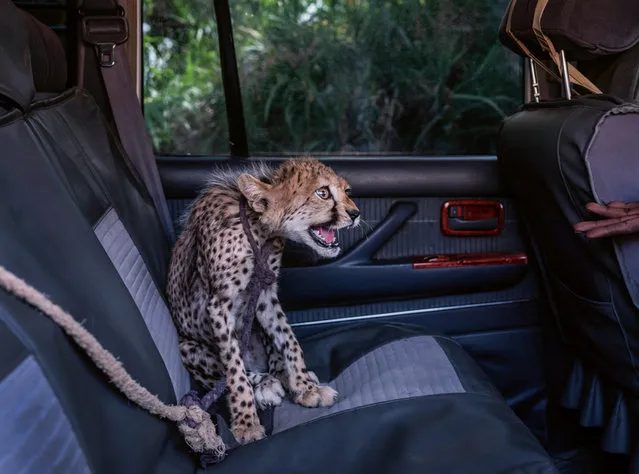
A five-month-old cheetah seated in the back of a Land Cruiser growls at an outstretched hand after being taken from traffickers in Ethiopia and driven to Harirad, Somaliland, in 2020. This photo is part of the work of more than 100 artists in Why We Photograph Animals, a new collection of wildlife photography that aims to help understand why people have photographed animals at different points in history and what it means in the present. (Photo by Nichole Sobecki/Thames & Hudson)