Loading...
Done
New Yorkers Celebrate At West Indian Day Parade

“The Labor Day Parade (or West Indian Carnival), is an annual celebration held on American Labor Day (the first Monday in September), in Crown Heights, Brooklyn, New York. Ms. Jessie Waddell and some of her West Indian friends started the Carnival in Harlem in the 1920s by staging costume parties in large enclosed places like the Savoy, Renaissance and Audubon Ballrooms due to the cold wintry weather of February. This is the usual time for the pre-Lenten celebrations held in most countries around the world. However, because of the very nature of Carnival, and the need to parade in costume to music, indoor confinement did not work well. The earliest known Carnival street parade was held on September 1, 1947. The Trinidad Carnival Pageant Committee was the founding force behind the parade, which was held in Harlem. The parade route was along Seventh Avenue, starting at 110th St.” – Wikipedia

Photo: A reveler looks on during the West Indian-American Day Parade September 5, 2011 in the Brooklyn borough of New York City. More than 2 million spectators were expected to attend the celebration of Caribbean culture. (Photo by Mario Tama/Getty Images)
Details
06 Sep 2011 11:18:00
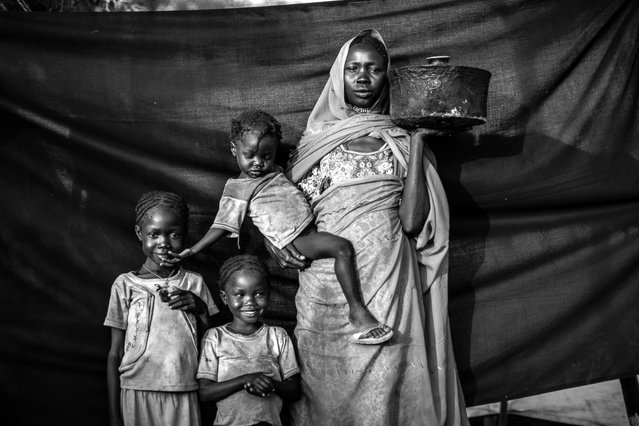
Magbola Alhadi, 20, and her three children pose for a portrait in Jamam refugee camp in Maban County, South Sudan on August 11th, 2012. Magboola and her family weathered aerial bombing raids for several months, but decided it was time to leave their village of Bofe the night that soldiers arrived and opened fire. (Photo by Brian Sokol/Panos Pictures)

Magbola Alhadi, 20, and her three children pose for a portrait in Jamam refugee camp in Maban County, South Sudan on August 11th, 2012. Magboola and her family weathered aerial bombing raids for several months, but decided it was time to leave their village of Bofe the night that soldiers arrived and opened fire. With her three children, she travelled for 12 days from Bofe to the town of El Fudj, on the South Sudanese border. The most important thing that Magboola was able to bring with her is the saucepan she holds in this photograph. It wasn't the largest pot that she had in Bofe, but it was small enough she could travel with it, yet big enough to cook sorghum for herself and her three daughters (from left: Aduna Omar, 6, Halima Omar, 4, and Arfa Omar, 2) during their journey. (Photo by Brian Sokol/Panos Pictures)
Details
18 Sep 2015 15:04:00
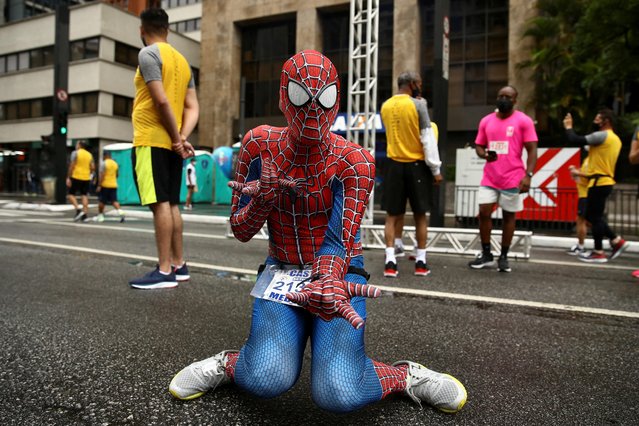
A runner dressed as Spiderman poses before the annual “Sao Silvestre Run”, an international race through the streets of Sao Paulo, Brazil on December 31, 2021. (Photo by Carla Carniel/Reuters)

A runner dressed as Spiderman poses before the annual “Sao Silvestre Run”, an international race through the streets of Sao Paulo, Brazil on December 31, 2021. (Photo by Carla Carniel/Reuters)
Details
09 Jan 2022 05:23:00
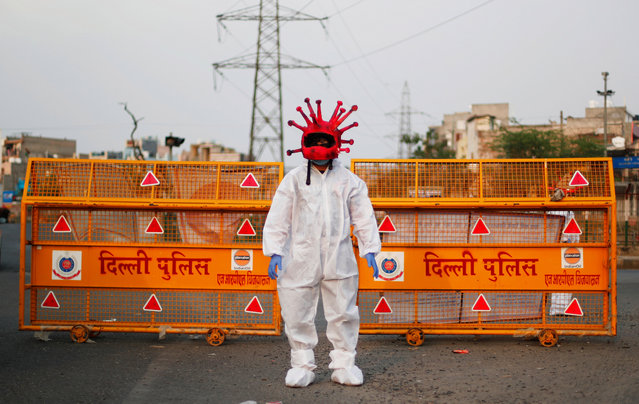
An artist wearing a coronavirus-shaped helmet and a protective suit stands next to a police barricade as he requests people to stay at home during an extended lockdown to slow the spread of the coronavirus disease (COVID-19) in New Delhi, India, April 30, 2020. (Photo by Adnan Abidi/Reuters)

An artist wearing a coronavirus-shaped helmet and a protective suit stands next to a police barricade as he requests people to stay at home during an extended lockdown to slow the spread of the coronavirus disease (COVID-19) in New Delhi, India, April 30, 2020. (Photo by Adnan Abidi/Reuters)
Details
12 May 2020 00:05:00
A Police officer reacts to protestors outside the Piet Retief Magistrates court where the five accused in the shooting of the Coka brothers on the Pampoenkraal farm appeared, Mhkondo, Mpumalanga, South Africa on April 19, 2021. (Photo by Jacques Nelles)

A Police officer reacts to protestors outside the Piet Retief Magistrates court where the five accused in the shooting of the Coka brothers on the Pampoenkraal farm appeared, Mhkondo, Mpumalanga, South Africa on April 19, 2021. (Photo by Jacques Nelles)
Details
28 Apr 2021 08:59:00
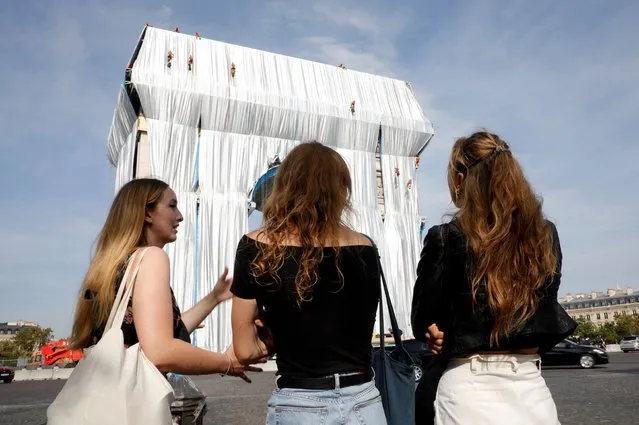
Bystanders look on as workers arrange silver blue fabric, part of the process of wrapping L'Arc de Triomphe in Paris on September 13, 2021, designed by the late artist Christo. Work has begun on wrapping the Arc de Triomphe in Paris in silvery-blue fabric as a posthumous tribute to the artist Christo, who had dreamt of the project for decades. Bulgarian-born Christo, a longtime Paris resident, had plans for sheathing the imposing war memorial at the top of the Champs-Elysees while renting an apartment near it in the 1960s (Photo by Geoffroy Van der Hasselt/AFP Photo)

Bystanders look on as workers arrange silver blue fabric, part of the process of wrapping L'Arc de Triomphe in Paris on September 13, 2021, designed by the late artist Christo. Work has begun on wrapping the Arc de Triomphe in Paris in silvery-blue fabric as a posthumous tribute to the artist Christo, who had dreamt of the project for decades. Bulgarian-born Christo, a longtime Paris resident, had plans for sheathing the imposing war memorial at the top of the Champs-Elysees while renting an apartment near it in the 1960s (Photo by Geoffroy Van der Hasselt/AFP Photo)
Details
01 May 2022 04:48:00
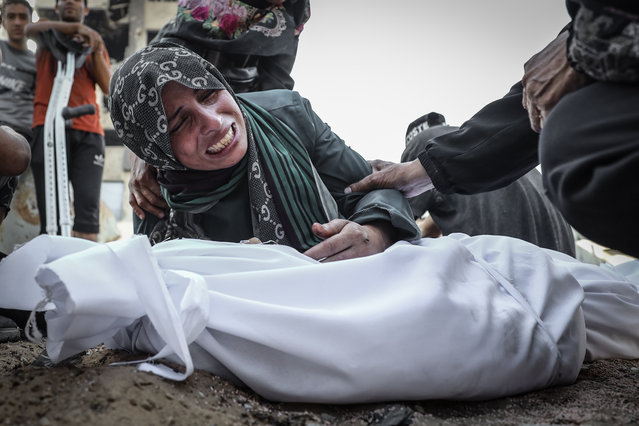
Mother Nesrin Mehre, mourns near the body of Muhammad Mehre was killed in an Israeli attack on al-Nasr neighborhood in northwestern Gaza, on September 23, 2025. His body was taken from al-Shifa Hospital for burial. (Photo by Khames Alrefi/Anadolu via Getty Images)

Mother Nesrin Mehre, mourns near the body of Muhammad Mehre was killed in an Israeli attack on al-Nasr neighborhood in northwestern Gaza, on September 23, 2025. His body was taken from al-Shifa Hospital for burial. (Photo by Khames Alrefi/Anadolu via Getty Images)
Details
22 Oct 2025 00:12:00
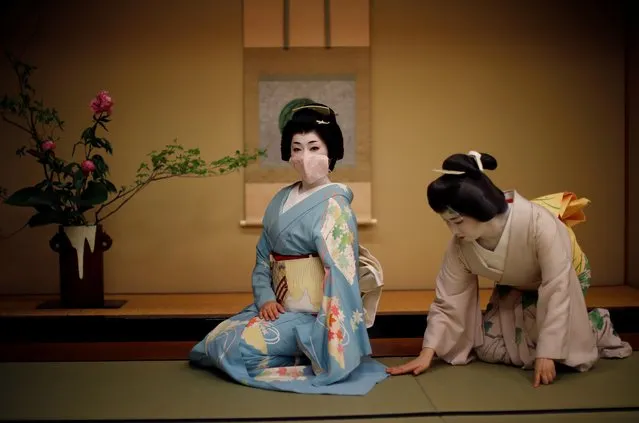
Mayu adjusts Koiku’s kimono, as Koiku wears a protective face mask while posing for a photograph, before they work at a party where they will entertain with other geisha at Japanese luxury restaurant Asada in Tokyo, Japan, June 23, 2020. The coronavirus pandemic has made Tokyo's geisha fear for their centuries-old profession as never before. Though the number of geisha - famed for their witty conversation, beauty and skill at traditional arts - has been falling for years, they were without work for months due to Japan's state of emergency and now operate under awkward social distancing rules. Engagements are down 95 percent, and come with new rules: no pouring drinks for customers or touching them even to shake hands, and sitting 2 meters apart. Masks are hard to wear with their elaborate wigs, so they mostly don't. “I was just full of anxiety”, said Mayu, 47. “I went through my photos, sorted my kimonos ... The thought of a second wave is terrifying”. (Photo by Kim Kyung-Hoon/Reuters)

Mayu adjusts Koiku’s kimono, as Koiku wears a protective face mask while posing for a photograph, before they work at a party where they will entertain with other geisha at Japanese luxury restaurant Asada in Tokyo, Japan, June 23, 2020. (Photo by Kim Kyung-Hoon/Reuters)
Details
23 Jul 2020 00:03:00