Loading...
Done
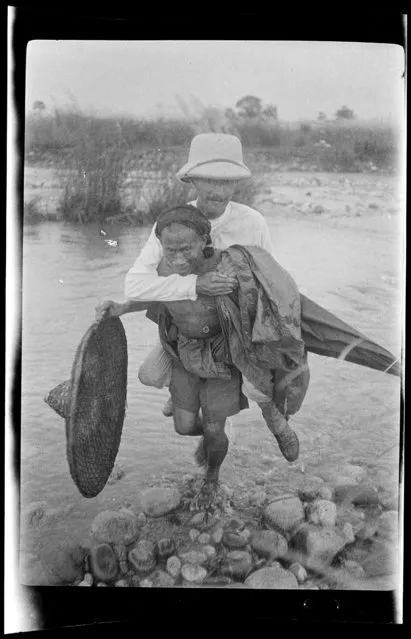
Hillcoat Riding Fu Tu. China, An Xian, 1917-1919. (Photo by Sidney David Gamble)

“Sidney D. Gamble (July 12, 1890 – 1968) was born in Cincinnati, Ohio, to David Berry and Mary Huggins Gamble; grandson of James Gamble, who, with William Procter, founded Procter & Gamble in 1837. in 1912 he graduated magna cum laude from Princeton University with a Bachelor of Literature degree and was elected to Phi Beta Kappa. He visited China for four extended periods, 1908, 1917–1919, 1924–27, and 1931–1932, doing Christian social work for the Y.M.C.A and conducting social surveys. He is now best known for his remarkable and extensive photographs of Peking and North China.” – Wikipedia. (Photo by Sidney David Gamble via Duke University Libraries)

Photo: Hillcoat Riding Fu Tu. China, An Xian, 1917-1919. P.S. All photos are available in high resolution.
Details
16 Aug 2012 11:24:00
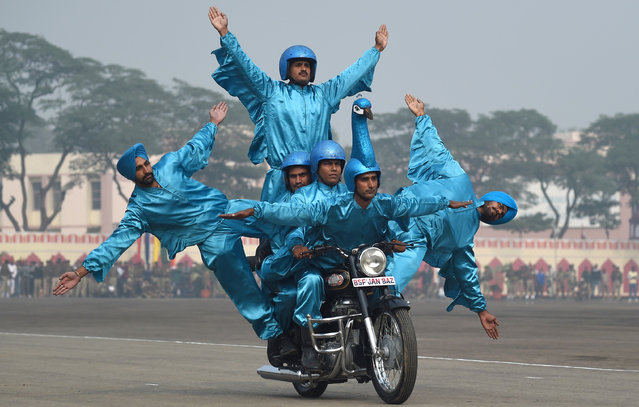
Members of the Indian Border Security Force (BSF) demonstrate their skills on motor-bikes during the BSF Golden Jubilee Day celebration in New Delhi on December 1, 2015. (Photo by Money Sharma/AFP Photo)

Members of the Indian Border Security Force (BSF) demonstrate their skills on motor-bikes during the BSF Golden Jubilee Day celebration in New Delhi on December 1, 2015. (Photo by Money Sharma/AFP Photo)
Details
02 Dec 2015 09:50:00
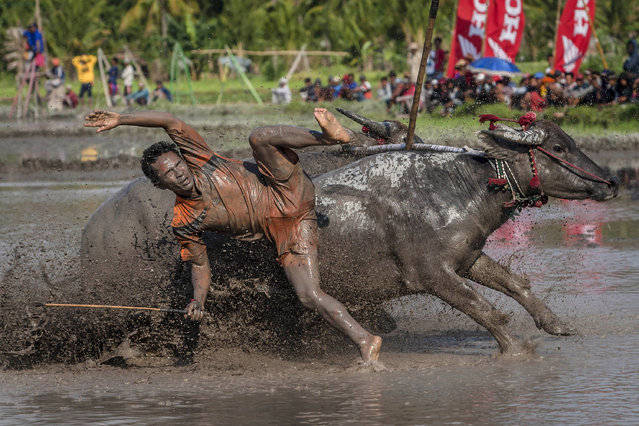
A jockey falls from his buffalos during Barapan Kebo or buffalo races as part of the Moyo festival on September 30, 2014 in Sumbawa Island, West Nusa Tenggara, Indonesia. (Photo by Ulet Ifansasti/Getty Images)

A jockey falls from his buffalos during Barapan Kebo or buffalo races as part of the Moyo festival on September 30, 2014 in Sumbawa Island, West Nusa Tenggara, Indonesia. The traditional Buffalo races, known as Barapan Kebo, are held by Samawa tribes in muddy rice fields to celebrate and provide entertainment ahead of the annual planting season. Jockeys secure themselves on a wooden structure attached to the buffalo, and maneuver across the mud in a race to the finish line. The jockeys weild long sticks, in a similar style to jousting, and direct them towards targets called “Saka”. (Photo by Ulet Ifansasti/Getty Images)
Details
04 Oct 2014 11:58:00
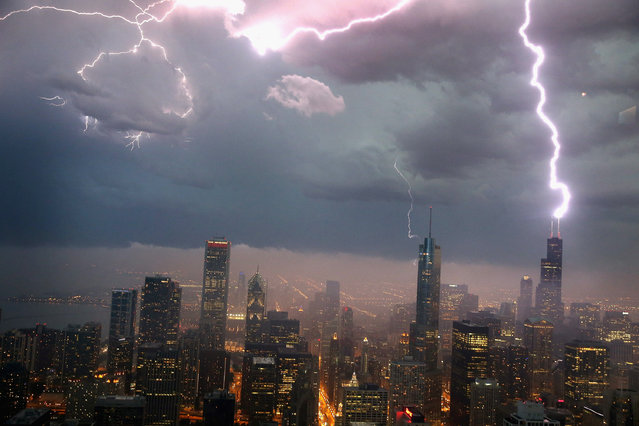
Lightning strikes the Willis Tower (formerly Sears Tower) in downtown on June 12, 2013 in Chicago, Illinois. (Photo by Scott Olson/Getty Images)

Lightning strikes the Willis Tower (formerly Sears Tower) in downtown on June 12, 2013 in Chicago, Illinois. (Photo by Scott Olson/Getty Images)
Details
02 Jan 2014 11:45:00
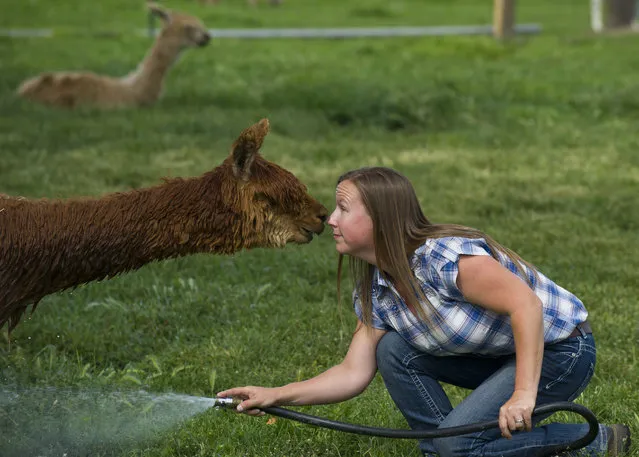
Elaine Vandiver shares a moment with a two-year old alpaca as they touch noses as she washes him at her farm at 1560 Stateline Road Monday, May 11, 2015, in Walla Walla, Wash. (Photo by Michael Lopez/Walla Walla Union-Bulletin via AP Photo)

Elaine Vandiver shares a moment with a two-year old alpaca as they touch noses as she washes him at her farm at 1560 Stateline Road Monday, May 11, 2015, in Walla Walla, Wash. (Photo by Michael Lopez/Walla Walla Union-Bulletin via AP Photo)
Details
16 May 2015 12:27:00
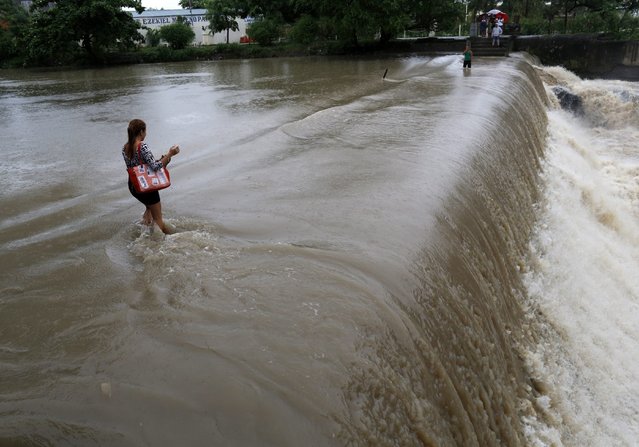
Filipinos cross a swelling river in Las Pinas city, south of Manila, Philippines, 09 July 2015. According to the Philippines State weather forecast, heavy rainfall is expected in Metro Manila and nearby provinces due to an enhanced Southwest Monsoon and Tropical Storm Linfa, Typhoon Chan-hom and Typhoon Nangka which are lining up across the Pacific Ocean. (Photo by Francis R. Malasig/EPA)

Filipinos cross a swelling river in Las Pinas city, south of Manila, Philippines, 09 July 2015. According to the Philippines State weather forecast, heavy rainfall is expected in Metro Manila and nearby provinces due to an enhanced Southwest Monsoon and Tropical Storm Linfa, Typhoon Chan-hom and Typhoon Nangka which are lining up across the Pacific Ocean. (Photo by Francis R. Malasig/EPA)
Details
10 Jul 2015 12:52:00
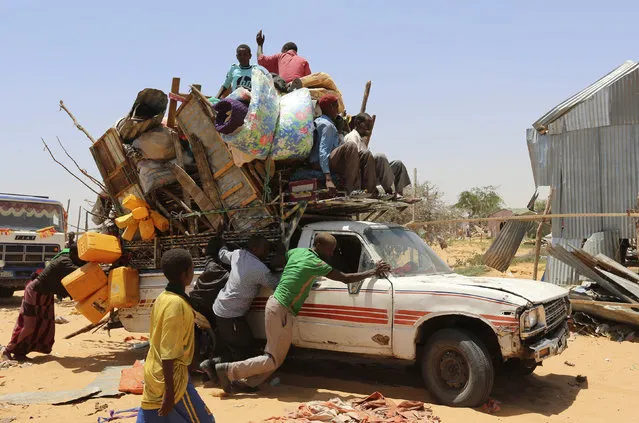
More than 6 billion people live in countries where serious levels of public sector corruption are fueling inequality and exploitation, according to Transparency International's 2015 index of perceived public sector corruption. The group's annual report measures perceptions of corruption due to the secrecy surrounding most corrupt dealings. Two thirds of the 168 countries assessed were identified as having a serious corruption problem. Somalia, which has been mired in conflict since civil war broke out in 1991, ranks bottom of the list. (Photo by Feisal Omar/Reuters)

More than 6 billion people live in countries where serious levels of public sector corruption are fueling inequality and exploitation, according to Transparency International's 2015 index of perceived public sector corruption. The group's annual report measures perceptions of corruption due to the secrecy surrounding most corrupt dealings. Two thirds of the 168 countries assessed were identified as having a serious corruption problem. Somalia, which has been mired in conflict since civil war broke out in 1991, ranks bottom of the list. (Photo by Feisal Omar/Reuters)
Details
13 May 2016 12:10:00
Galapagos – Rocking the Cradle: Four major ocean currents converge along the Galapagos archipelago, creating the conditions for an extraordinary diversity of animal life, April 25, 2016. The islands are home to at least 7,000 flora and fauna species, of which 97 percent of the reptiles, 80 percent of the land birds, 50 percent of the insects and 30 percent of the plants are endemic. The local ecosystem is highly sensitive to the changes in temperature, rainfall and ocean currents that characterize the climatic events known as El Niño and La Niña. These changes cause marked fluctuations in weather and food availability. Many scientists expect the frequency of El Niño and La Niña to increase as a result of climate change, making the Galapagos a possible early-warning location for its effects. (Photo by Thomas P. Peschak for National Geographic/World Press Photo)

Galapagos – Rocking the Cradle: Four major ocean currents converge along the Galapagos archipelago, creating the conditions for an extraordinary diversity of animal life, April 25, 2016. The islands are home to at least 7,000 flora and fauna species, of which 97 percent of the reptiles, 80 percent of the land birds, 50 percent of the insects and 30 percent of the plants are endemic. (Photo by Thomas P. Peschak for National Geographic/World Press Photo)
Details
16 Apr 2018 00:01:00