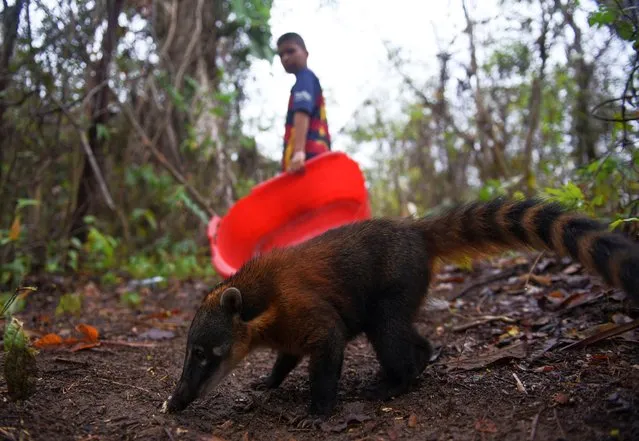
Eddy the badger is pictured as Nicanor goes to leave water and fruits for the animals affected by the fires, in San Buenaventura, Bolivia on November 26, 2023. (Photo by Claudia Morales/Reuters)
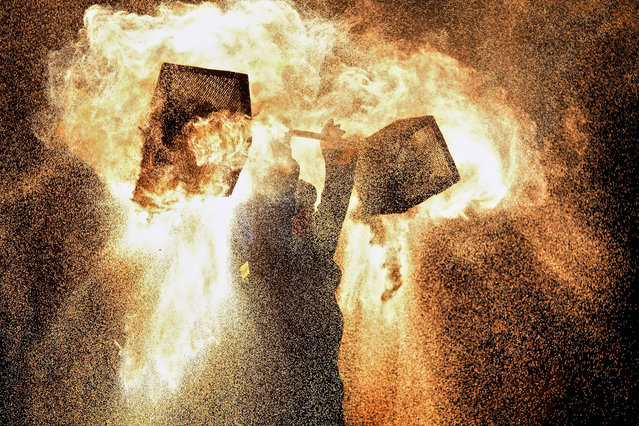
An artist performs a fire kettle show during the Mid-Autumn Festival at a night market in Beijing, Tuesday, September 17, 2024. (Photo by Andy Wong/AP Photo)
An Indian soldier blows fire as he performs an acrobatic manoeuvre known as 'Mallakhamb' during an event in Jaipur on December 5, 2024. (Photo by Himanshu Sharma/AFP Photo)
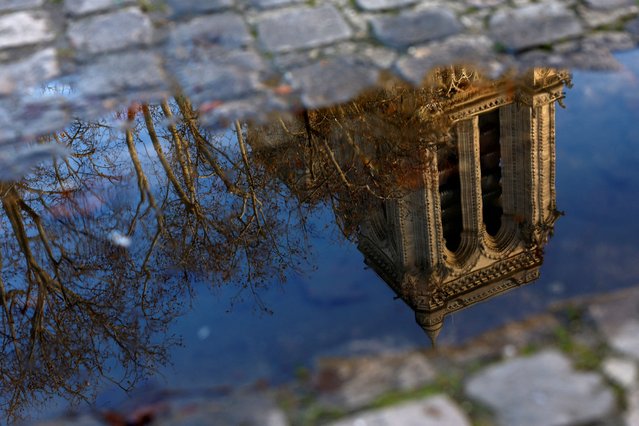
The towers of the Notre-Dame de Paris Cathedral, which was ravaged by a fire in 2019, are reflected in a puddle ahead of the reopening ceremonies, in Paris, France, on December 4, 2024. (Photo by Stephanie Lecocq/Reuters)
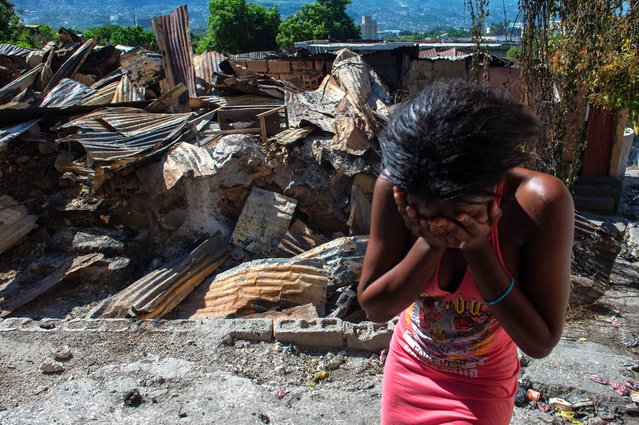
A woman cries outside her house after armed gangs set it on fire in the Post Marchand neighborhood of Port-au-Prince on December 17, 2024. (Photo by Clarens Siffroy/AFP Photo)
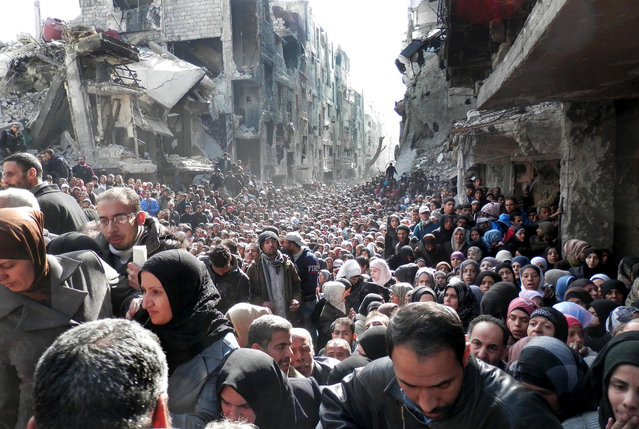
In this January 31, 2014 file photo released by the United Nations Relief and Works Agency for Palestine Refugees in the Near East (UNRWA), shows residents of the besieged Palestinian camp of Yarmouk, queuing to receive food supplies, in Damascus, Syria. That year, the U.N. was able to deliver food to about five percent of people in besieged areas including Yarmouk, while today estimates show the organization is reaching less than one percent. (Photo by UNRWA via AP Photo)
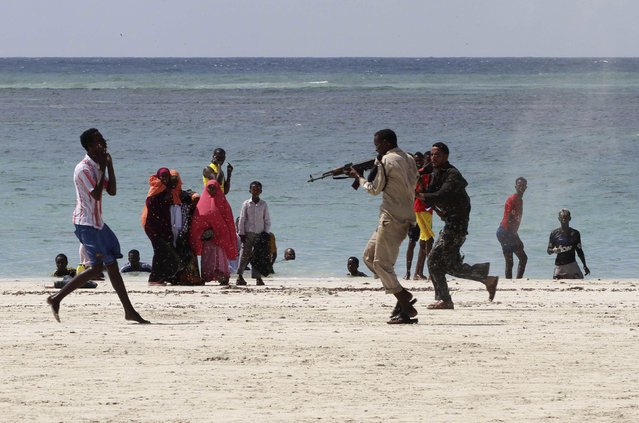
A Somali police officer arrests a suspected rebel member of the al Qaeda-affiliated al Shabaab among beach goers in Mogadishu. Al Shabaab claimed responsibility for today's pre-dawn attack on a Kenyan university campus near the Somali border. The following gallery examines who is al Shabaab. Here: Somali police officer (R) arrests a suspected rebel member (L) of the Al Qaeda-affiliated al Shabaab among beach goers at the Lido beach north of Somalia's capital Mogadishu March 23, 2012. (Photo by Feisal Omar/Reuters)
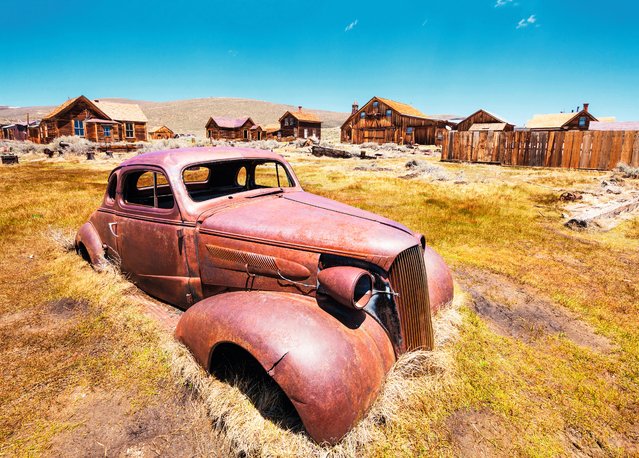
Kieron Connolly’s new book of photographs of more than 100 once-busy and often elegant buildings gives an idea of how the world might look if humankind disappeared. Here: Bodie, Mono County, California. Gold was discovered at Bodie in 1859 (just after the initial California gold rush) and it went from mining camp to boomtown. Its decline began in 1880, when word spread of new boomtowns elsewhere. The Standard Consolidated Mine closed in 1913, and four years later the Bodie Railway was abandoned. By 1940 the population was down to 40. Today, Bodie is maintained in a state of arrested decay as a visitor attraction. (Photo by Alamy Stock Photo)