Loading...
Done
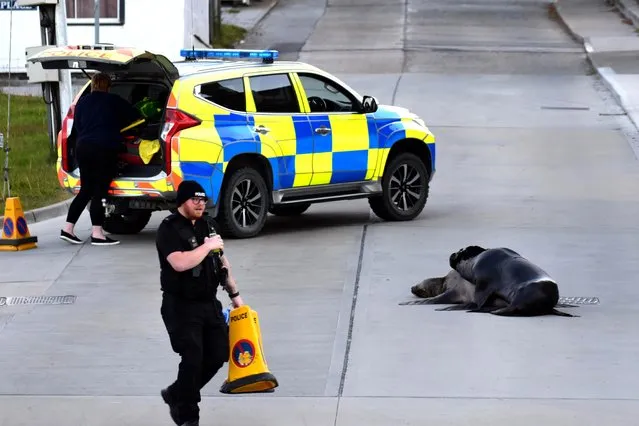
Police in Stanley, the Falklands capital, had to temporarily close a road after a pair of sea lions picked an awkward spot to get frisky on Sunday, December 5, 2021. (Photo by Genti Cena Photography/Triangle)

Police in Stanley, the Falklands capital, had to temporarily close a road after a pair of sea lions picked an awkward spot to get frisky on Sunday, December 5, 2021. (Photo by Genti Cena Photography/Triangle)
Details
19 Dec 2021 06:54:00
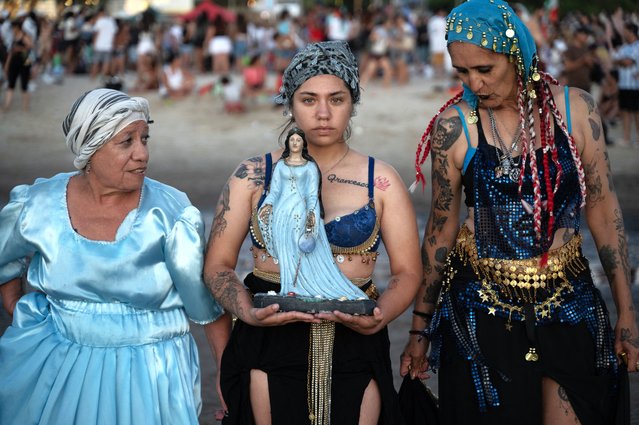
Believers offer tribute to Iemanja, the Goddess of the Sea of the Afro-American religion Umbanda, at Ramirez beach in Montevideo on February 2, 2025. (Photo by Eitan Abramovich/AFP Photo)

Believers offer tribute to Iemanja, the Goddess of the Sea of the Afro-American religion Umbanda, at Ramirez beach in Montevideo on February 2, 2025. (Photo by Eitan Abramovich/AFP Photo)
Details
09 Feb 2025 04:39:00
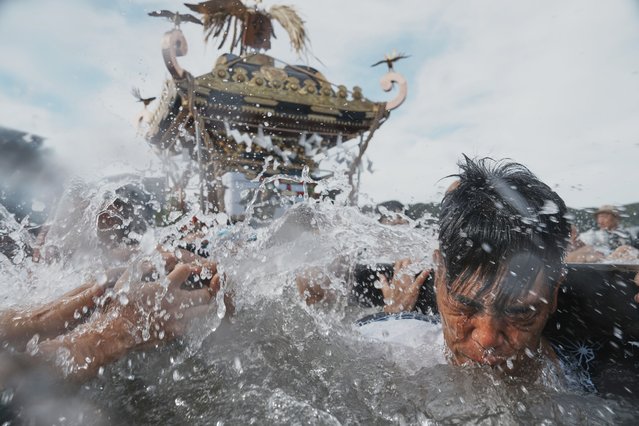
Participants carry a portable shrine, or mikoshi, into the sea during a purification rite at the annual Kurihama Sumiyoshi Shrine Festival at Kurihama, Yokosuka city, south of Tokyo Sunday, July 27, 2025. (Photo by Eugene Hoshiko/AP Photo)

Participants carry a portable shrine, or mikoshi, into the sea during a purification rite at the annual Kurihama Sumiyoshi Shrine Festival at Kurihama, Yokosuka city, south of Tokyo Sunday, July 27, 2025. (Photo by Eugene Hoshiko/AP Photo)
Details
10 Sep 2025 04:03:00
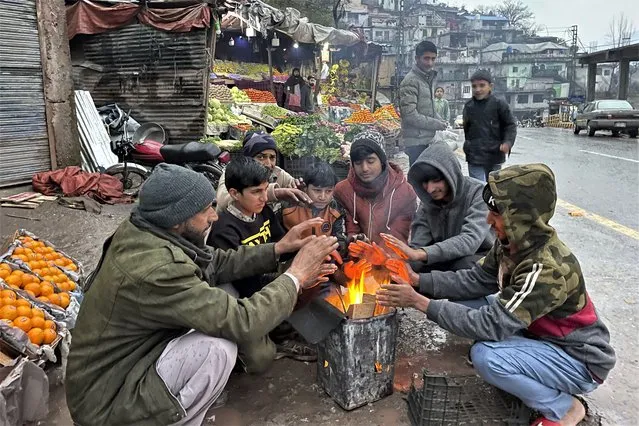
Vendors warm themselves as they light a bonfire at a market during a nationwide power outage, in Muzaffarabad on January 23, 2023. A massive power breakdown in Pakistan on January 23 affected most of the country's more than 220 million people, including in the mega cities of Karachi and Lahore. (Photo by Sajjad Qayyum/AFP Photo)

Vendors warm themselves as they light a bonfire at a market during a nationwide power outage, in Muzaffarabad on January 23, 2023. A massive power breakdown in Pakistan on January 23 affected most of the country's more than 220 million people, including in the mega cities of Karachi and Lahore. (Photo by Sajjad Qayyum/AFP Photo)
Details
27 Jan 2023 06:04:00
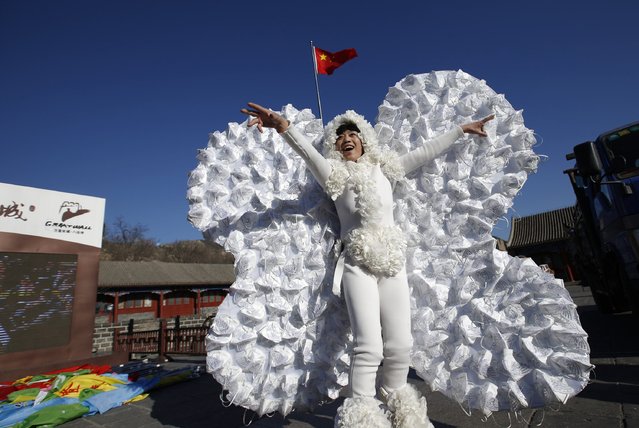
Chinese artist Kong Ning poses in a costume symbolizing a butterfly, which is decorated with 365 masks on its wings to represent the number of days in a year, during her performance art at the Badaling section of the Great Wall on the outskirts of Beijing January 1, 2015. (Photo by Kim Kyung-Hoon/Reuters)

Chinese artist Kong Ning poses in a costume symbolizing a butterfly, which is decorated with 365 masks on its wings to represent the number of days in a year, during her performance art at the Badaling section of the Great Wall on the outskirts of Beijing January 1, 2015. Kong, whose works include themes related to China's air pollution problem, named her new performance art “Hua Die” (transforming into a butterfly) and performed it on the first day of the new year as she hopes that China has clean air for this year. (Photo by Kim Kyung-Hoon/Reuters)
Details
02 Jan 2015 12:24:00
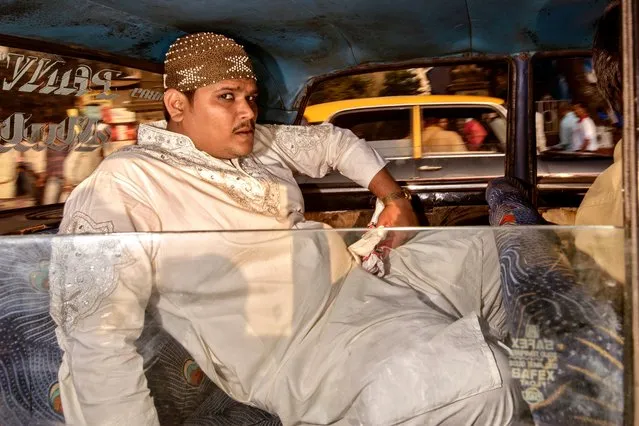
“I’m not scared of breaking the fourth wall”, Wallace has said of the photos where the subject is clearly aware of him taking the shot. “If they are looking at you in a photograph most photographers will think, oh, that’s not a good image. (But) people like to be involved and in the picture. You can see what they are thinking, see them talking”. (Photo by Dougie Wallace/The Guardian)

In Dougie Wallace’s photos of Mumbai taxis, the chatter, yelling, and constant horns of the city are almost audible. A selection of his images is on show at Gayfield Creative Spaces, Edinburgh, as part of the Retina photography festival until 30 July. For four years, the Glasgow-born Wallace focused his photos on one kind of taxi in particular: the Premier Padmini, a 1960s workhorse painted in black and yellow. Locally known as “Kaali-Peeli”, there were once more than 60,000 of them in the Indian city. But thanks to laws restricting pollution, the cars now are fast disappearing from Mumbai’s streets. (Photo by Dougie Wallace/The Guardian)

Details
13 Jul 2016 13:50:00
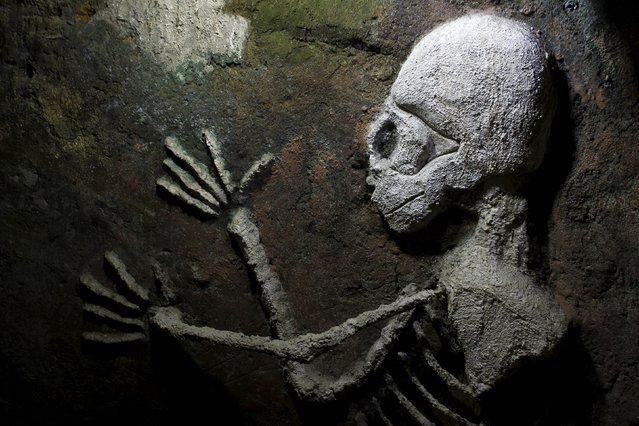
A figure of a skeleton is seen painted in a hallway of the house built underground by Manuel Barrantes in San Isidro de Perez Zeledon, Costa Rica, March 14, 2016. (Photo by Juan Carlos Ulate/Reuters)

A figure of a skeleton is seen painted in a hallway of the house built underground by Manuel Barrantes in San Isidro de Perez Zeledon, Costa Rica, March 14, 2016. Barrantes started digging through red soil and volcanic rock on his farm 12 years ago to build his subterranean house, between 15 and 63 feet (4.57 and 19.2m) underground. The dwelling, which Barrantes says provides a peaceful and comfortable home for him and his family away from noise pollution and the effects of climate change, now covers about 2,000 square feet (185.8 square metres). (Photo by Juan Carlos Ulate/Reuters)
Details
17 Mar 2016 15:34:00
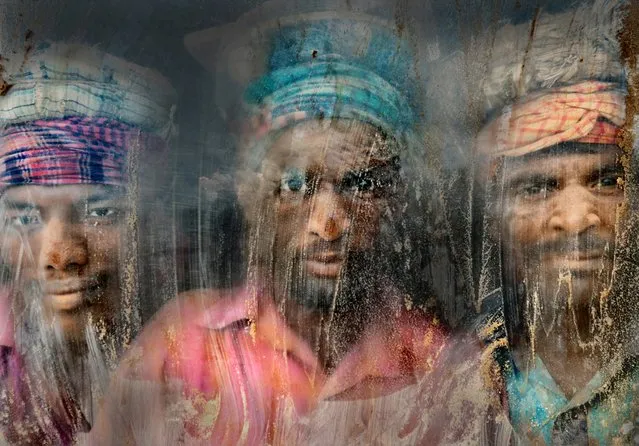
Gravel Workmen of Chittagong, Bangladesh, by Faisal Azim. Gravel workmen look through a glass window at a gravel-crushing yard in Chittagong. Full of dust and sand, it is an extremely unhealthy environment for working, but still hundreds of people work here for their livelihoods. (Photo by Faisal Azim/2016 Atkins CIWEM Environmental Photographer of the Year)

From Tibetan monks playing basket ball with ice thawing high up in the Himalayas, to the pollution that hides behind the Taj Mahal, here’s pick from 60 exceptional environmental photographs, by photographers and filmmakers from 70 countries, that will go on show at the Royal Geographical Society in London from 29 June to 21 August. The winners will be announced on 28 June. Here: Gravel Workmen of Chittagong, Bangladesh, by Faisal Azim. Gravel workmen look through a glass window at a gravel-crushing yard in Chittagong. Full of dust and sand, it is an extremely unhealthy environment for working, but still hundreds of people work here for their livelihoods. (Photo by Faisal Azim/2016 Atkins CIWEM Environmental Photographer of the Year)
Details
01 Jun 2016 12:25:00