Loading...
Done
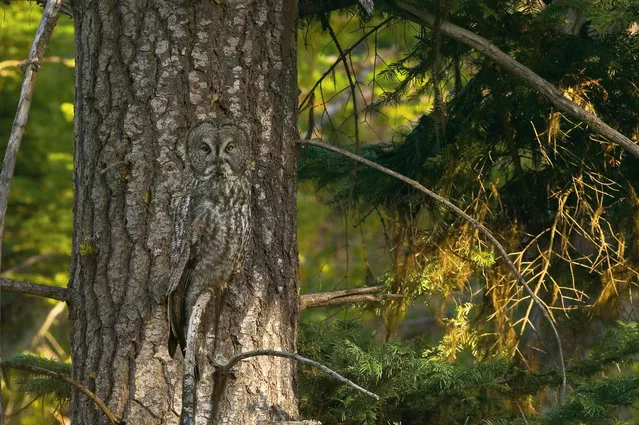
Vanishing Act By Art Wolfe

An amazing series by Art Wolfe that were taken as part of his “Vanishing Act” in which the Seattle-based photographer shows the talent of animals in disguising themselves from predators. “This collection has been a long time in the making. Finding and filming animals on location is an exhilarating and painstaking process. I’m still adding to the project even now”. Have fun spotting the hidden animals.
Details
22 Oct 2013 09:44:00
Nose to Nose; Human/Nature winner. “Doug Gimesy was documenting work at the Joey and Bat Sanctuary near Melbourne when he met a wombat (Vombatus ursinus) whose mother had been killed by a car. Gimesy watched as a young veterinary student bottle-fed the orphaned joey, then touched her nose to the joey’s in a tender moment of interspecies bonding”. (Photo by Doug Gimesy/BigPicture)

Nose to Nose; Human/Nature winner. “Doug Gimesy was documenting work at the Joey and Bat Sanctuary near Melbourne when he met a wombat (Vombatus ursinus) whose mother had been killed by a car. Gimesy watched as a young veterinary student bottle-fed the orphaned joey, then touched her nose to the joey’s in a tender moment of interspecies bonding”. (Photo by Doug Gimesy/BigPicture)
Details
25 Jun 2023 05:33:00
Australian model and designer Madeline Stuart, who has Down syndrome, acknowledges attendees after presenting creations from her label 21 Reasons Why By Madeline Stuart during New York Fashion Week in Manhattan, New York, U.S., February 12, 2017. (Photo by Andrew Kelly/Reuters)

Australian model and designer Madeline Stuart, who has Down syndrome, acknowledges attendees after presenting creations from her label 21 Reasons Why By Madeline Stuart during New York Fashion Week in Manhattan, New York, U.S., February 12, 2017. (Photo by Andrew Kelly/Reuters)
Details
15 Feb 2017 00:03:00


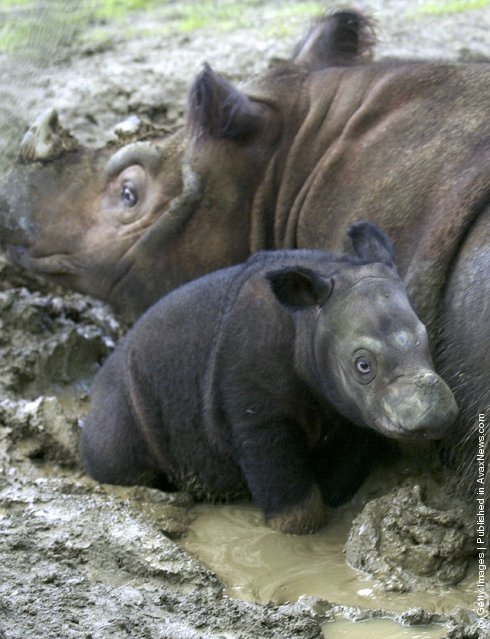
“The Sumatran Rhinoceros (Dicerorhinus sumatrensis) is a member of the family Rhinocerotidae and one of five extant rhinoceroses. It is the only extant species of the genus Dicerorhinus. It is the smallest rhinoceros, standing about 120–145 centimetres (3.9–4.76 ft) high at the shoulder, with a body length of 250 centimetres (8.2 ft) and weight of 500–800 kilograms (1,100–1,800 lb). Like the African species, it has two horns; the larger is the nasal horn, typically 15–25 centimetres (5.9–9.8 in), while the other horn is typically a stub. A coat of reddish-brown hair covers most of the Sumatran Rhino's body”. – Wikipedia

Photo: Emi, a Sumatran rhinoceros lies in the mud with her three-week-old female calf at the Cincinnati Zoo and Botanical Garden August 19, 2004 in Cincinnati, Ohio. Emi made history by becoming the first Sumatran rhino to produce two calves in captivity. (Photo by Mike Simons/Getty Images)

Details
22 Jun 2011 12:37:00
A Balinese man performs a traditional dance at Art Center Denpasar on Indonesia's resort island of Bali on May 30, 2025. (Photo by Sonny Tumbelaka/AFP Photo)

A Balinese man performs a traditional dance at Art Center Denpasar on Indonesia's resort island of Bali on May 30, 2025. (Photo by Sonny Tumbelaka/AFP Photo)
Details
05 Jul 2025 03:34:00
Kids in fancy dress eat for free at Asda Cafés in Leeds, UK on Halloween on 31st October, 2025 – a real treat for families this spooky season. (Photo by Doug Jackson/PinPep

Kids in fancy dress eat for free at Asda Cafés in Leeds, UK on Halloween on 31st October, 2025 – a real treat for families this spooky season. (Photo by Doug Jackson/PinPep)
Details
25 Nov 2025 05:35:00
The designers are encouraged to speak to the driver they are designing for, develop a relationship and work from there: “One can’t tell the story of the other if they don’t know one-another”, they say. (Photo by Sandesh Parulkar/Taxi Fabric/The Guardian)

India’s classic Ambassador taxis and juddery auto rickshaws are iconic sights in the cities of the subcontinent. In Mumbai, one project has been using them as canvases for Indian graphic designers, giving them the opportunity to design new interiors for the vehicles. (Photo by Taxi Fabric/The Guardian)
Details
06 Feb 2016 12:50:00
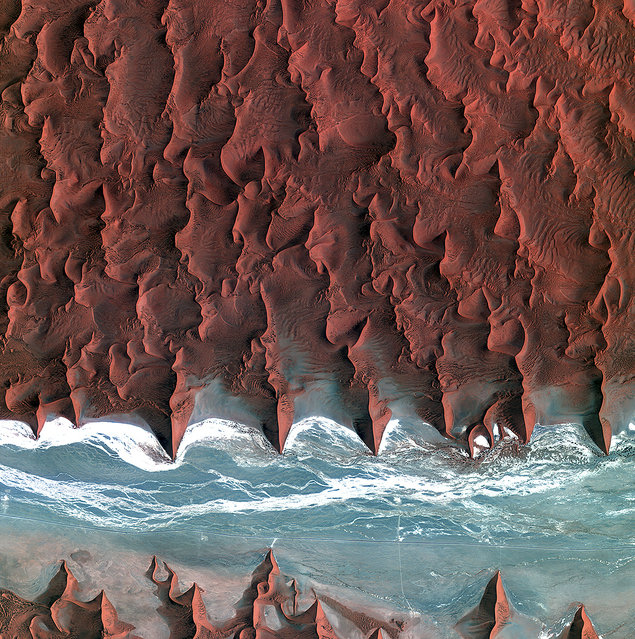
These are the dunes of the Namib Desert, taken by Korea's Kompstat-2 satellite. The blue and white area is the dried riverbed of the Tsauchab river. (Photo by The European Space Agency)

These are the dunes of the Namib Desert, taken by Korea's Kompstat-2 satellite. The blue and white area is the dried riverbed of the Tsauchab river. (Photo by The European Space Agency)
Details
17 Aug 2014 09:13:00