Loading...
Done
Vladimir Mogilnikov, 62, washes his hands in a communal washing room in a dormitory for the workers of Proletarka textile factory in the town of Tver, 200 kilometres north-west from Moscow on August 8, 2020. (Photo by Andrey Borodulin/AFP Photo)

Vladimir Mogilnikov, 62, washes his hands in a communal washing room in a dormitory for the workers of Proletarka textile factory in the town of Tver, 200 kilometres north-west from Moscow on August 8, 2020. (Photo by Andrey Borodulin/AFP Photo)
Details
07 Sep 2020 00:03:00
Punjab police's “Shakti Teams” a squad formed for women safety waits before an official flag off ceremony in Amritsar on September 14, 2021. (Photo by Narinder Nanu/AFP Photo)

Punjab police's “Shakti Teams” a squad formed for women safety waits before an official flag off ceremony in Amritsar on September 14, 2021. (Photo by Narinder Nanu/AFP Photo)
Details
22 Sep 2021 08:55:00
Newlyweds take wedding photos hanging from bridge, Yueyang, Hunan province, China on August 9, 2016. (Photo by Top Photo Corporation/Rex Features/Shutterstock)

Newlyweds take wedding photos hanging from bridge, Yueyang, Hunan province, China on August 9, 2016. They held such a special wedding ceremony on China's Qixi Festival. (Photo by Top Photo Corporation/Rex Features/Shutterstock)
Details
14 Sep 2016 10:41:00
Sergio Valverde Espinoza, a Catholic priest of the Cristo Rey church who modified a popular song called “Sopa de Caracol”, or Snail Soup in English, gestures during a Mass in San Jose, Costa Rica, Sunday, May 2, 2021. Valverde changed the song's lyrics to a message calling for the use of face masks and care during the pandemic. (Photo by Carlos Gonzalez/AP Photo)

Sergio Valverde Espinoza, a Catholic priest of the Cristo Rey church who modified a popular song called “Sopa de Caracol”, or Snail Soup in English, gestures during a Mass in San Jose, Costa Rica, Sunday, May 2, 2021. Valverde changed the song's lyrics to a message calling for the use of face masks and care during the pandemic. (Photo by Carlos Gonzalez/AP Photo)
Details
04 May 2021 10:11:00
Writing Letter

“Kusakabe Kimbei (1841 – 1934) was a Japanese photographer. He usually went by his given name, Kimbei, because his clientele, mostly non-Japanese-speaking foreign residents and visitors, found it easier to pronounce than his family name. Kusakabe Kimbei worked with Felice Beato and Baron Raimund von Stillfried as a photographic colourist and assistant before opening his own workshop in Yokohama in 1881 in the Benten-dōri quarter, and from 1889 operating in the Honmachi quarter. He also opened a branch in the Ginza quarter of Tokyo”. – Wikipedia

Photo: Writing Letter. (Photo by Kusakabe Kimbei)
Details
21 Apr 2012 13:28:00
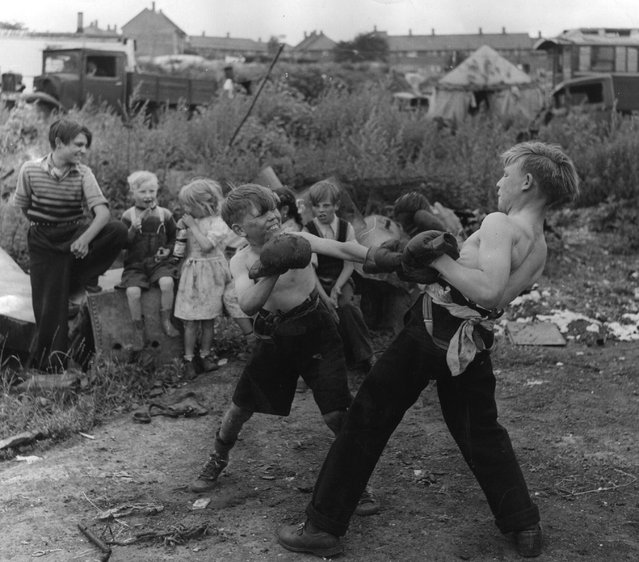
The unromantic gypsies. Children boxing in a gypsy camp in Kent, England on July 1, 1951. Like all boys these gypsy lads like to try their hand at boxing. Encouraged by their friends they fight it out on Corke's Meadow. Few Romanies now live a life of wandering romance. Most are like the three hundred squatters of Corke's Meadow, Kent, which is part of a “gypsy problem” that involves about 100,000 today. Of those about 25,000 can be rightly called gypsies, the rest are Mumpers and Posh-rats and Hobos. Corke's Meadow has both kinds. “Picture Post” cameraman Bert Hardy photographs the Corke's Meadow gypsies in their encampment. (Photo by Hulton-Deutsch Collection/Corbis via Getty Images)

The unromantic gypsies. Children boxing in a gypsy camp in Kent, England on July 1, 1951. Like all boys these gypsy lads like to try their hand at boxing. Encouraged by their friends they fight it out on Corke's Meadow. Few Romanies now live a life of wandering romance. Most are like the three hundred squatters of Corke's Meadow, Kent, which is part of a “gypsy problem” that involves about 100,000 today. Of those about 25,000 can be rightly called gypsies, the rest are Mumpers and Posh-rats and Hobos. Corke's Meadow has both kinds. “Picture Post” cameraman Bert Hardy photographs the Corke's Meadow gypsies in their encampment. (Photo by Hulton-Deutsch Collection/Corbis via Getty Images)
Details
12 Mar 2017 00:01:00
A rescued red fox rests under a closet at “Pawsitive Beginnings” fox rescue sanctuary in Key Largo, Florida, USA on August 1, 2023. Pawsitive Beginnings is a nonprofit group that works closely with organizations in parts of the USA where fur farming takes place to find permanent placement for foxes when needed. According to Pawsitive Beginnings, about 300 fur farms operate in the United States and there are very few federal laws to regulate the treatment of these animals born in captivity, raised for one year, and then killed for their coats. (Photo by Cristobal Herrera-Ulashkevich/EPA/EFE)

A rescued red fox rests under a closet at “Pawsitive Beginnings” fox rescue sanctuary in Key Largo, Florida, USA on August 1, 2023. Pawsitive Beginnings is a nonprofit group that works closely with organizations in parts of the USA where fur farming takes place to find permanent placement for foxes when needed. According to Pawsitive Beginnings, about 300 fur farms operate in the United States and there are very few federal laws to regulate the treatment of these animals born in captivity, raised for one year, and then killed for their coats. (Photo by Cristobal Herrera-Ulashkevich/EPA/EFE)
Details
13 Aug 2023 05:02:00
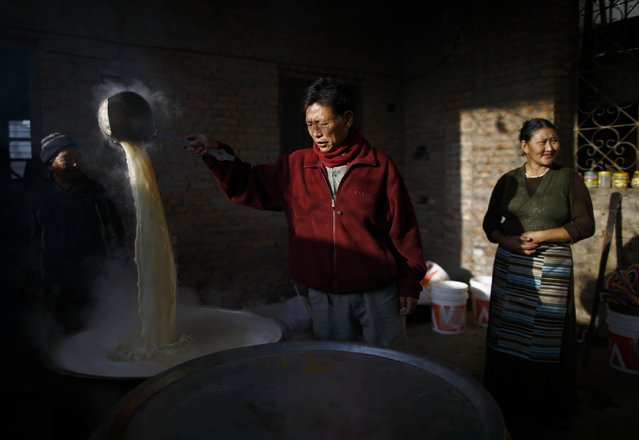
A Tibetan man stirs butter tea made for the arriving guest during the function organised to mark Losar or the Tibetan New Year at a Tibetan Refugee Camp in Lalitpur February 19, 2015. (Photo by Navesh Chitrakar/Reuters)

A Tibetan man stirs butter tea made for the arriving guest during the function organised to mark Losar or the Tibetan New Year at a Tibetan Refugee Camp in Lalitpur February 19, 2015. Tibetans across the world marked the arrival of the New Year with prayers and festivities. (Photo by Niranjan Shrestha/AP Photo)
Details
20 Feb 2015 13:06:00