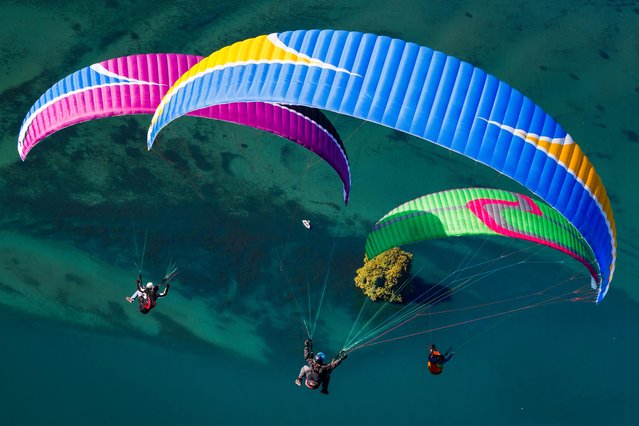
Paragliders fly towards the landing area of the “Acro Show” above Lake Geneva in Villeneuve, Switzerland on Sunday, August 26, 2018. (Photo by Valentin Flauraud/Keystone via AP Photo)
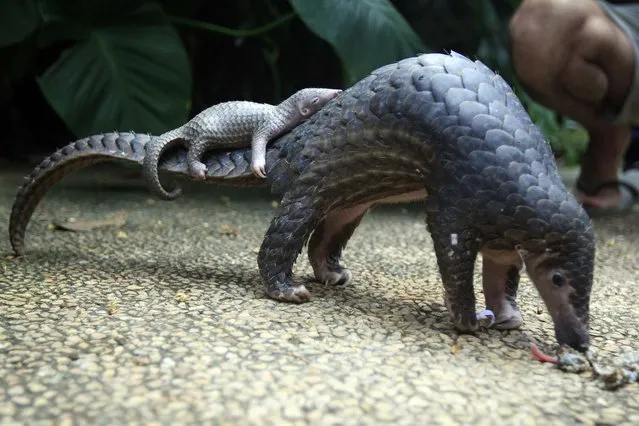
A pangolin carries its baby at a Bali zoo, Indonesia, Thursday, June 19, 2014. The pangolin baby was born on May 31. (Photo by Firdia Lisnawati/AP Photo)
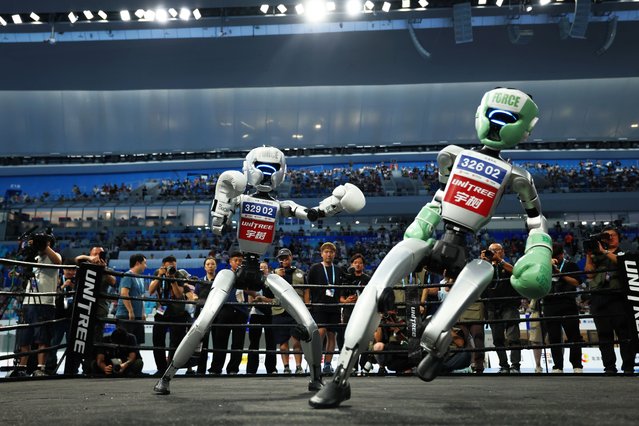
Humanoid robots fight during a kickboxing match on day two of the 2025 World Humanoid Robot Games at National Speed Skating Oval on August 16, 2025 in Beijing, China. The 2025 World Humanoid Robot Games (WHRG) will be held from August 14 to 17 in Beijing's National Speed Skating Oval, bringing together 280 teams from 16 countries across five continents. (Photo by Lintao Zhang/Getty Images)
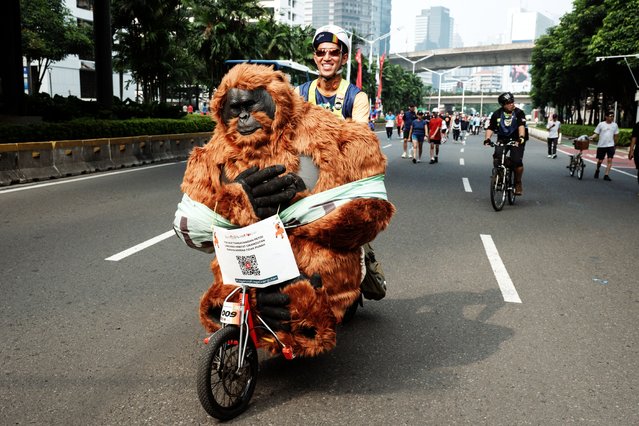
A participant rides a bicycle carrying an orangutan mascot costume as he attends an awareness action calling for the protection of orangutans, organised by local environmental NGO Satya Bumi to mark World Orangutan Day, observed on August 19, during Car Free Day in Jakarta on August 24, 2025. (Photo by Yasuyoshi Chiba/AFP Photo)
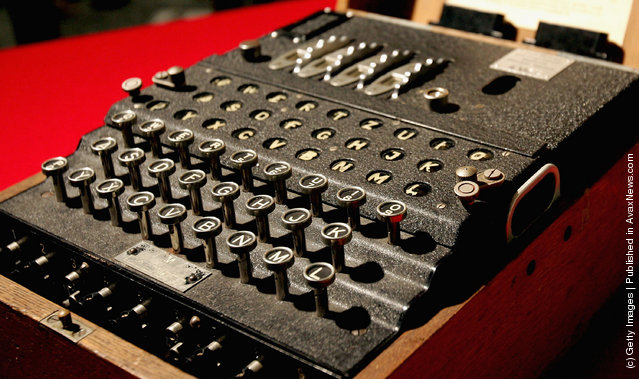
The Enigma coding machine used by the Germans in WWII on display at Bletchley Park National Code Centre, November 25, 2004 in Bletchley, England. (Photo by Ian Waldie/Getty Images)
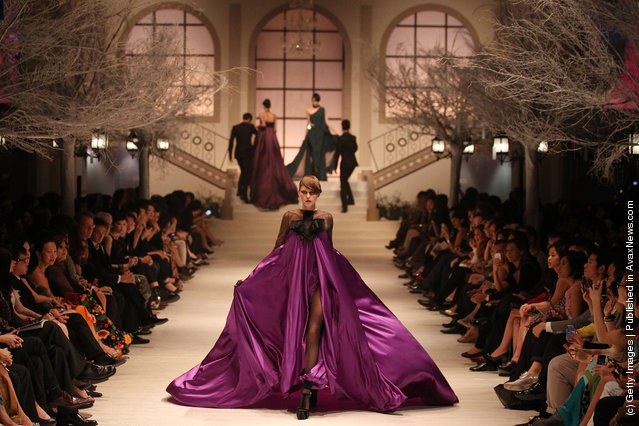
A model showcases “The Bride” by Stephane Rolland on the catwalk as part of Women's Fashion Week Haute Couture program at Marina Bay Sands on October 30, 2011 in Singapore. (Photo by Chris McGrath/Getty Images)
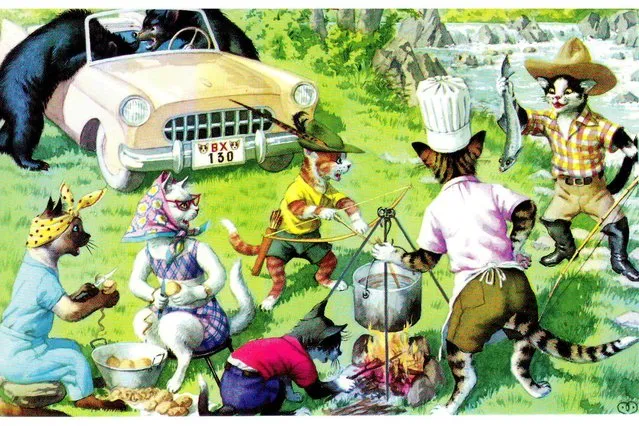
From the 1940s through the 1960s, the Alfred Mainzer Company of Long Island City, NY published a series of linen and photochrome humorous cat postcards illustrated by Eugen Hartung (or Hurtong) (1897–1973), sometimes referred to as “Mainzer Cats”. These postcards normally illustrate settings that are filled with action, often with a minor disaster just about to occur. While the dressed cats were by far the most popular and most plentiful cards, Hartung also painted other dressed animals – primarily mice, dogs, and hedgehogs.