Loading...
Done
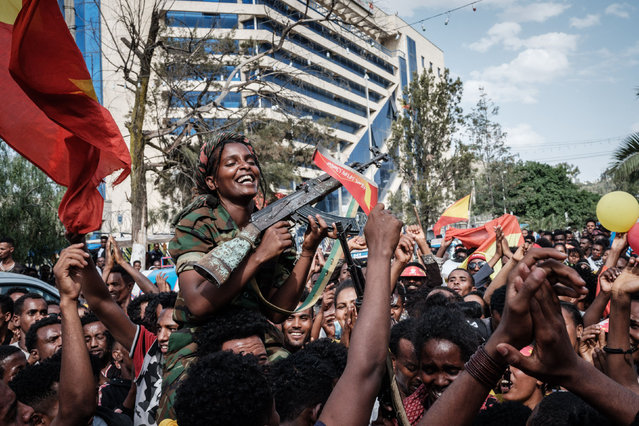
Female soldiers of Tigray Defence Force (TDF) celebrate while they sit on men's shoulders as people celebrate their return on a street in Mekele, the capital of Tigray region, Ethiopia, on June 29, 2021. Rebel fighters in Ethiopia's war-hit Tigray seized control of more territory on June 29, 2021, one day after retaking the local capital and vowing to drive all “enemies” out of the region. (Photo by Yasuyoshi Chiba/AFP Photo)

Female soldiers of Tigray Defence Force (TDF) celebrate while they sit on men's shoulders as people celebrate their return on a street in Mekele, the capital of Tigray region, Ethiopia, on June 29, 2021. Rebel fighters in Ethiopia's war-hit Tigray seized control of more territory on June 29, 2021, one day after retaking the local capital and vowing to drive all “enemies” out of the region. (Photo by Yasuyoshi Chiba/AFP Photo)
Details
16 Jul 2021 10:26:00
A demonstrator uses her phone to take a “selfie” picture during the 12th annual “SlutWalk” march through central Jerusalem on June 14, 2024 to protest against rape culture, including sеxual assault and harassment directed at women, and calling for an end to the ongoing war in the Gaza Strip and action to release hostages taken captive during the October 7 attacks. (Photo by Hazem Bader/AFP Photo)

A demonstrator uses her phone to take a “selfie” picture during the 12th annual “SlutWalk” march through central Jerusalem on June 14, 2024 to protest against rape culture, including sеxual assault and harassment directed at women, and calling for an end to the ongoing war in the Gaza Strip and action to release hostages taken captive during the October 7 attacks. (Photo by Hazem Bader/AFP Photo)
Details
17 Oct 2025 03:59:00
Rabbit Island in Japan

Only after World War II did the secret spill: Ōkunoshima, located in the Inland Sea of Japan between Hiroshima and Shikoku, was the top-secret site for manufacturing chemical warfare. When the factories were closed down, a number of exotic wild rabbits were seen freely roaming the island. They were assumed to have been the test subjects for the chemical weapons, which the military failed to eradicate when the factory was demolished.
Details
17 Feb 2014 12:23:00
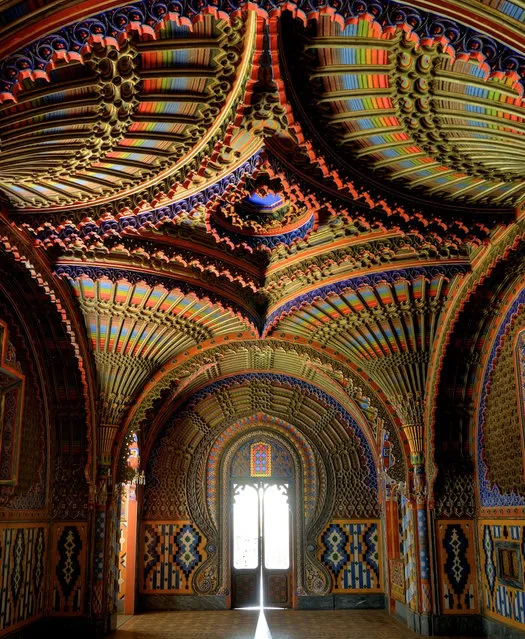
Italian Peacock Room in Tuscany

The extravagant residence Castello di Sammezzano sits on top of a hill in Tuscany, Northern Italy. Originally it was built in the Moorish style in 1605 for Ximenes d'Aragona and then re-designed between 1853 and 1889. After the war the castello was used as a luxury hotel until closure in the mid to late 1990's. It was abandoned until April 2012 when the FPXA committee was formed, aiming to promote and enhance the castle.
Details
17 May 2013 11:06:00
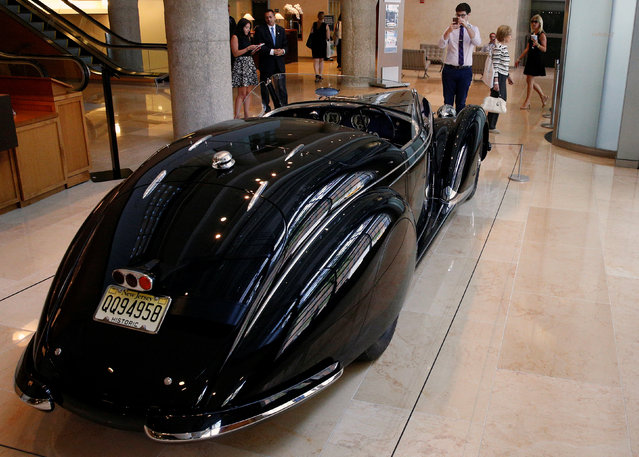
People look at a 1939 Alfa Romeo 8C 2900B Lungo Touring Spider displayed at Sotheby's in New York City, New York, U.S. July 21, 2016. The car, unveiled in a pre-publicity showing in New York on Thursday, is expected to sell for more than US$15 million – and could set a record for the most money ever paid for a pre-war auto at auction. “This is a personal favourite of mine, the 1939 Alfa Romeo is one of the grandest pre-war cars ever built”, said Ian Kelleher, managing director, RM Sotheby's US West Coast division. “You can achieve speeds in excess of 100 miles an hour in this car. (Photo by Brendan McDermid/Reuters)

People look at a 1939 Alfa Romeo 8C 2900B Lungo Touring Spider displayed at Sotheby's in New York City, New York, U.S. July 21, 2016. The car, unveiled in a pre-publicity showing in New York on Thursday, is expected to sell for more than US$15 million – and could set a record for the most money ever paid for a pre-war auto at auction. (Photo by Brendan McDermid/Reuters)
Details
22 Jul 2016 12:22:00
Revellers celebrate "Ash Monday" by participating in a colourful "flour war", a traditional festivity marking the end of the carnival season and the start of the 40-day Lent period until the Orthodox Easter,in the port town of Galaxidi, some 215 km (134 miles) north west of Athens, March 18, 2013. The revellers "fight" by throwing coloured flour, charcoal dust and powder painting until they essentially run out of supplies. (Photo by Yannis Behrakis/Reuters)

Revellers celebrate "Ash Monday" by participating in a colourful "flour war", a traditional festivity marking the end of the carnival season and the start of the 40-day Lent period until the Orthodox Easter,in the port town of Galaxidi, some 215 km (134 miles) north west of Athens, March 18, 2013. The revellers "fight" by throwing coloured flour, charcoal dust and powder painting until they essentially run out of supplies. (Photo by Yannis Behrakis/Reuters)
Details
20 Mar 2013 07:23:00
A view motorists have grown accustomed seeing, a military truck made by Oshkosh Corp. is taken for a test drive Thursday, April 11, 2013 in Oshkosh, Wis. Faced with deep cuts in U.S. military spending, and the end of the wars in Iraq and Afghanistan, Oshkosh Corp. is laying off 900 employees in its defense division based in Oshkosh. Approximately 700 hourly workers at the state's largest manufacturer will lose their jobs in mid-June, followed by approximately 200 salaried employees through July. (Photo by Mark Hoffman via The Journal Sentinel)

A view motorists have grown accustomed seeing, a military truck made by Oshkosh Corp. is taken for a test drive Thursday, April 11, 2013 in Oshkosh, Wis. Faced with deep cuts in U.S. military spending, and the end of the wars in Iraq and Afghanistan, Oshkosh Corp. is laying off 900 employees in its defense division based in Oshkosh. Approximately 700 hourly workers at the state's largest manufacturer will lose their jobs in mid-June, followed by approximately 200 salaried employees through July. (Photo by Mark Hoffman via The Journal Sentinel)
Details
14 Apr 2013 11:15:00
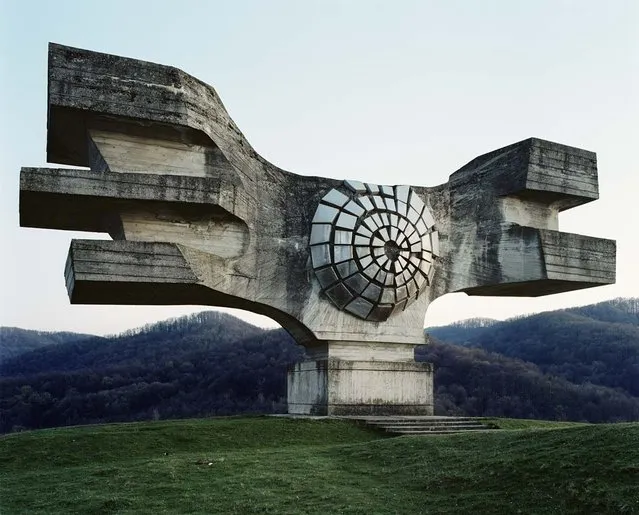
The monument of Ilirska Bistrica was designed by Janez Lenassi and built in 1965. It is dedicated to Slovenian soldiers that fell in World War II. (Photo by Jan Kempenaers)

The brutalist war memorials found throughout the former Yugoslavia were weird enough when they were built in the 1960s and 70s. Today, separated by the end of an architectural movement and the disintegration of the country, they seem almost alien. Belgian photographer Jan Kempenaers treats them purely as artistic objects in his book, “Spomenik”, named for the Serb-Croat word for monument. Known for photographing geographical oddities, Kempenaers was captivated by the spomenik after seeing them in an art encyclopedia. After hearing that many had been destroyed or abandoned, he set out to record what was left. (Photo by Jan Kempenaers)
Details
18 Aug 2014 09:07:00