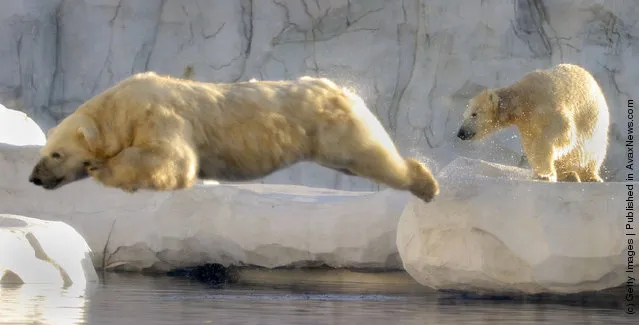
Talini (R), a 9-month old 160-pound polar bear cub, swims with her mother Barle at the Detroit Zoo's Artic Ring of Life exhibit August 25, 2005 in Royal Oak, Michigan. Talini's birth was the first polar bear birth at the Detroit Zoo in fifteen years. Her mother Barle was wild born and was rescued by the Detroit Zoo from a circus in Puerto Rico in 2002. (Photo by Bill Pugliano/Getty Images)
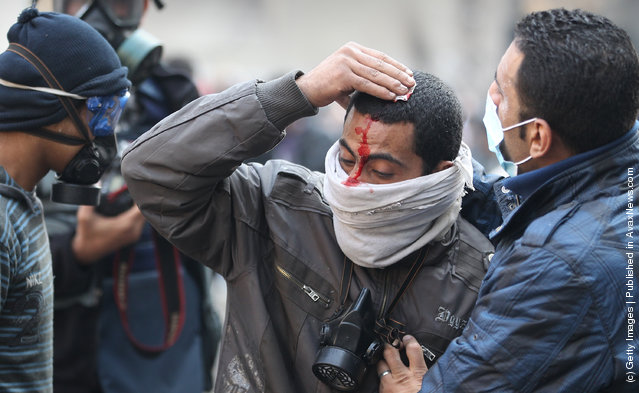
An injured protestor is led away during clashes with police near Tahrir Square on November 23, 2011 in Cairo, Egypt. Thousands of Egyptians are continuing to occupy Tahrir Square after four days of clashes with security forces despite a promise from military leaders to bring forward Presidential elections. (Photo by Peter Macdiarmid/Getty Images)
The Swiss Federal Palace (Bundeshaus) is illuminated by giant light projection "The Jewel of the Mountains" in Bern, Switzerland October 15, 2015. The light and sound show will run every evening until November 29, 2015. (Photo by Ruben Sprich/Reuters)
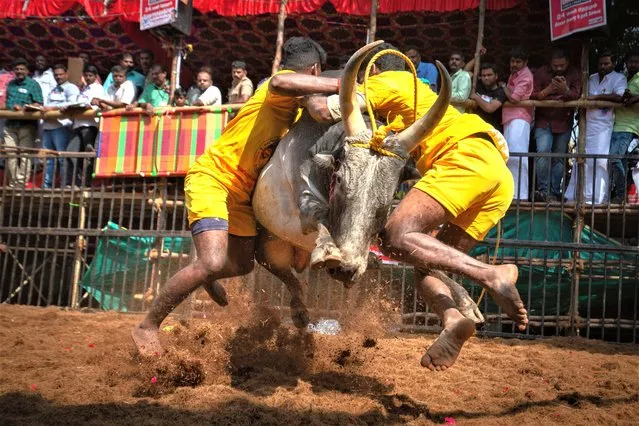
Men tackle a bull as they participate in the annual bull-taming sport of Jallikattu played to celebrate the harvest festival of Pongal on January 15, 2023 in Avaniyapuram, near Madurai, India. (Photo by Abhishek Chinnappa/Getty Images)
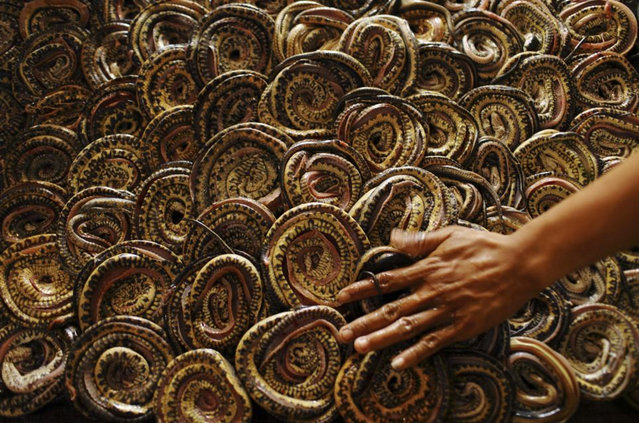
Images from a snake slaughterhouse at Kapetakan village in Indonesia’s West Java province. Wakira, who is known as “Boss Cobra”, owns the slaughterhouse that produces snake meat and skin. Snake meat is believed by some to be a remedy for skin diseases and asthma, as well as an aid to increase virility. The snake skins, measuring in the hundreds of metres, are sold to bag factories in the West and Central Java provinces on a monthly basis. The price of a bag made from snake skin costs between 150,000 rupiah ($ 15.60) and 300,000 rupiah ($31.20), depending on its size. That snakeskin handbag you’ll buy is costing a hell of a lot more.