Loading...
Done
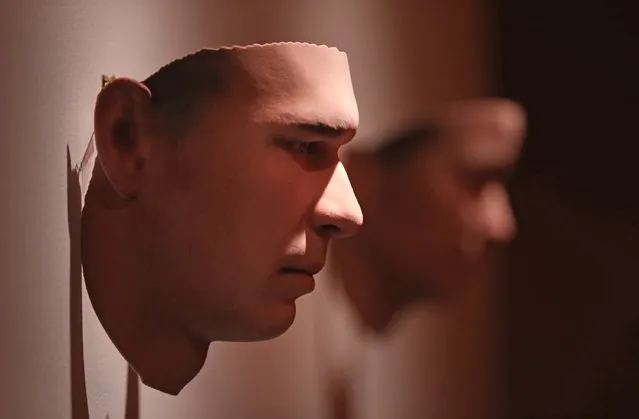
Artist Heather Dewey-Hagborg's 'Stranger Visions', comprising of 3D printed faces extracted from DNA taken from discarded cigarette butts and chewing gum, is displayed at the Big Bang Data exhibition at Somerset House on December 2, 2015 in London, England. (Photo by Peter Macdiarmid/Getty Images for Somerset House)

Artist Heather Dewey-Hagborg's 'Stranger Visions', comprising of 3D printed faces extracted from DNA taken from discarded cigarette butts and chewing gum, is displayed at the Big Bang Data exhibition at Somerset House on December 2, 2015 in London, England. The show highlights the data explosion that's radically transforming our lives. It opens on December 3, 2015 and runs until February 28, 2016 at Somerset House. (Photo by Peter Macdiarmid/Getty Images for Somerset House)
Details
04 Dec 2015 08:03:00
Visitors at the National Zoo check out a parrotfish made from found waste from the ocean in Washington, DC on May 23, 2016. The artwork can be seen at the National Zoo until September 5th. (Photo by Keith Lane/The Washington Post)

Visitors at the National Zoo check out a parrotfish made from found waste from the ocean in Washington, DC on May 23, 2016. The artwork can be seen at the National Zoo until September 5th. (Photo by Keith Lane/The Washington Post)
Details
25 May 2016 13:11:00
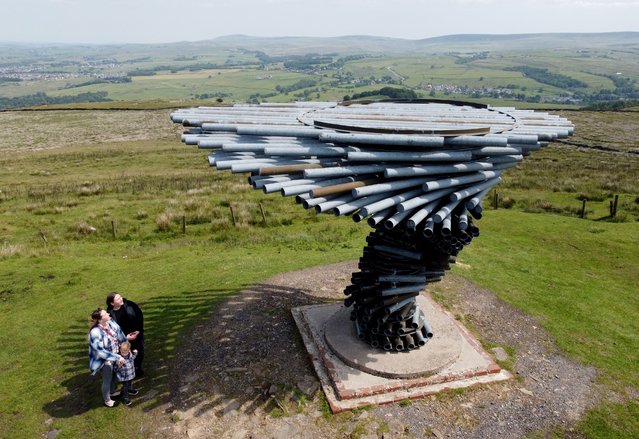
Migle Politike (left) with son Aaron and friend Goda Zubkaityte on Wednesday, June 11, 2025 stop to look at the Singing Ringing Tree, a musical sculpture designed to look like a windswept tree, at Crown Point overlooking Burnley, Lancashire, UK. The wind-powered musical sculpture emits a low, tuneful song when the wind blows. (Photo by Martin Rickett/PA Wire)

Migle Politike (left) with son Aaron and friend Goda Zubkaityte on Wednesday, June 11, 2025 stop to look at the Singing Ringing Tree, a musical sculpture designed to look like a windswept tree, at Crown Point overlooking Burnley, Lancashire, UK. The wind-powered musical sculpture emits a low, tuneful song when the wind blows. (Photo by Martin Rickett/PA Wire)
Details
24 Jul 2025 04:30:00
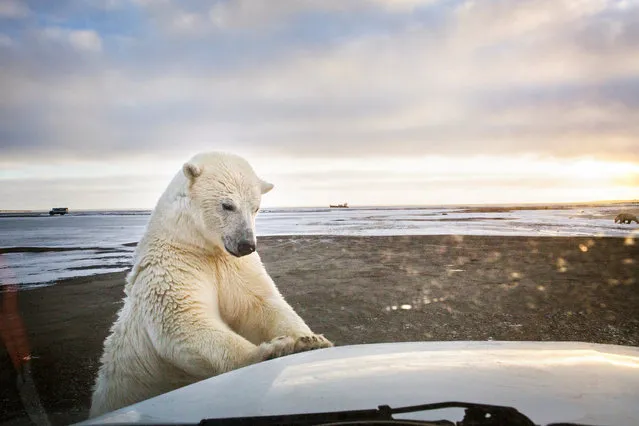
In late summer and early autumn polar bears flock to the native village of Kaktovik in the Alaskan Arctic to eat at “the boneyard” – the remains of whales annually hunted by the community. (Photo by Katie Orlinsky/Getty Images)

A selection of work by four photojournalists who have won grants of $10,000 and editorial support from the agency. Here: “Chasing Winter” by Katie Orlinksy. In late summer and early autumn polar bears flock to the native village of Kaktovik in the Alaskan Arctic to eat at “the boneyard” – the remains of whales annually hunted by the community. (Photo by Katie Orlinsky/Getty Images)
Details
02 Sep 2016 13:55:00
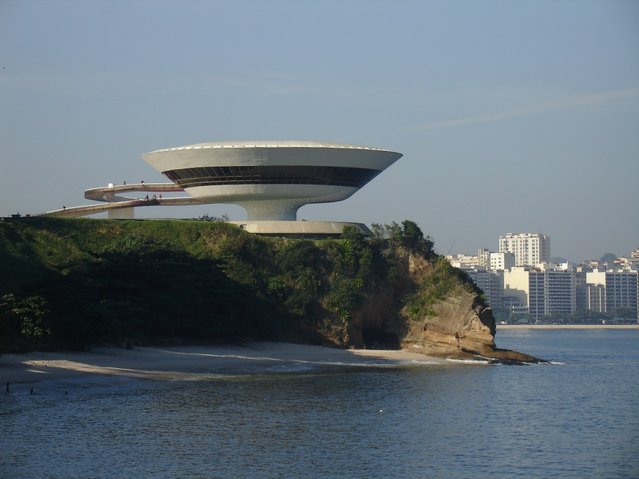
Niterói Contemporary Art Museum

The Niterói Contemporary Art Museum (Museu de Arte Contemporânea de Niterói — MAC) is situated in the city of Niterói, Rio de Janeiro, Brazil, and is one of the city’s main landmarks. It was completed in 1996.
Details
13 Aug 2013 10:18:00
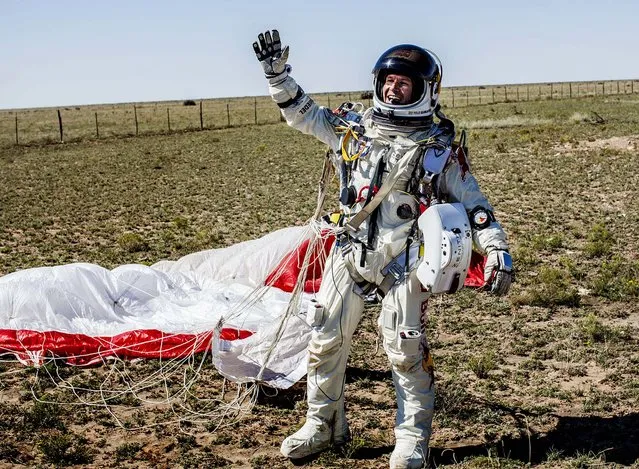
Baumgartner celebrates after successfully completing the jump. (Photo by Balazs Gardi/Red Bull Stratos)

“A skydiver has made history by smashing the world record for the highest skydive after leaping from 128,097ft (39,044m). Daredevil Felix Baumgartner ascended to the edge of space in a pressurised capsule suspended beneath a giant helium balloon. He then jumped out, freefalling for four minutes and 19 seconds before opening his parachute”.

Photo: Baumgartner celebrates after successfully completing the jump. (Photo by Balazs Gardi/Red Bull Stratos)

Details
15 Oct 2012 10:17:00


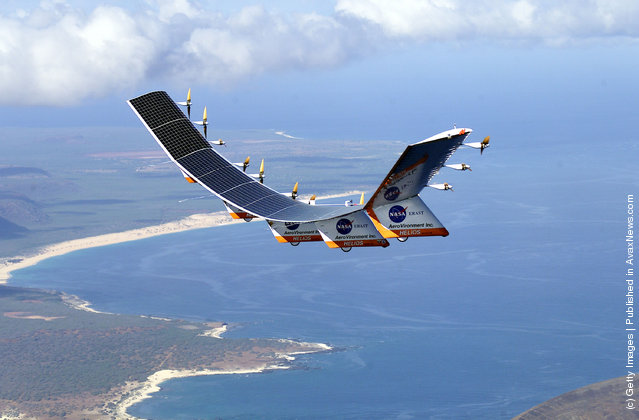
“NASA's Pathfinder, Pathfinder Plus, Centurion and Helios Prototype were an evolutionary series of solar- and fuel-cell-system-powered unmanned aerial vehicles. AeroVironment, Inc. developed the vehicles under NASA's Environmental Research Aircraft and Sensor Technology (ERAST) program. They were built to develop the technologies that would allow long-term, high-altitude aircraft to serve as “atmospheric satellites”, to perform atmospheric research tasks as well as serve as communications platforms”. – Wikipedia

Photo: The solar-electric Helios Prototype flying wing is flies over the Hawaiian islands of Niihau and Lehua during the first solar-powered test flight July 14, 2001 from the U.S. Navy's Pacific Missile Range Facility on Kauai, HI. The 18-hour flight was a functional checkout of the aircraft's systems and performance in preparation for an attempt to reach sustained flight at 100,000 feet altitude later in the summer. (Photo Courtesy of NASA/Getty Images)
Details
14 Jul 2011 09:24:00
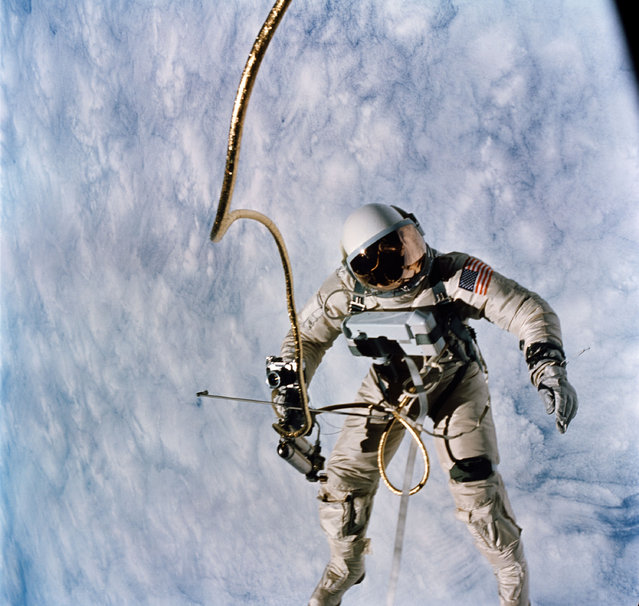
Astronaut Edward H. White II, pilot for the Gemini-Titan 4 (GT-4) spaceflight, floats in the zero-gravity of space during the third revolution of the GT-4 spacecraft on June 3, 1965. White wears a specially designed spacesuit. His face is shaded by a gold-plated visor to protect him from unfiltered rays of the sun. (Photo by NASA)

Astronaut Edward H. White II, pilot for the Gemini-Titan 4 (GT-4) spaceflight, floats in the zero-gravity of space during the third revolution of the GT-4 spacecraft on June 3, 1965. White wears a specially designed spacesuit. His face is shaded by a gold-plated visor to protect him from unfiltered rays of the sun. In his right hand he carries a Hand-Held Self-Maneuvering Unit (HHSMU) that gives him control over his movements in space. White also wears an emergency oxygen chest pack; and he carries a camera mounted on the HHSMU for taking pictures of the sky, Earth and the GT-4 spacecraft. He is secured to the spacecraft by a 25-feet umbilical line and a 23-feet tether line. Both lines are wrapped together in gold tape to form one cord. Astronaut James A. McDivitt, command pilot, remained inside the spacecraft during the extravehicular activity (EVA). Astronaut White died in the Apollo/Saturn 204 fire at Cape Kennedy on January 27, 1967. (Photo by NASA)
Details
22 Jul 2014 12:05:00