Loading...
Done
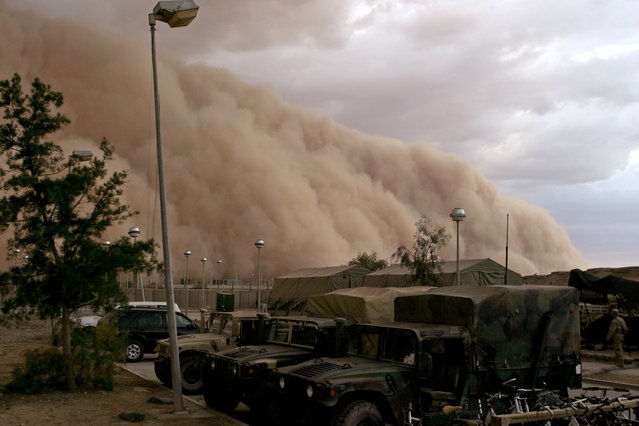
A massive sand storm cloud is close to enveloping a military camp as it rolls over Al Asad, Iraq, April 27, 2005. (Photo by Cpl. Alicia M. Garcia, U.S. Marine Corps/Reuters/U.S. Department of Defense)

A massive sand storm cloud is close to enveloping a military camp as it rolls over Al Asad, Iraq, April 27, 2005. (Photo by Cpl. Alicia M. Garcia, U.S. Marine Corps/Reuters/U.S. Department of Defense)
Details
03 Apr 2015 13:02:00
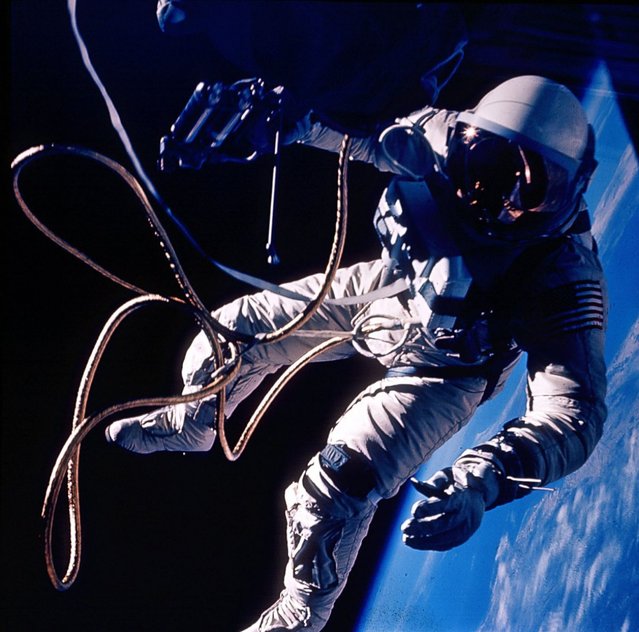
The First U.S. Spacewalk – Gemini 4 Ed White made the United States' first spacewalk on June 3, 1965 during the Gemini 4 mission. The extra-vehicular activity (EVA) started at 19:45 UT (3:45 p.m. EDT) on the third orbit when White opened his hatch and used the hand-held manuevering oxygen-jet gun to push himself out of the capsule. (Photo by NASA)

The First U.S. Spacewalk – Gemini 4 Ed White made the United States' first spacewalk on June 3, 1965 during the Gemini 4 mission. The extra-vehicular activity (EVA) started at 19:45 UT (3:45 p.m. EDT) on the third orbit when White opened his hatch and used the hand-held manuevering oxygen-jet gun to push himself out of the capsule. (Photo by NASA)
Details
11 Apr 2014 08:40:00
Galapagos – Rocking the Cradle: Four major ocean currents converge along the Galapagos archipelago, creating the conditions for an extraordinary diversity of animal life, April 25, 2016. The islands are home to at least 7,000 flora and fauna species, of which 97 percent of the reptiles, 80 percent of the land birds, 50 percent of the insects and 30 percent of the plants are endemic. The local ecosystem is highly sensitive to the changes in temperature, rainfall and ocean currents that characterize the climatic events known as El Niño and La Niña. These changes cause marked fluctuations in weather and food availability. Many scientists expect the frequency of El Niño and La Niña to increase as a result of climate change, making the Galapagos a possible early-warning location for its effects. (Photo by Thomas P. Peschak for National Geographic/World Press Photo)

Galapagos – Rocking the Cradle: Four major ocean currents converge along the Galapagos archipelago, creating the conditions for an extraordinary diversity of animal life, April 25, 2016. The islands are home to at least 7,000 flora and fauna species, of which 97 percent of the reptiles, 80 percent of the land birds, 50 percent of the insects and 30 percent of the plants are endemic. (Photo by Thomas P. Peschak for National Geographic/World Press Photo)
Details
16 Apr 2018 00:01:00
Winner. “I took this vertical image in the Quarry Bay district of Hong Kong during the dusk ‘blue hour’, when there was a perfect balance between the ambient light in the sky and the artificial lights of the high-rise residential buildings”. MICK RYAN, JUDGE: “Quarry Bay is a rich area for great shots and this is a particularly striking image of these old apartments, a unique perspective that was wisely taken as the light fades and the apartment lights come on”. (Photo by Jatinder Heer/The Guardian)

Winner. “I took this vertical image in the Quarry Bay district of Hong Kong during the dusk ‘blue hour’, when there was a perfect balance between the ambient light in the sky and the artificial lights of the high-rise residential buildings”. (Photo by Jatinder Heer/The Guardian)
Details
02 Nov 2018 00:05:00


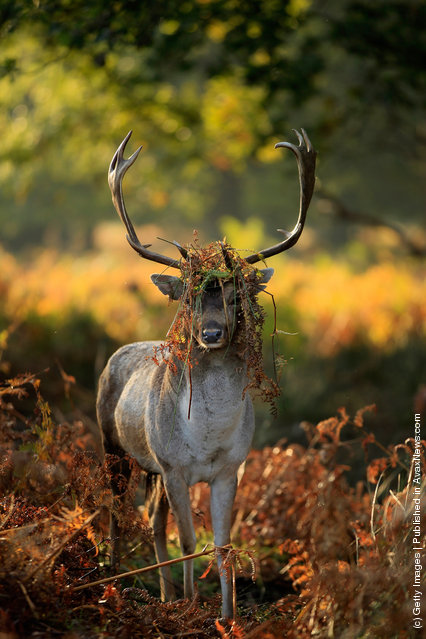
A deer forages for food in the early morning sun as cooler temperatures bring on the autumn season at Dunham Massey on on October 11, 2010 in Lymm, England. Shortening daylight hours and cooler weather brings on the rutting season for Red and Fallow deer herds and Autumn foliage colours across Britain. (Photo by Christopher Furlong/Getty Images)
Details
02 Jul 2011 13:25:00
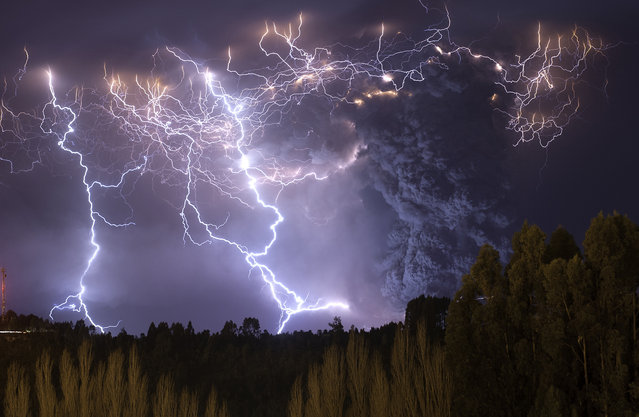
The eruption of Cordon Caulle began on June 4, 2011, located in the Region of Los Rios in Chile. For about 12 months, people and animals became accustomed to living with the daily fall of ash, which also caused problems in the air traffic in South America. The explosions and lightning during first days of the eruption could be seen from hundreds of miles around. This photograph was taken on the second night of eruption from the town of Lago Ranco. (Photo and caption by Francisco Negroni/National Geographic Traveler Photo Contest)

The eruption of Cordon Caulle began on June 4, 2011, located in the Region of Los Rios in Chile. For about 12 months, people and animals became accustomed to living with the daily fall of ash, which also caused problems in the air traffic in South America. The explosions and lightning during first days of the eruption could be seen from hundreds of miles around. This photograph was taken on the second night of eruption from the town of Lago Ranco. (Photo and caption by Francisco Negroni/National Geographic Traveler Photo Contest)

ATTENTION! All pictures are presented in high resolution. To see Hi-Res images – just TWICE click on any picture. In other words, click small picture – opens the BIG picture. Click BIG picture – opens VERY BIG picture.
Details
23 Jun 2013 11:24:00
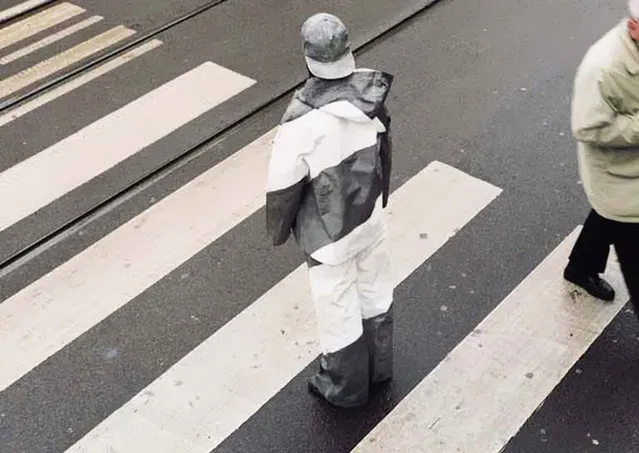
Rotterdam 2002

“The artist herself produces the camouflage suit. For each photo, for each environment of her choice, she designs a new suit, which again and again has to be made with the greatest precision, or the illusive effect will not work. By uniting the figure with the background, Desiree Palmen reaches a surprising visual effect that requests a special effort for the observing eye: it must disentangle what is flat and what is spatial.”
Details
24 Jun 2012 02:54:00


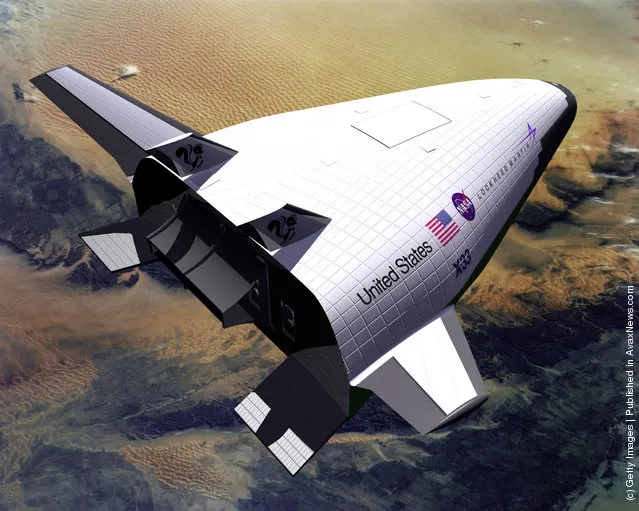
“The Lockheed Martin X-33 is an unmanned, sub-scale technology demonstrator suborbital spaceplane developed in the 1990s under the U.S. government-funded Space Launch Initiative program”. – Wikipedia

Photo: An Artist's Rendering Shows How Nasa's X-33 Technology Demonstrator, A Cost-Cutting Fully Reusable Single-Stage-To-Orbit Space Vehicle, Will Look Upon Completion. The 67 Foot-Long, 278,600 Pound, Twin Engine Space Vehicle, Capable Of Reaching Speeds In Excess Of Mach 15, Will Lead To The Construction Of A 127 Foot-Long, 2,186,000 Pound Version With Seven Engines And A 50,000 Pound Payload Capacity Called The “Venturestar”. (Photo By Nasa/Getty Images)
Details
22 Mar 2011 12:05:00