Loading...
Done
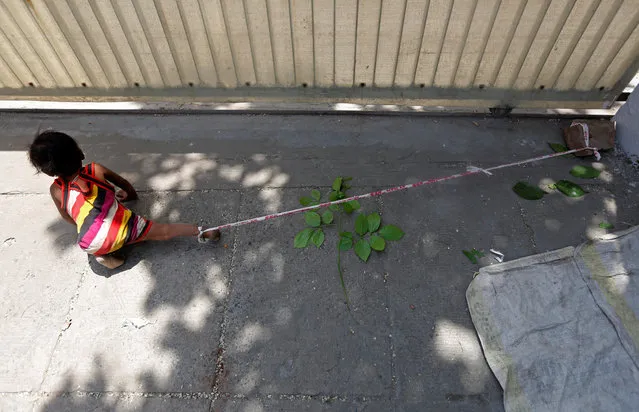
Barrier tape is tied around 15-month-old Shivani's ankle to prevent her from running away, while her mother Sarta Kalara works at a construction site nearby, in Ahmedabad, India, April 19, 2016. Kalara says she has no option but to tether her daughter Shivani to a stone despite her crying, while she and her husband work for 250 rupees ($3.8) each a shift digging holes for electricity cables in the city of Ahmedabad. There are about 40 million construction workers in India, at least one in five of them women, and the majority poor migrants who shift from site to site, building infrastructure for India's booming cities. Across the country it is not uncommon to see young children rolling in the sand and mud as their parents carry bricks or dig for new roads or luxury houses. (Photo by Amit Dave/Reuters)

Barrier tape is tied around 15-month-old Shivani's ankle to prevent her from running away, while her mother Sarta Kalara works at a construction site nearby, in Ahmedabad, India, April 19, 2016. Kalara says she has no option but to tether her daughter Shivani to a stone despite her crying, while she and her husband work for 250 rupees ($3.8) each a shift digging holes for electricity cables in the city of Ahmedabad. There are about 40 million construction workers in India, at least one in five of them women, and the majority poor migrants who shift from site to site, building infrastructure for India's booming cities. Across the country it is not uncommon to see young children rolling in the sand and mud as their parents carry bricks or dig for new roads or luxury houses. (Photo by Amit Dave/Reuters)
Details
14 Dec 2016 07:39:00
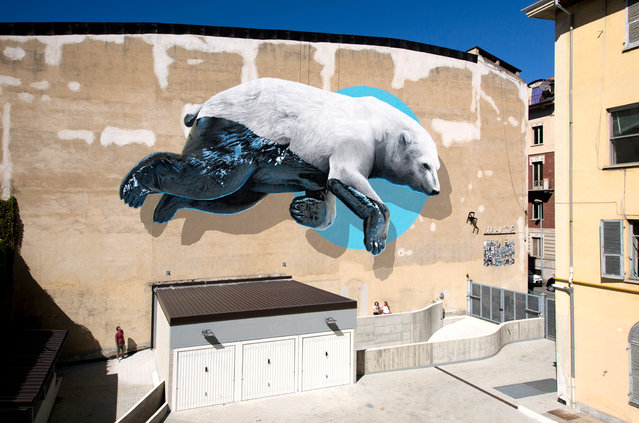
A polar bear whose bottom half is caked in oily black gunk. A whale wrapped in striped fabric: a pseudo straightjacket. These are the messes climate change leaves behind, the things we know are happening but often don’t have the opportunity to see with our own eyes. Swiss street art duo Christian Rebecchi and Pablo Togni, otherwise known as NeverCrew, met in art school when they were 15 and started making work together soon after. As a team, the artists adorn the world with eye-popping and gut-wrenching images depicting the consequences of humanity’s actions on earth. Here: “Black machine” mural painting and installation on the Colosseo theater in Turin, Italy, in September 2015. (Photo by NeverCrew/The Huffington Post)

A polar bear whose bottom half is caked in oily black gunk. A whale wrapped in striped fabric: a pseudo straightjacket. These are the messes climate change leaves behind, the things we know are happening but often don’t have the opportunity to see with our own eyes. Swiss street art duo Christian Rebecchi and Pablo Togni, otherwise known as NeverCrew, met in art school when they were 15 and started making work together soon after. As a team, the artists adorn the world with eye-popping and gut-wrenching images depicting the consequences of humanity’s actions on earth. (Photo by NeverCrew/The Huffington Post)
Details
13 Aug 2016 11:09:00
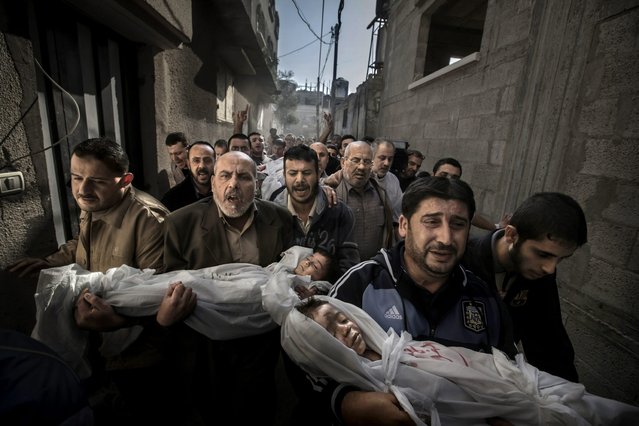
In this photo provided on Friday Feb. 15, 2013 by World Press Photo, the 2013 World Press Photo of the year by Paul Hansen, Sweden, for Dagens Nyheter, shows two-year-old Suhaib Hijazi and her three-year-old brother Muhammad who were killed when their house was destroyed by an Israeli missile strike. (Photo by Paul Hansen/Dagens Nyheter/AP Photo)

Swedish photographer Paul Hansen won the 2012 World Press Photo award Friday for newspaper Dagens Nyheter with a picture of two Palestinian children killed in an Israeli missile strike being carried to their funeral.

Photo: In this photo provided on Friday February 15, 2013 by World Press Photo, the 2013 World Press Photo of the year by Paul Hansen, Sweden, for Dagens Nyheter, shows two-year-old Suhaib Hijazi and her three-year-old brother Muhammad who were killed when their house was destroyed by an Israeli missile strike. Their father, Fouad, was also killed and their mother was put in intensive care. Fouad's brothers carry his children to the mosque for the burial ceremony as his body is carried behind on a stretcher in Gaza City, Palestinian Territories, November 20, 2012. (Photo by Paul Hansen/Dagens Nyheter/AP Photo)
Details
16 Feb 2013 12:17:00
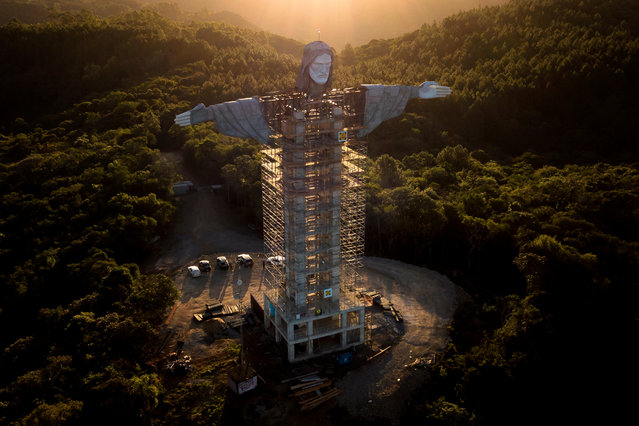
Aerial view of the Christ The Protector Statue and the Valle de Taquari on April 20, 2021 in Encantado, Brazil. The statue being built in Encantado, southern Brazil, will surpass the iconic Christ The Redeemer of Rio de Janeiro by seven meters. Made of steel and concrete, it will stand 43 meters including its pedestal, and become the third-tallest statue of Jesus Christ in the world. (Photo by Buda Mendes/Getty Images)

Aerial view of the Christ The Protector Statue and the Valle de Taquari on April 20, 2021 in Encantado, Brazil. The statue being built in Encantado, southern Brazil, will surpass the iconic Christ The Redeemer of Rio de Janeiro by seven meters. Made of steel and concrete, it will stand 43 meters including its pedestal, and become the third-tallest statue of Jesus Christ in the world. (Photo by Buda Mendes/Getty Images)
Details
05 May 2021 09:19:00
Pistachio, a puppy who was born with green fur, is seen on the day he was born on a farm on the island of Sardinia, in Pattada, Italy, October 9, 2020. (Photo by Cristian Mallocci/Handout via Reuters)

Pistachio, a puppy who was born with green fur, is seen on the day he was born on a farm on the island of Sardinia, in Pattada, Italy, October 9, 2020. (Photo by Cristian Mallocci/Handout via Reuters)
Details
01 Nov 2020 00:05:00
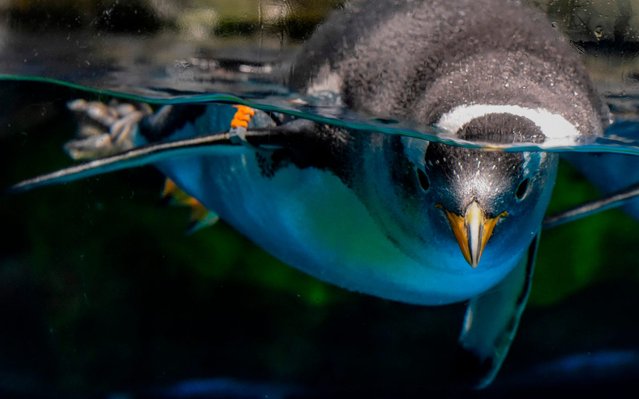
This picture taken on May 4, 2020 shows a gentoo penguin swimming in an enclosure at the Ocean Park theme park, which is currently closed due to the COVID-19 novel coronavirus, in Hong Kong. (Photo by Richard A. Brooks/AFP Photo)

This picture taken on May 4, 2020 shows a gentoo penguin swimming in an enclosure at the Ocean Park theme park, which is currently closed due to the COVID-19 novel coronavirus, in Hong Kong. (Photo by Richard A. Brooks/AFP Photo)
Details
15 Jan 2021 00:03:00
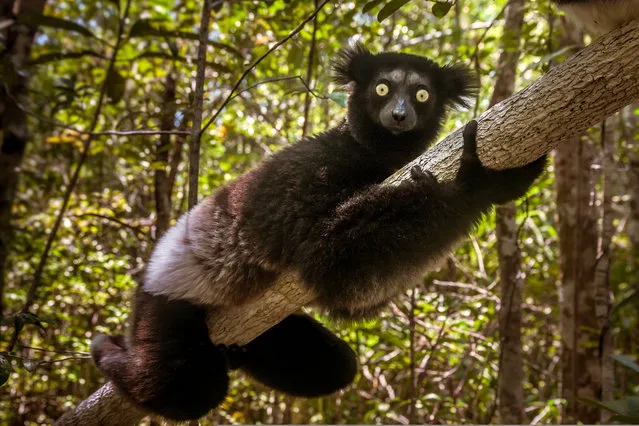
The secretive indri (Indri indri) of Madagascar, the largest living lemur. It is also critically endangered and highly evolutionarily distinct with no close relatives, which makes its branch one of most precarious on the mammal evolutionary tree. In the likely event that the indri goes extinct, we will lose 19m years of unique evolutionary history from the mammal tree of life. (Photo by Pierre-Yves Babelon/Aarhus University)

The secretive indri (Indri indri) of Madagascar, the largest living lemur. It is also critically endangered and highly evolutionarily distinct with no close relatives, which makes its branch one of most precarious on the mammal evolutionary tree. In the likely event that the indri goes extinct, we will lose 19m years of unique evolutionary history from the mammal tree of life. (Photo by Pierre-Yves Babelon/Aarhus University)
Details
18 Nov 2018 00:02:00
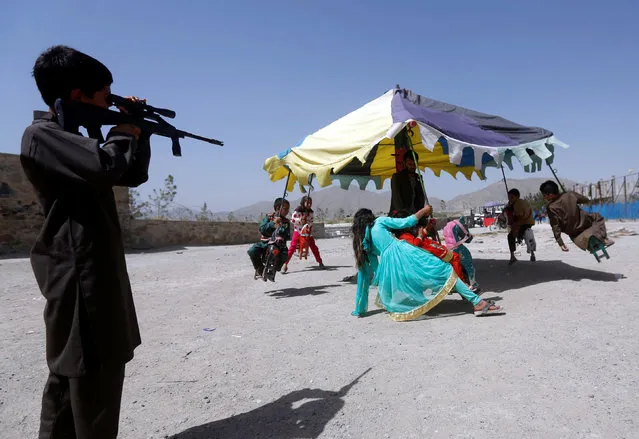
An Afghan boy looks through the scope of a toy gun, as other children ride on swings during the first day of the Muslim holiday of Eid al-Fitr, which marks the end of the holy month of Ramadan, in Kabul, Afghanistan June 25, 2017. (Photo by Omar Sobhani/Reuters)

An Afghan boy looks through the scope of a toy gun, as other children ride on swings during the first day of the Muslim holiday of Eid al-Fitr, which marks the end of the holy month of Ramadan, in Kabul, Afghanistan June 25, 2017. (Photo by Omar Sobhani/Reuters)
Details
11 Oct 2017 07:30:00