Loading...
Done
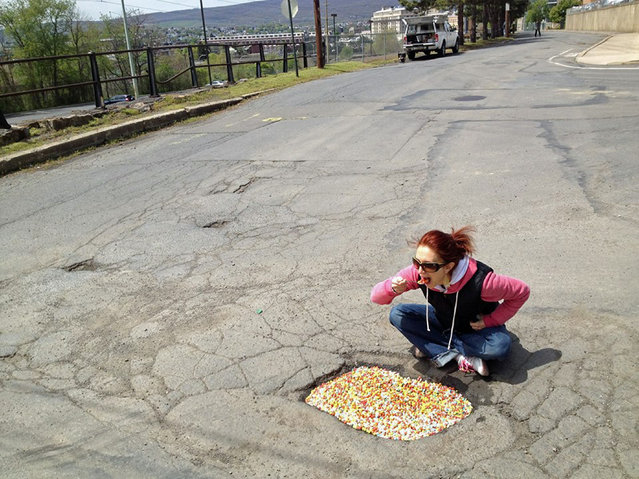
Funny pothole art: Cereal bowl pothole. (Photo by Caters News)

“Residents in a small town littered with giant potholes may be ready to “crack” the art world – after turning their massively damaged roads into hilarious masterpieces. Fun-natured drivers from Scranton, Pennsylvania have been challenged by an arts group to turn the ugly craters in their neighborhood into pothole art”. – Caters News. Photo: Cereal bowl pothole. (Photo by Caters News)
Details
08 Jul 2014 13:33:00
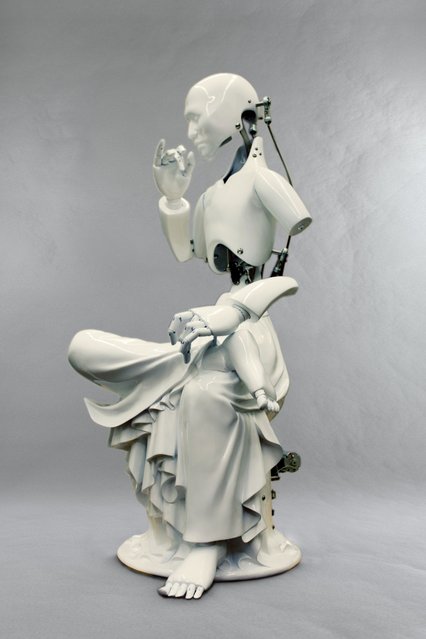
Wang Zi Won’s Mechanical Buddhas

South Korean artist Wang Zi Won creates enlightened robots, including the Buddha and an idealized mechanical doll based upon himself, as a guidepost for a future in which technology lead to self-actualization.
Humans will evolve and adapt themselves to enhanced science and technology just as men and animals in the past evolved to adapt themselves to their natural circumstances. The artist sees this as our destiny, not as a negative, gloomy dystopia.
Details
22 Mar 2013 12:02:00
Chris Hondros RetrospectivePart2

Chris Hondros, a Getty Images photographer, was fatally wounded on April 20, 2011, in a mortar attack by government forces while covering the civil war in Libya. Hondros' work is woven in our history as he covered everything from politics to marathons. A new film will focus on his life as told through his images. Here's a look at some of his finest and final work. Some of these images are graphic in nature
Details
23 Aug 2013 17:38:00
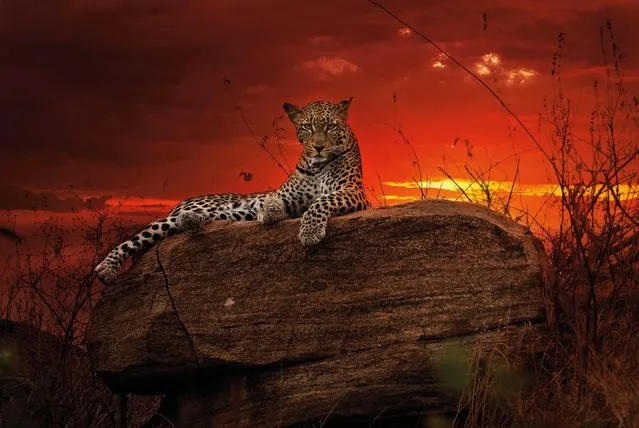
“Wild Africa”. (Photo by Alex Bernasconi)

Award-winning photographer Alex Bernasconi has captured thousands of images – from hiding hippos to wandering zebras – in his travels across Africa. His amazing work features in a new edition of his book Wild Africa. These amazing pictures create a snapshot of the life of some of the planet’s most spectacular animals and natural habitats. Photo: “Wild Africa”. (Photo by Alex Bernasconi)
Details
15 Sep 2013 10:12:00
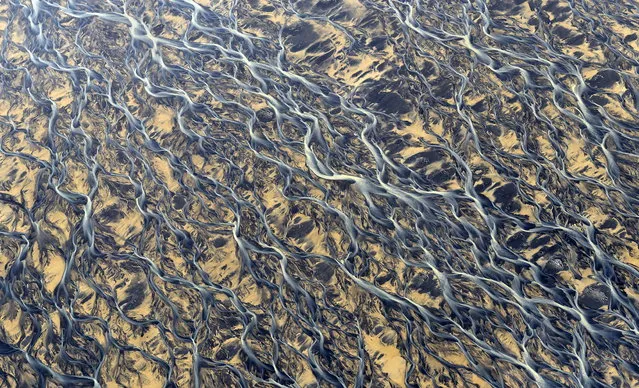
These pictures look like an artist has painted abstract patterns on canvas – but in fact they are natural rivers captured on camera. The spectacular rivers in Iceland's central highlands and southern parts originate from glaciers, which is why the water is a milky colour. (Photo by Andrey Ermolaev/Solent News)

These picture look like an artist has painted abstract patterns on canvas – but in fact they are natural rivers captured on camera. The spectacular rivers in Iceland's central highlands and southern parts originate from glaciers, which is why the water is a milky colour. They are shallow rivers and the water spreads quickly over a flat and sandy surface, creating random and beautiful patterns. Photographer Andrey Ermolaev from Moscow, Russia, flew 500ft above the unique sight in a small plane. (Photo by Andrey Ermolaev/Solent News)
Details
05 May 2014 10:57:00
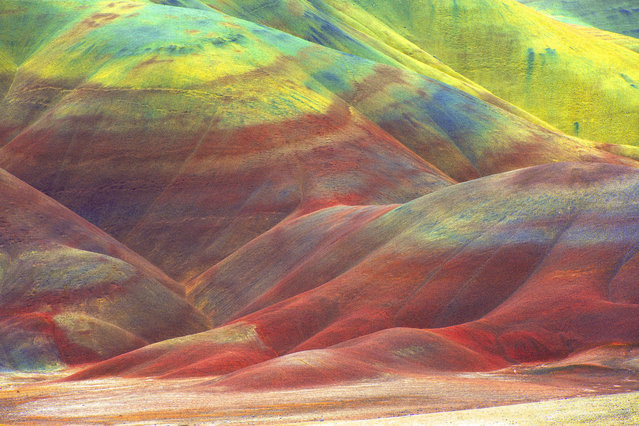
Layers of breathtaking colour streak the rolling hills of this vast desert, making the landscape appear as though it has been tie-dyed. The natural phenomenon, nicknamed the “Painted Desert”, was formed when the area was once a river floodplain. (Photo by Mark Brodkin/Solent News/SIPA Press)

Layers of breathtaking colour streak the rolling hills of this vast desert, making the landscape appear as though it has been tie-dyed. The natural phenomenon, nicknamed the “Painted Desert”, was formed when the area was once a river floodplain. Each colour corresponds to a different underground geological feature – rocks which have seemingly dyed the layers of earth above. Formed from volcanic activity, the hills at the John Day Fossil Beds National Monument in East Central Oregon, USA, are almost bursting with colour. Pictured: The colourful hills at the John Day Fossil Beds National Monument in East Central Oregon, USA. (Photo by Mark Brodkin/Solent News/SIPA Press)
Details
30 Jul 2014 11:00:00
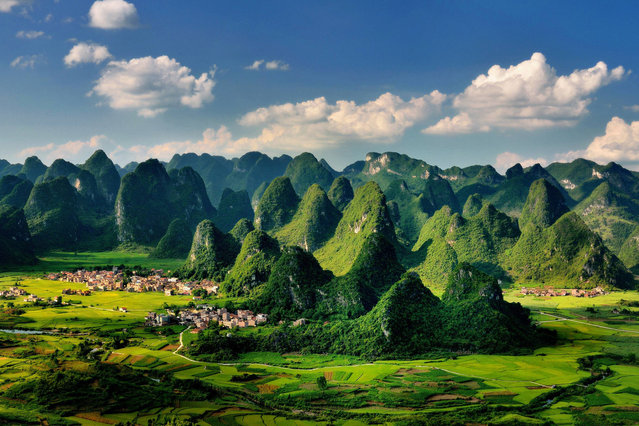
File photo taken on July 24, 2011 shows the scenery of karst landform in Dacai Township under Maonan Autonomous County of Huaijiang, south China's Guangxi Zhuang Autonomous Region. The World Heritage Committee on Monday inscribed an extension of South China Karst, a natural World Heritage Site since 2007, into the UNESCO's World Heritage List. (Photo by Wang Xiufa/Xinhua)

File photo taken on July 24, 2011 shows the scenery of karst landform in Dacai Township under Maonan Autonomous County of Huaijiang, south China's Guangxi Zhuang Autonomous Region. The World Heritage Committee on Monday inscribed an extension of South China Karst, a natural World Heritage Site since 2007, into the UNESCO's World Heritage List. (Photo by Wang Xiufa/Xinhua)
Details
07 Aug 2014 10:19:00
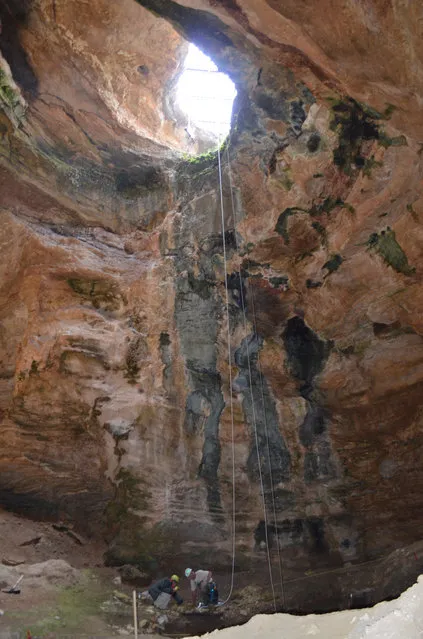
This July 2014 image provided by the Bureau of Land Management shows the interior of the Natural Trap Cave in north-central Wyoming. The cave holds the remains of tens of thousands of animals, including many now-extinct species, from the late Pleistocene period tens of thousands of years ago. Scientists have resumed digging for the first time in more than 30 years. (Photo by AP Photo/Bureau of Land Management)

This July 2014 image provided by the Bureau of Land Management shows the interior of the Natural Trap Cave in north-central Wyoming. The cave holds the remains of tens of thousands of animals, including many now-extinct species, from the late Pleistocene period tens of thousands of years ago. Scientists have resumed digging for the first time in more than 30 years. (Photo by AP Photo/Bureau of Land Management)
Details
10 Aug 2014 10:35:00